
Memory, erasure, and the living archive across Sydney's major institutional sites, 14 March – 14 June 2026
A Title with a History
The Biennale of Sydney, now in its 25th edition, takes the word 'Rememory' as both title and guiding proposition. The term comes from Toni Morrison's 1987 novel Beloved, where it describes states in which traumatic past events are recalled piecemeal by communities engaged in a sustained struggle against erasure. Morrison used it to restore authority to those whose histories had been systematically suppressed — to make the act of remembering itself a form of resistance and reconstruction. The Biennale's curatorial text draws directly on this lineage, positioning rememory not as nostalgia but as an active, collective reassembling of fragments: personal, familial, political.
For professionals working in collecting and presenting institutions, the conceptual framing will be familiar in its ambitions while distinctive in its particular intellectual anchor. The choice of Morrison as a source is neither decorative nor vague. It commits the edition to a specific understanding of history — one that is non-linear, contested, and constituted as much by what has been deliberately forgotten as by what has been preserved.
The Artistic Director
Hoor Al Qasimi, President and Director of Sharjah Art Foundation, serves as Artistic Director of this edition — the first Arab curator to lead the Biennale of Sydney, and the first woman to do so since 2018. Al Qasimi assumed responsibility for the Sharjah Biennial at 22, and has since built a practice of curating large-scale international exhibitions that draw consistently on non-Western and Indigenous art histories. In 2024, ArtReview placed her at the top of its Power 100 list. Most recently she curated the sixth Aichi Triennale in Japan, becoming the first non-Japanese person appointed to that role.
In her curatorial statement she describes the edition as feeling "especially present, even insistent," noting an irony in the fact that an exhibition turning toward the written, visual, and oral histories of culture should arrive at this particular moment. The framing is less about thematic illustration than about method: "histories that have been fragmented, erased or suppressed are revisited and reassembled, not as linear accounts but as shared and evolving acts of remembering."
For gallery and museum professionals, the significance of Al Qasimi's appointment extends beyond her institutional profile. Her sustained work with non-Western artists, her management of a foundation that has become a key production and commissioning context for artists from the Global South, and her stated interest in Sydney's multicultural communities — including its First Nations communities and its large diasporic populations — all signal a coherent curatorial vision rather than an opportunistic theme.
The Artists and the Work
The full participant list includes 83 artists, collectives, and collaborations from 37 countries. Of the commissioned works — which constitute the majority of new presentations — several reward particular attention for their formal ambition and material specificity.
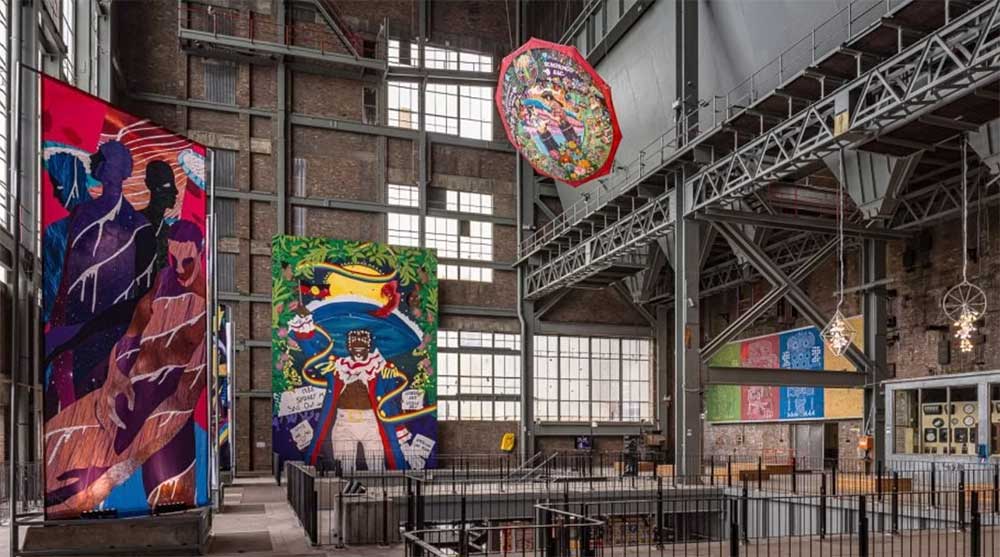
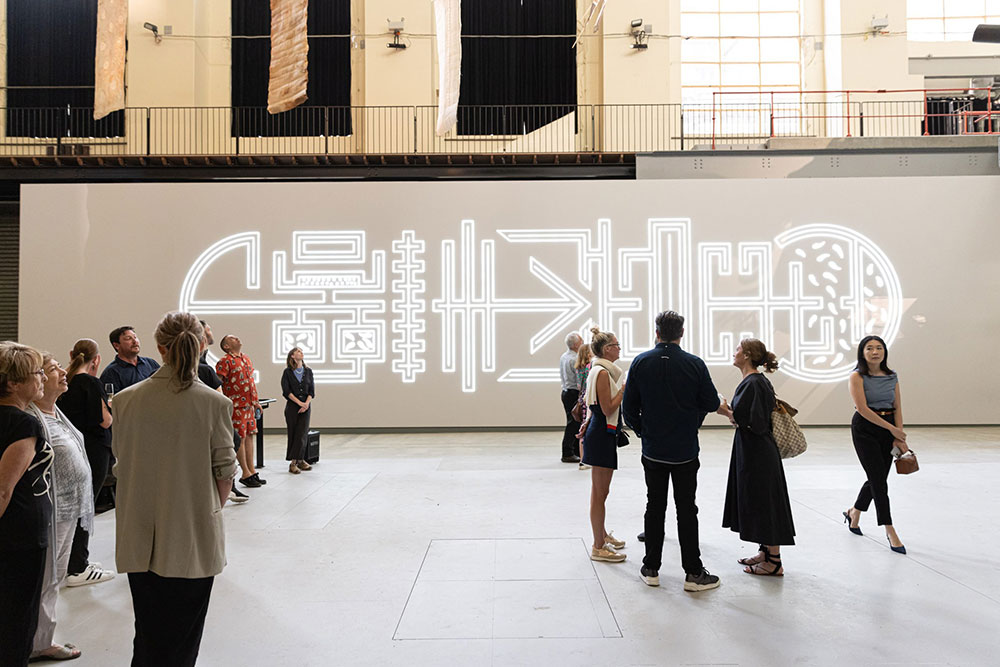
Nikesha Breeze, working from an Afro-Futurist and global African diasporic perspective, presents Living Histories at White Bay Power Station. The installation uses large-scale fabric columns crafted to resemble the African baobab tree as the structural framework through which first-hand accounts of enslaved African-Americans in the Antebellum South are made audible. The choice of the baobab — a tree whose cultural resonances across the African continent include ancestral memory and communal gathering — is integral rather than incidental to the work's meaning. Breeze has described the installation as an act of archival reclamation.
Nahom Teklehaimanot, the Eritrean artist whose practice engages with the experience of living as a refugee, will exhibit three large-scale canvases at the Art Gallery of New South Wales under the title This is My Silence You Name the Sound. His figurative approach, which employs a distinctive collage methodology, understands displacement as a condition held in tension between exile and solidarity. The scale and placement within the AGNSW makes this among the more institutionally visible presentations of the edition.
At the same venue, senior Anangu (Pitjantjatjara) artist Frank Young leads the latest iteration of the Kulata Tjuta Project — "kulata tjuta" meaning "many spears" — a long-running collaborative undertaking of cultural maintenance. This edition marks fifteen years of the project, with three generations of spear-makers contributing hand-carved works that articulate the continuity of Indigenous knowledge through a practice explicitly understood as contemporary art. The project began in the Amata community in the Anangu Pitjantjatjara Yankunytjatjara Lands and has evolved across successive presentations.
Joana Hadjithomas and Khalil Joreige, the Lebanese filmmakers whose practice has long engaged with questions of collective memory and traumatic national history, present a new commission at Campbelltown Arts Centre. The work centres on a group of friends who decide to leave their neighbourhood for Australia, their migration intersecting with the annual mass movement of red crabs on Christmas Island. The structure — human migration crossing the path of a natural, cyclical migration — allows the artists to work in their characteristic register of the speculative and the documentary simultaneously, exploring what the curatorial text calls "imaginaries of utopian elsewheres."
At White Bay Power Station, Taiwanese artist Hou I-Ting presents a new installation exploring the relationship between personal and collective memory through material and spatial means. Kiri Dalena, the Filipino artist and filmmaker whose practice has long engaged with political violence and its representation, also exhibits at the same site.
Palestinian artist Khalil Rabah, whose ongoing Palestinian Museum of Natural History and Humankind has been exhibited in Athens, Istanbul, and Amsterdam, contributes work that interrogates the concept of the archive and the museum itself as a site of constructed knowledge — a particularly resonant provocation within a biennale context. His oil pastel series Testimonies, drawn on large sheets of fine-grain paper, operates at an intimate scale that sits in deliberate tension with the institutional frameworks the work critiques.
Nil Yalter, the Turkish-French artist born in 1938 who is recognised as a pioneer of feminist and video art in Europe, brings work from a practice spanning more than six decades. Her early installations — among the first examples of video and interactive digital media in European art — addressed the experiences of migrants, workers, and women through a research-based methodology drawn from anthropology and literature. Her presence in the edition underlines the curatorial interest in situating contemporary preoccupations within longer historical arcs.
Irish artist Niamh McCann, whose materially intricate practice is grounded in an Irish perspective while engaging with questions of colonialism and diaspora, and Lebanese-French artist Nasri Sayegh, who employs embroidery as both a documentary and reparative practice — describing the stitch as a form of suture between absence and recollection — are among the international participants whose work extends the curatorial framework across diverse geographic and material registers.
The Ngurrara Artists, representing the Walmajarri, Mangala, Juwaliny, Wangkajunga, and Manjilarra peoples of the Great Sandy Desert, contribute a work centred on the Ngurrara Canvas II — a collaborative painting that functions as a map of country, story, song, and ceremony. Ngurrara artist and Coordinator Murungkurr Terry Murray has described the canvas as "our turlpu, our heart, and pirlurr, our spirit." Its presence in the edition speaks to the broader commitment to presenting First Nations cultural production on its own terms rather than as ethnographic illustration.
The First Nations Program and Institutional Partnerships
The Fondation Cartier pour l'art contemporain serves as Visionary Partner for this edition, funding commissions by fifteen First Nations artists from around the world. Working alongside the Fondation Cartier First Nations Curatorial Fellow Bruce Johnson McLean — a member of the Wierdi people of the Birri Gubba Nation with over twenty-five years of experience as a curator, writer, and advisor — the commissioned artists include Cannupa Hanska Luger, Rose B. Simpson, Gabriel Chaile, Gunybi Ganambarr, Warraba Weatherall, and others from Australia, the Americas, and beyond. The scale and specificity of this commissioning program, directed through a dedicated curatorial fellowship, is notable as a model for how large international art events can approach First Nations participation with structural rather than tokenistic intent.
Warraba Weatherall, a Kamilaroi artist whose practice challenges institutional power structures, presents wall-based sculptural works at Chau Chak Wing Museum that reframe and critique the archival documentation of Indigenous cultural material held in Australian museum collections. The decision to site this work at a university museum — an institution that is itself an archive — sharpens the critical register of the work considerably.
Aboriginal artist Dennis Golding uses the Biennale as a platform for a broader community engagement project rooted in his own experience growing up in The Block in Redfern. His practice for this edition includes site-specific installations at White Bay Power Station alongside a series of programs — jewellery-making workshops using beads 3D-printed from bricks of the Aboriginal Flag mural, community bingo nights at Redfern Town Hall, and walking tours of the area with long-term local resident Aunty Donna Ingram — that function as extended durational works connecting the formal exhibition to lived community memory.
Venues and Geographic Reach
The exhibition is distributed across five major sites: White Bay Power Station, the Art Gallery of New South Wales, Chau Chak Wing Museum at the University of Sydney, Campbelltown Arts Centre, and Penrith Regional Gallery. This geographic spread, which extends the Biennale into Western Sydney in a deliberate and sustained way, reflects a stated commitment to access and inclusivity that is structural rather than rhetorical. The inclusion of Campbelltown and Penrith as full exhibition venues — rather than satellite or community program sites — changes the relationship between the Biennale and the city's diverse western communities in ways that will be of interest to institutions working on questions of audience development and geographic equity.
White Bay Power Station, the industrial heritage site that has become the Biennale's largest and most architecturally dramatic venue, provides the setting for several of the major commissions including those by Nikesha Breeze and Dennis Golding. The site's post-industrial character continues to offer artists a context in which the relationship between historical industry, labour, and contemporary life can be explored with material directness.
Institutional Context and Curatorial Positioning
The Biennale of Sydney, established in 1973, is the longest-running biennale in the Asia-Pacific region and presents itself as the largest contemporary art event of its kind in Australia. Over its history it has presented work by more than 2,400 artists from more than 130 countries. Admission is free, a policy the organisation describes as a core commitment to access.
The choice of Al Qasimi as Artistic Director brings to Sydney a curatorial sensibility that has been shaped by working consistently outside the dominant Euro-American art world circuit. Her background at Sharjah — an institution that has been central to building infrastructure and visibility for artists from the Arab world and the Global South — gives her edition a particular credibility in its engagement with displacement, diaspora, and colonial history that goes beyond thematic alignment.
For professionals in the sector, Rememory raises questions that are worth attending to carefully: about how biennales commission and present First Nations work, about the institutional positioning of political art, about the relationship between archival practices in art and in museums, and about what it means to present memory as a medium rather than a subject. The edition does not resolve these questions, but it frames them with enough curatorial rigour that serious engagement is warranted.
The vernissage for art professionals is scheduled for 11–13 March 2026, with the public opening running from 14 March through 14 June. Further details on the full artist list, venue-specific programming, and education programs are available at www.biennaleofsydney.art.