
The Sixth Kochi-Muziris Biennale and the Biennale as Living Form
An overview for art institution and gallery professionals
The sixth edition of the Kochi-Muziris Biennale, titled For the Time Being, opened on 12 December 2025 and runs through 31 March 2026 across more than twenty venues in Kochi, Kerala. Curated by performance artist Nikhil Chopra with the Goa-based collective HH Art Spaces, this iteration arrives after a period of notable institutional turbulence, carrying the weight of postponements, governance restructuring, and the ongoing question of what a large-scale public biennale should actually be for.
History and Institutional Context
The Kochi-Muziris Biennale was founded in 2012 by artists Bose Krishnamachari and Riyas Komu under the auspices of the Kochi Biennale Foundation, a non-profit trust. Its title deliberately invokes Muziris, the ancient trading port on Kerala's Malabar Coast that flourished from the first century BCE until its destruction by floods in the fourteenth century, framing the project within a longer arc of cosmopolitan exchange that predates European colonialism. That historical framing has proven generative: each successive edition has been shaped by a different artist-curator, from Jitish Kallat's maritime explorations in 2014 to Anita Dube's feminist politics in 2018 and Shubigi Rao's focus on threatened knowledge in the pandemic-delayed 2022 edition.
The sixth edition was originally scheduled for December 2024 but was delayed by a combination of funding difficulties and concerns over the status of Aspinwall House, the heritage colonial-era building in Fort Kochi that serves as the biennale's principal venue. The intervening period prompted a governance review that resulted in the appointment of Venu Vasudevan as chair of the board of trustees and Thomas Varghese as chief executive, while Krishnamachari assumed the role of president. These changes are worth noting for institutional observers: the restructuring reflects an ongoing negotiation between the biennale's artist-led origins and the administrative demands of running a large-scale international exhibition on a budget that remains a fraction of comparable events elsewhere.
Curatorial Vision: For the Time Being
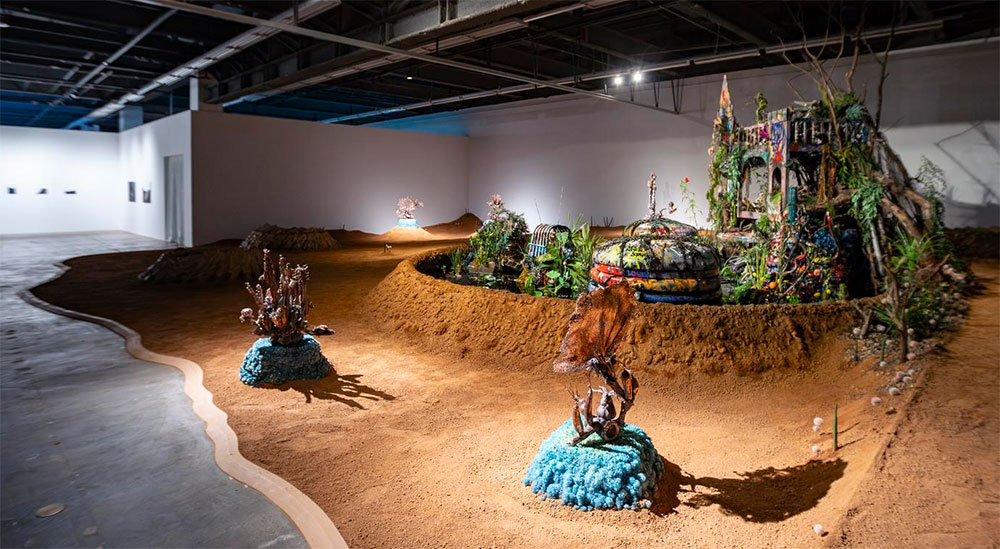
Nikhil Chopra's curatorial framework is rooted in his own practice as a durational performance artist. Having participated in the 2014 Kochi Biennale with a 52-hour live work at Aspinwall House, he returns now as curator with a methodology shaped by a decade running HH Art Spaces as an artist-collective. His stated aim is to treat the biennale not as a finished spectacle but as what he calls a 'living ecosystem'—an exhibition that grows and shifts across its 110-day duration rather than presenting a fixed array of completed works.
The phrase 'for the time being' is well-chosen in its deliberate provisional quality. Chopra has spoken of wanting to resist the conventional biennale model's pressure toward polished resolution, favouring instead an acknowledgment of flux, incompleteness, and process. The curatorial statement positions the body as its central organising metaphor: bodies as bearers of memory, as sites of encounter, as witnesses to time and political precarity. This extends outward to the landscape of Kochi itself—a coastal city built on centuries of human and non-human movement, now also the site of India's first international container transshipment hub.
The exhibition features 66 artists and collectives from more than 20 countries, spread across the venue network with only six of the twenty-plus sites requiring ticketed entry. Alongside the core programme, the biennale encompasses a Students' Biennale, residencies, collateral exhibitions, film screenings, workshops, and an extensive performance calendar. Chopra has described the whole as operating through what he terms 'friendship economies'—the informal networks of mutual support and resource-sharing that sustain artist-led initiatives, here elevated to become the structural logic of the exhibition itself. In an era when institutional funding for the arts is under pressure across many contexts, this framing carries a degree of practical as well as philosophical weight.
Selected Works and the Range of Practice
The artist list brings together figures of very different generations and orientations. Marina Abramović is present with Waterfall (2000–03), an audio-visual installation displaying 108 Tibetan Buddhist monks and nuns chanting the Heart Sutra. Tino Sehgal's Kiss (2003), his choreography for two performers whose long, slow horizontal embrace places the viewer in the uncomfortable position of witness, is also included—a work that manages to be simultaneously intimate and conceptually rigorous.
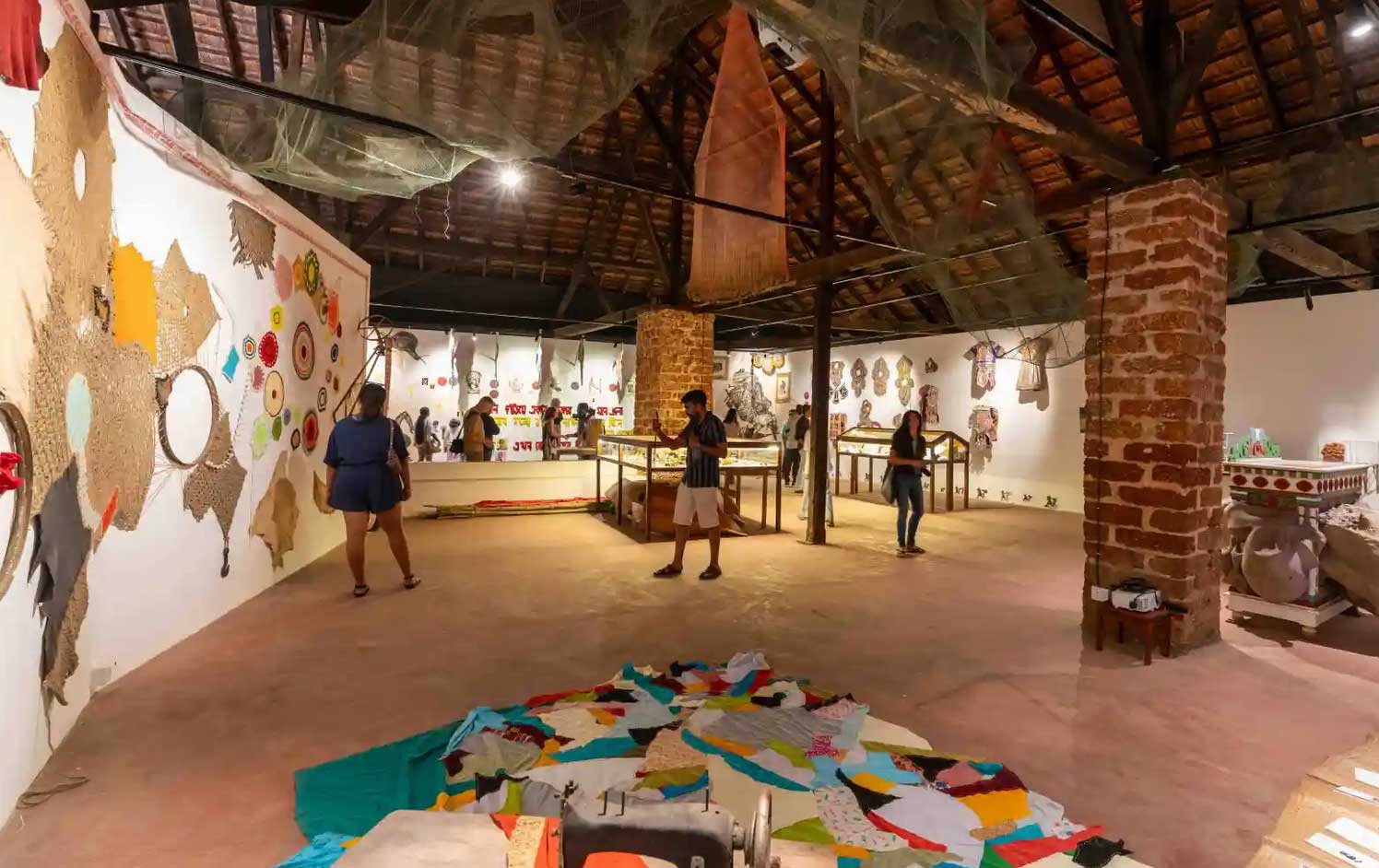
Ibrahim Mahama's Parliament of Ghosts (2017–present) occupies the Anand Warehouse, a building with its own colonial mercantile history: once used by the Dutch and later the British to store goods in transit. Mahama has constructed an enclosed chamber lined with curtains of used jute sacks—materials that previously carried pepper, grain, and timber from the colonies to Europe—surrounding salvaged chairs gathered from furniture shops across Kochi. The accumulated material history of the space and the objects speaks without requiring interpretive mediation.
Among the newly commissioned works, Air of Firozabad/Air of Palestine by Dima Srouji and Piero Tomassoni consists of hundreds of glass baubles blown in Firozabad, India's glass-blowing centre, each containing air sourced from Palestine. The work is formally restrained and conceptually precise: the fragility of the glass, the invisibility of the air, the distance between sites of production and sites of conflict. Kulpreet Singh's film Indelible Black Marks (2022–present) addresses stubble burning in Punjab's farming belt, approaching environmental and agricultural crisis from within rather than from a position of external observation—Singh comes from a farming family and the work carries the difference.
Panjeri Artists' Union, a fourteen-member anti-caste collective from West Bengal working near the India-Bangladesh border, occupies the entrance to Aspinwall House. Their installation of protest materials, chalk performances, and texts by Dalit thinkers and political poets establishes an immediate register of political seriousness. Shilpa Gupta's sonic installation Listening Air at the Ginger House Museum Hotel collects songs and resistance anthems that cross borders, while a further site-specific work by Gupta incorporates discarded furniture as instruments to play Faiz Ahmad Faiz's 1979 protest song. The presence of the historical photographs of Lionel Wendt (1900–44), the Sri Lankan photographer whose images of subaltern male bodies combine formal precision with a charged eroticism, provides an unexpected counterpoint: work made with evident care for its subjects, resistant to easy instrumentalisation by theory.
Structural Questions and Practical Observations
The opening days of the biennale were, by multiple accounts, marked by incomplete installations, ongoing construction, and the presence of angle-grinders and scissor lifts alongside finished works. This is partly by design—the embrace of 'the unfinished spectacle' is explicit in the curatorial framework—but it also reflects the chronic underfunding and logistical difficulties that have followed the biennale across several editions. For institutional visitors arriving in the opening week, the gap between the curatorial vision of productive incompleteness and the more mundane reality of production delays is worth holding in mind.
The question of venue is also live. The government of Kerala owns approximately a third of the Aspinwall House site; the remainder is held by the DLF group, a private real estate developer. The biennale has access to the government portion for this edition, with the hope—expressed but not confirmed—that the private portion may become available. The broader aspiration is for a permanent arts and culture hub at the site. For those interested in the relationship between cultural institutions and property, the situation at Aspinwall House is an instructive case study in the practical constraints that shape even well-intentioned cultural ambitions.
The no-VIP-days policy deserves mention. The biennale has maintained since its founding a commitment to open access—there are no preview events restricted to collectors or press—and around 500,000 people typically attend each edition, drawn predominantly from Kerala itself. In an international art context increasingly attentive to questions of access and audience, this structural feature represents a genuine distinction from the prevailing model.
Significance for the Field
The Kochi-Muziris Biennale is now in its thirteenth year and is the largest contemporary art biennale in South Asia. It holds a particular position in the international field because it was conceived and has been continuously run by artists, with the rule that each edition's curator must themselves be a practising artist. The implications of that structural choice are visible across the programming: there is generally more tolerance for process-based and durational work, more attention to the conditions of artistic labour, and less emphasis on the kind of spectacular resolved presentation that characterises biennials designed primarily for international art-world consumption.
Chopra's reading of the moment—sceptical of finished spectacle, attentive to embodied knowledge, oriented toward collective and collaborative modes of working—is coherent with broader tendencies visible across institutional programming internationally. What the Kochi context adds is specificity: the layered histories of the port city, the political traditions of Kerala, the material realities of working at this scale on limited resources. Whether the formal strategy of productive incompleteness translates successfully across the full 110 days remains to be seen; the biennale continues through 31 March 2026.
For institutions and galleries considering the biennale as a site of research, partnership, or professional travel, the sixth edition presents a substantial and varied programme with a genuinely distinct model of exhibition-making. Its difficulties are inseparable from its qualities, and both are worth attending to.
Kochi-Muziris Biennale: For the Time Being | 12 December 2025 – 31 March 2026 | Kochi, Kerala, India | kochimuzirisbiennale.org