

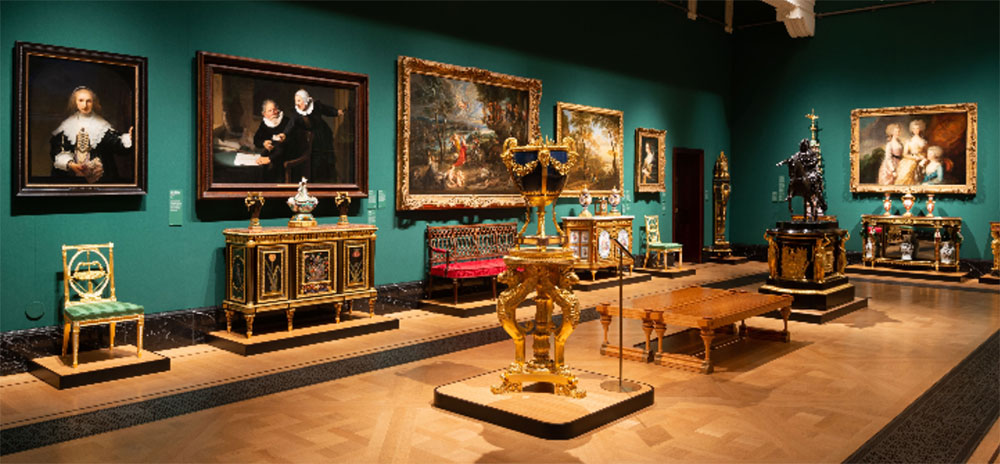
The King's Gallery at Buckingham Palace occupies a singular position among London's public art institutions. As the principal exhibition space for the Royal Collection — one of the largest and most historically significant art collections held in private stewardship anywhere in the world — it offers colleagues working in galleries, museums and arts organisations a model of how a working royal palace can operate as a serious cultural venue open to professional scrutiny and public engagement.The collection held in trust by His Majesty The King comprises some one million objects accumulated by successive monarchs over more than five centuries. The Gallery does not attempt to display this collection wholesale; instead, it presents a focused, thematically driven programme of changing exhibitions drawn selectively from within it. For professionals accustomed to the constraints of institutional collecting and display, this approach — abundance deliberately disciplined into argument — merits close attention.
History and Architecture
The site on which the Gallery stands has its own layered history of some relevance to those interested in adaptive reuse. John Nash designed the original structure as one of three Ionic pavilions for Buckingham Palace, completed in 1831. Queen Victoria subsequently had it converted into a private chapel in 1843. The chapel was destroyed in an air raid in 1940, and the ruins remained until, at the suggestion of Queen Elizabeth II and Prince Philip, the Duke of Edinburgh, the space was redeveloped as a public gallery for the Royal Collection in 1962.
That original 1962 gallery attracted five million visitors over its first 37 years before closing in 1999 for expansion and modernisation. The architect John Simpson was appointed following a competition held in 1997, and the enlarged gallery reopened in May 2002 to coincide with the Golden Jubilee. The new classical entrance on Buckingham Palace Road — deliberately composed to sit harmoniously alongside the Palace while reading as a distinct public threshold — has been of interest to those working in the field of heritage architecture and historic adaptation.
Following the accession of His Majesty King Charles III, the space known as The Queen's Gallery was formally renamed The King's Gallery in 2024. This small but symbolic change reflects a broader institutional responsiveness to the living nature of the monarchy that gives the collection its meaning and continuity.
Exhibition Programme
The Gallery's programme is driven by thematic depth rather than encyclopaedic breadth. A single major exhibition occupies the space at any given time, typically running for six to eight months before closure for installation of the next presentation. The gallery spaces include three large exhibition rooms and a number of smaller ancillary areas, together providing a flexible environment capable of accommodating large-scale paintings, works on paper, decorative arts, furniture, jewellery and photography.
The current major exhibition, Royal Portraits: From Holbein to Hockney, runs until April 2026 and brings together over one hundred portraits spanning five centuries, including works by Hans Holbein, Anthony van Dyck, Lucian Freud and Annie Leibovitz alongside contemporary commissions of His Majesty King Charles III and rarely seen preparatory drawings. The exhibition is a substantive case study in how portraiture functions as a record of power, identity and institutional continuity — a subject of considerable relevance to colleagues working in history of art and collection development.
Visiting Information
Buckingham Palace Road in central London, with its own dedicated public entrance separate from the Palace's main frontage. The nearest underground stations are Victoria (approximately five to six minutes on foot, served by the Circle, District and Victoria lines), with Green Park and Hyde Park Corner both reachable within twelve minutes. Victoria Coach Station is a ten-minute walk. Visiting professionals arriving by car should note that on-site parking is not available through the standard admissions route; accessible parking can be arranged in advance through the Specialist Sales team.
The Gallery operates on a timed-entry, pre-booked ticketing basis, and advance booking is strongly recommended. During the installation period between exhibitions, the Gallery closes entirely — currently it is closed until 10 April 2026
Standard opening hours when the Gallery is in operation are 10:00 to 17:30 with last entry at 16:15. The Gallery is closed on 25 and 26 December and during State Visits. From Thursday to Monday throughout most of the year, with seven-day opening during the summer months of July and August.
The Royal Collection Trust also maintains a substantial picture library and a network of publications and loans through which collection material reaches partner institutions internationally. For galleries and museums interested in borrowing works or exploring curatorial collaboration, the Trust's Specialist Sales team provides an appropriate initial point of contact.