
The Metropolitan Museum of Art and the Ronald S. Lauder Neue Galerie New York announced an agreement to merge the two institutions by 2028, subject to the necessary regulatory approvals. The announcement, timed to coincide with the Neue Galerie's approaching twenty-fifth anniversary, marks one of the most consequential structural decisions in American museum life in recent decades — not because of its scale alone, but because of what it signals about how institutions are choosing to think about long-term collection stewardship, audience development, and the enduring fragility of the specialist museum model.
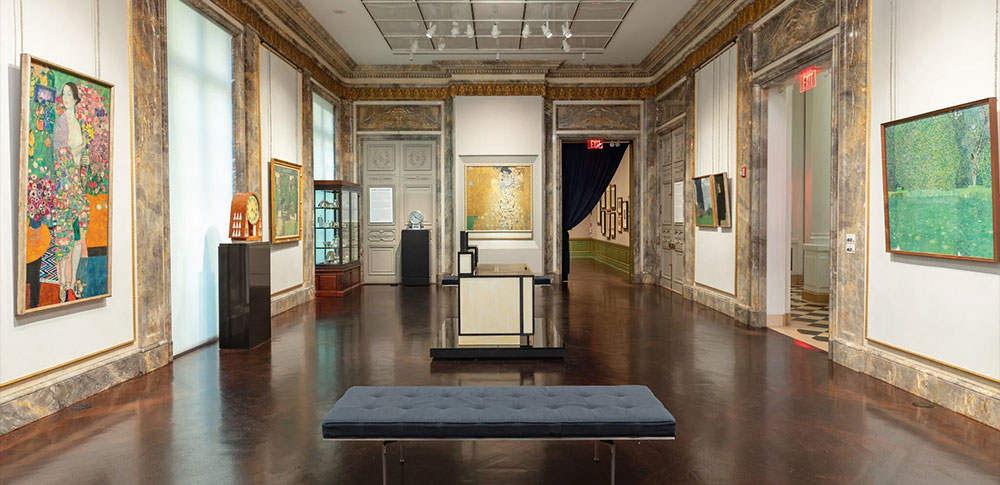
The Neue Galerie, opened in 2001 by cosmetics heir and philanthropist Ronald S. Lauder and his late co-founder Serge Sabarsky, has occupied distinct position on Museum Mile. Housed in the William Starr Miller House, a six-storey Beaux-Arts mansion at the corner of Fifth Avenue and 86th Street, designed by Carrère & Hastings and completed in 1914. The museum is a focused, immersive environment dedicated to early twentieth-century Austrian and German art and design.
Its permanent collection includes works by Gustav Klimt, Egon Schiele, Oskar Kokoschka, Gabriele Münter, Ernst Ludwig Kirchner, Max Beckmann, and Josef Hoffmann, among others. The most celebrated single object in the collection is Klimt's Portrait of Adele Bloch-Bauer I (1907), acquired by Lauder in 2006 for $135 million following its restitution from Austria. Lauder has described the work as "... our Mona Lisa," he told the New York Times, and the merged institution's plans confirm that the work will remain on view at its current address.
Upon completion, the Neue Galerie building and its collection will be formally renamed The Met Ronald S. Lauder Neue Galerie, joining The Met Fifth Avenue and The Met Cloisters as the third distinct site within the Metropolitan Museum of Art's institutional umbrella. The model of The Met Cloisters — a satellite with a focused collection identity, its own visitor experience, and a clear sense of remove from the main building appears to have been instructive.
The financial architecture of the agreement is substantial. The Met is seeking to raise $200 million in endowment funding to support the ongoing care and operation of the Neue Galerie. Lauder and his daughter, Aerin Lauder Zinterhofer, have committed significant funds toward that goal, and more than two dozen Met trustees have already pledged support, led by trustee Marina Kellen French. The Neue Galerie's existing endowment and broader assets will transfer to the Met as part of the transaction.
Alongside the financial commitments, Lauder and Lauder Zinterhofer will donate thirteen works from their personal holdings to the merged institution. The gift is carefully curated to deepen the collection's existing strengths. Among the promised works are Klimt's large-scale Die Tänzerin (The Dancer) (1916–18), Kirchner's Die Russische Tänzerin Mela (The Russian Dancer Mela) (1911), Beckmann's Galleria Umberto (1925), and future promised works by Otto Dix, George Grosz, and Franz Marc. The donation reflects the Lauder family's desire, in their own words, to further enhance the collection's depth and enrich the stories it can share about a pivotal period in the history of the visual arts.
For the Metropolitan, the strategic rationale is straightforward, if the logistics are not. The Met's director and chief executive, Max Hollein — himself Vienna-born, and a former director of institutions in Frankfurt before leading the San Francisco Museums before joining the Met in 2018 — has been candid about a gap in the encyclopaedic collection. "If you look at Vienna 1900, Berlin 1920s — this was really the epicentre of the development of the avant-garde," Hollein told the New York Times, "and it's important to have a broad and deep collection there." The Neue Galerie's holdings address that absence with a precision that organic acquisition could never replicate within any reasonable timeframe or budget.
The professional relationship between Hollein and Lauder predates this announcement by two decades. Hollein joined the Neue Galerie's board in 2006. In 2020, Lauder made the largest single gift in the history of the Met's arms and armour department, donating 91 objects. The merger, in that context, is less a sudden development than the formalisation of a long-standing alignment of purpose between two individuals with shared intellectual and curatorial commitments.
The Neue Galerie will continue to operate with its existing staff and curatorial identity intact. The Café Sabarsky, long regarded as one of the more civilised museum cafés in New York, serving Viennese-style food and coffee in a room that reads as an extension of the collection's period, will remain open. The shops will continue. The programming and research capacities are expected to be augmented by access to the Met's resources, and the merger's architects have been explicit that the goal is not absorption in any homogenising sense, but a form of structural protection that also opens the collection to wider international audiences through digital initiatives and collaborative programming.
A joint advisory board is being established to steer the integration process, with Lauder serving as inaugural chair. The Met and the Neue Galerie's respective curatorial and operational expertise will inform how that process unfolds over the two years between announcement and completion.
Practically, the immediate calendar is shaped by the Neue Galerie's already-planned renovation programme. The building will close on 27 May 2026 for construction work intended to ensure the long-term integrity of the 1914 structure, and will reopen in autumn 2026 in time to mark its twenty-fifth anniversary with a dedicated exhibition, the details of which are to be announced. The renovation was scheduled independently of the merger announcement; the coincidence of timing is nonetheless fortuitous.
The merger also sits within the Met's broader institutional trajectory. The museum is currently midway through a $1.5 billion capital campaign, which includes completed reimagining of the Michael C. Rockefeller Wing for the arts of Africa, Oceania and the Ancient Americas, and plans for a new wing of modern and contemporary art galleries designed by architect Frida Escobedo, expected to open in 2030. The addition of the Neue Galerie's holdings of Viennese Secession and German Expressionist work would speak directly to those new galleries' chronological and intellectual territory.
In a personal reflection published alongside the announcement, Lauder described the twenty-five years of the Neue Galerie's independent life with a particular kind of institutional pride — the pride of a founder who built something coherent and beloved, and who is now making a deliberate decision about what happens next. "Through the efforts of our devoted staff, we have fulfilled our mission of creating a beloved museum of early twentieth-century Austrian and German art and design," he wrote, "one that I'm pleased will now have a permanent home as a part of The Met."