

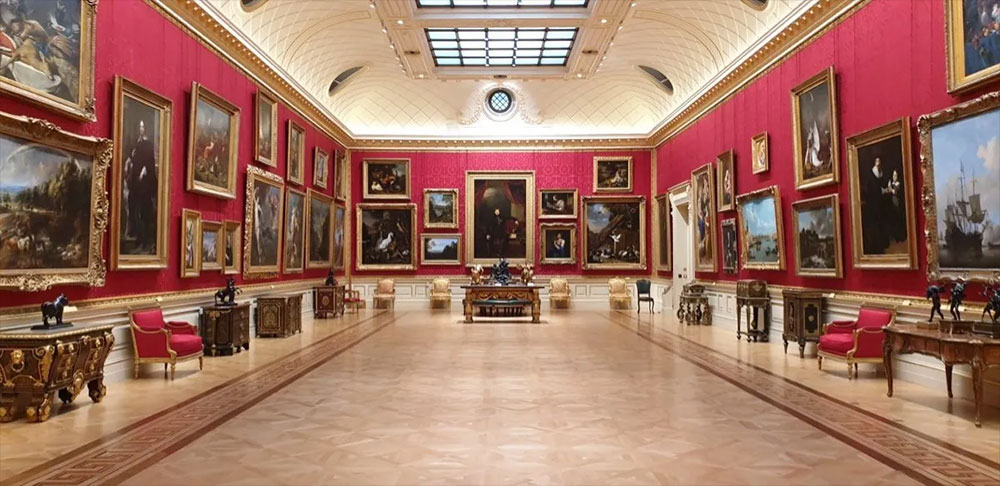
For professionals working across art institutions and commercial galleries, the Wallace Collection occupies a singular position within the London cultural landscape — and, increasingly, within the international museum community. Housed at Hertford House in Manchester Square, the former townhouse of the Seymour family, Marquesses of Hertford, it presents fine and decorative arts from the 15th to the 19th centuries across 25 galleries, with particularly significant holdings in French 18th-century paintings, furniture, arms and armour, and porcelain. Admission remains free to all.
Origins and Formation
The Wallace Collection is displayed at Hertford House, formerly the principal London residence of the Marquesses of Hertford and Sir Richard Wallace, and has been open to the public as a museum since 1900. Its formation, however, spans several generations and two countries. The major part of the collection was acquired between 1840 and 1888 by the 4th Marquess of Hertford and his illegitimate son, Sir Richard Wallace. Both men spent most of their adult lives in Paris, and in many ways their taste in art can be seen as more French than British.
The 4th Marquess, one of the greatest collectors of the 19th century, determined the essential character of the Wallace Collection we see today. His acquisitions included the great majority of the paintings, porcelain and furniture now in the Wallace Collection, as well as the non-European arms and armour. He held a deep respect for artistic quality, excellent condition, and established provenance.
In 1870, Wallace inherited the collection and shortly afterwards moved to London, where he refurbished Hertford House and installed more of the artworks. In 1872 he brought over to London many of the works of art inherited from Lord Hertford, to which he added important collections of medieval and Renaissance objects and European arms and armour. Wallace's philanthropy was considerable: before leaving Paris, he presented the city with fifty cast-iron drinking fountains, still known today as Les Wallaces. Lady Wallace, on her death in 1897, left the works of art on the ground and first floors of Hertford House to the British nation. The Wallace Collection comprises approximately 5,500 works of art.
The Collection in Detail
The Collection displays an array of European oil paintings from the 14th to the mid-19th century. It is particularly strong in Dutch and Flemish paintings of the 17th century and in 18th- and 19th-century French paintings, though there are also outstanding works by English, Italian and Spanish artists. Among the painters represented are Titian, Rubens, Rembrandt, Hals, Velázquez, Poussin, Canaletto, Gainsborough and Lawrence.
The French decorative arts holdings are of a depth and provenance that few institutions outside France can match. Comprising works by the most celebrated cabinetmakers of the period — including André-Charles Boulle, Jean-François Oeben, Martin Carlin and Jean-Henri Riesener — much of the furniture carries French royal provenance: five pieces from Marie-Antoinette's private apartments, a chest-of-drawers from Louis XV's bedroom at Versailles, chairs from the palace of Fontainebleau, and wall-lights from the Château of Saint-Cloud.
Sir Richard Wallace made a distinctive mark on the collections he had inherited, in particular through his love of the art of the Middle Ages and Renaissance. Two significant acquisitions transformed his collection: much of the great collection of arms and armour assembled by the British antiquarian Sir Samuel Rush Meyrick, and the equally substantial collection of the Comte de Nieuwerkerke, former Director of Fine Arts under Napoleon III. The resulting armoury is among the most scholarly and materially rich in Britain.
The paintings are presented not in the manner of a conventional public gallery — white walls, neutral light, measured distance — but as they would have been encountered in an aristocratic 19th-century home. The museum lacks the standard white or grey walls typical of a gallery; instead, coloured wallpaper, gilded frames and porcelain compete for attention. This environment presents both a curatorial challenge and a distinguishing institutional identity.
Governance and Legal Framework
The Wallace Collection is a Non-Departmental Public Body sponsored by the Department for Digital, Culture, Media and Sport, from which the museum receives Grant-in-Aid funding provided by Parliament. Its Board of Trustees operates under the Museums and Galleries Act 1992, which specifies the Board's general function to maintain, exhibit, grant access to, and promote public understanding of the Collection.
A defining legal characteristic of the Collection has long been the condition attached to Lady Wallace's bequest — widely interpreted as prohibiting any object from leaving the Collection, even for loan exhibitions. In 2019, after consulting with the Department for Digital, Culture, Media and Sport, the Charity Commission granted an Order under the Charities Act 2011 authorising the lending of objects for exhibition. This represented a significant institutional development, bringing the Wallace Collection in line with other national museums for the first time in its history.
Institutional Engagement and Loans
The shift in lending policy has opened meaningful possibilities for inter-institutional collaboration. The first loan agreed with the Board of Trustees was Titian's Perseus and Andromeda, which the National Gallery in London borrowed as part of their Titian: Love, Desire, Death exhibition. Subsequently, the Wallace Collection lent Nicolas Poussin's Dance to the Music of Time to the National Gallery's Poussin and the Dance exhibition — co-organised with the J. Paul Getty Museum in Los Angeles — marking the first time in the museum's 121-year history that the painting had left the building.
Following the loosening of loan restrictions, the Wallace Collection entered discussions on joint exhibitions with museums in London, Los Angeles and Vienna. The ability to lend has made other institutions more willing to reciprocate, either by lending to the Wallace Collection or by embarking on joint shows.
Loan requests are considered carefully in order to minimise disturbance to the unique environment of Hertford House, and special attention is paid to avoid lending objects deemed of particular importance to the Collection's audiences. Institutions wishing to explore loan agreements are advised to approach the Collection directly and to allow for a considered lead time in negotiations.
Research and Conservation
The institution has developed a reputation for methodical, long-term scholarly work. A Venetian Views Project, launched in 2017, has been conserving, analysing and researching works by Canaletto, Francesco Guardi and their followers, with technical analysis carried out by the Hamilton Kerr Institute at the University of Cambridge. A major collaborative research project with Waddesdon Manor and the Royal Collection Trust on the cabinetmaker Jean-Henri Riesener concluded with the publication of the first major monograph on the artist. These projects demonstrate the institutional appetite for sustained cross-institutional scholarship.
Temporary Exhibitions
The Wallace Collection opened enlarged temporary exhibition galleries in June 2018, tripling its previous exhibition space. The new space enables the Collection to explore aspects of its existing holdings in greater depth and to facilitate collaborations with other institutions, both within the UK and internationally. Recent temporary exhibitions have ranged across subjects including Frans Hals, Peter Paul Rubens, Fragonard, and the intersection of fashion and Old Master painting. Forthcoming programming for 2026 includes exhibitions focused on Grayson Perry and on Winston Churchill as a painter, suggesting an institutional willingness to explore the permanent collection through varied critical lenses.
A Resource for the Profession
For curators, dealers and scholars, the Wallace Collection offers direct access to works rarely encountered in comparable concentration elsewhere. Its curatorial staff maintain active research agendas and have demonstrated readiness to engage with external colleagues on exhibition projects and publication. Press and research enquiries can be directed to the institution through its website. For institutions considering loan requests, the Collections team welcomes initial contact, with the understanding that each case is evaluated individually against the terms established by the Charity Commission order.
The Wallace Collection is not a static archive of aristocratic taste. It is a functioning national museum, increasingly engaged with the broader professional community, and — given the depth and specificity of what it holds — one whose growing accessibility to the international sector represents a genuine development for the field.
The Wallace Collection, Hertford House, Manchester Square, London W1U 3BN. Open daily. Admission free. www.wallacecollection.org