

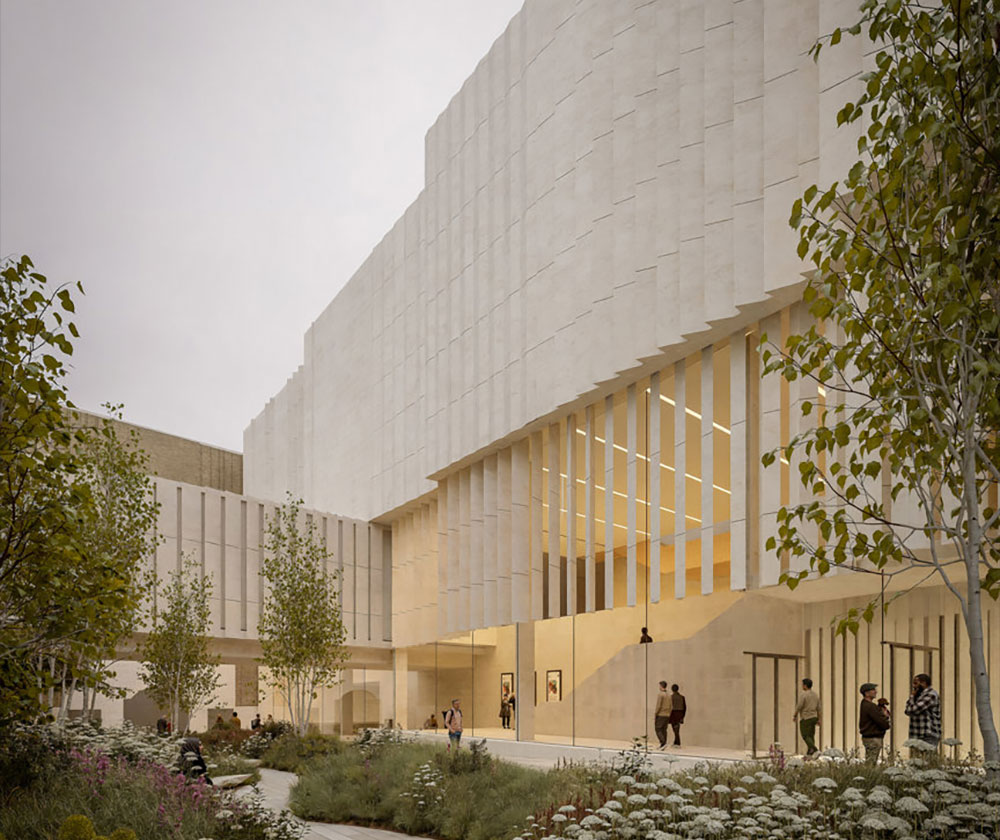
A £750 million campaign — the largest transformation of the National Gallery London since its founding in 1824 — sets out to reshape both the institution's physical footprint and the reach of its collection. For those working in galleries and art institutions, the implications extend well beyond Trafalgar Square.
The Origins and Ambition of Project Domani
The National Gallery concluded its bicentenary celebrations in 2024 and, in their wake, announced the most consequential development in the institution's history. Project Domani — the name drawn from the Italian word for 'tomorrow' — is a £750 million capital campaign encompassing a new wing, an acquisitions fund for twentieth and twenty-first century paintings, and a long-term endowment designed to secure the Gallery's financial sustainability. It is not a renovation of what exists but a structural reconception of what the Gallery can become.
At its core, the project addresses two distinct but interconnected ambitions: the expansion of the Gallery's physical capacity, and a fundamental shift in the chronological scope of its collection. Until recently, the National Gallery's atelier of acquisition operated under an informal boundary at around 1900, a limit that has long been regarded within the sector as pragmatically convenient rather than intellectually coherent. As Director Sir Gabriele Finaldi has observed, it is 'slightly frustrating to reach 1900 and then not go on.' Project Domani formalises the end of that constraint.
The consequence is significant. When the new wing opens — projected for the early 2030s — the National Gallery will become the only museum in the world dedicated exclusively to paintings in which a visitor can trace the full history of Western painting in a single institution, from the medieval period to the present day. That is not a marketing proposition; it is a genuinely new position in the global museum landscape, and one that will require curatorial, acquisitions, and programming strategies of corresponding depth and imagination.
The Site and the Urban Context
The new wing will occupy the site of St Vincent House, a 1960s building to the west of the main Wilkins building, separated from it by St Martin's Street. The property has been in the National Gallery's portfolio since 1998, acquired specifically for the purpose of eventual expansion — a long-held institutional intention that Project Domani now brings to realisation. The building carries no listed status and will be demolished to make way for the new structure.
The site occupies a significant position in central London, sitting between Trafalgar Square to the east and Leicester Square to the west. A stated ambition of Project Domani is to invigorate this corridor, establishing the Gallery as an active presence in what the institution describes as London's arts quarter, rather than a building that turns its back on the neighbourhood to the west. New public realm, landscaped spaces and accessible routes through the site are integral to the architectural brief, making the urban dimension of the project as important as the gallery floors themselves.
The Architectural Competition
In September 2025 the National Gallery launched an international architectural competition for the new wing. Sixty-five submissions were received, a number that reflects both the scale of the commission and the profile of the institution. From that field, six architects were shortlisted to develop full design proposals: Farshid Moussavi Architecture with Piercy & Company; Foster + Partners; Kengo Kuma and Associates; Renzo Piano Building Workshop with Williams Matthews Associates and Adamson Associates; Selldorf Architects with Purcell; and Studio Seilern Architects with Donald Insall Associates, Vista Building Safety Ltd, and Ralph Appelbaum Associates.
On 7 April 2026, the jury announced the winning submission. Kengo Kuma and Associates — working alongside UK-based design firms BDP and MICA — was awarded the commission, receiving the highest available jury score, a verdict described by the panel as unanimous and the design as 'exemplary.' John Booth, Chair of Trustees and Jury Chair, stated that the submission was 'a beautiful design inside and out, sensitive to our existing Grade I exteriors and distinctive gallery spaces,' adding that the new building would help to unite Leicester and Trafalgar Squares by creating 'enticing new public realm between them.'
The Design
Kengo Kuma and Associates is a Tokyo-based atelier founded by Kengo Kuma in 1990. The firm's portfolio spans architecture, interior, and landscape design, with particular depth in cultural and civic commissions. Relevant precedents include the V&A Dundee, the Besançon Art Center in France, the Southern Apex of the Calouste Gulbenkian Foundation in Lisbon, and Japan's national stadium for the 2020 Olympic Games. BDP brings extensive experience across public, education, and cultural buildings in the UK and internationally; MICA's portfolio includes the Ashmolean Museum in Oxford, the Dulwich Picture Gallery, and the Horniman Museum in London.
The proposed design uses Portland stone as its primary material — a deliberate alignment with much of the surrounding architecture — arranged in a stepped massing that responds to the scale of the adjacent streets. The jury noted the design's sensitivity to the Sainsbury Wing galleries by Venturi Scott Brown, recently renovated by Selldorf Architects, and to the Wilkins building. The facade is striated with vertical ridging and fins, casting directional shadow lines across the stone surface. As the building rises it becomes progressively more opaque, providing the controlled environment that paintings demand while drawing natural light into the lower floors through more transparent ground-level treatment.
Internally, the floors are differentiated in atmosphere and purpose. The ground floor will feature vaults and arches that echo the existing gallery's architectural vocabulary, and will contain a temporary exhibition space of approximately 800 square metres — nearly double the capacity of the Sainsbury Wing basement gallery. The main and upper floors will be given over to the permanent collection, with bridge links to both the Sainsbury Wing and the Wilkins building. The architectural character of the upper floor moves to a more geometric idiom. At the building's summit, a public roof garden with views toward Leicester Square will be accessible to all visitors. The addition of significant greenery — confirmed by the jury in their assessment of the design — brings a landscape dimension to an otherwise densely built site. Overall, the new wing is expected to increase the Gallery's total hanging space by more than fifteen percent.
Kuma himself described the commission as 'a privilege,' noting that the National Gallery's collection is 'a treasure of humanity' and that the responsibility of expanding the spaces to hold it 'we carry with the greatest care and humility.' Sir Gabriele Finaldi, in announcing the result, described Kuma's trajectory as demonstrating 'exceptional design elegance, a keen sensitivity to location and to history, and a supremely beautiful handling of light and of materials.'
Funding and Philanthropy
Of the £750 million total campaign, approximately £375 million has already been secured. The fundraising includes what the National Gallery reports are the two largest publicly confirmed cash donations to a museum or gallery anywhere in the world. Crankstart, the charitable foundation of Sir Michael Moritz KBE and his wife Harriet Heyman, has pledged £150 million, matched by an equal commitment of £150 million from the Julia Rausing Trust. A further £75 million has been contributed by the National Gallery Trust, Chair of Trustees John Booth, and a number of additional donors.
The remaining £375 million to be raised is earmarked not for construction alone but for the acquisitions fund — enabling the Gallery to build its post-1900 collection — and for an endowment intended to cover the long-term operating costs of the new wing. That endowment dimension is structurally important. One of the persistent vulnerabilities of major museum expansions is the gap between capital funding for construction and recurrent funding for operation; the explicit inclusion of an endowment within Project Domani's financial architecture reflects a considered approach to institutional sustainability.
John Booth has framed the broader strategic stakes plainly: 'Project Domani will bolster the significance of both the National Gallery and the UK within a highly competitive international cultural landscape.'
Implications for the Wider Sector
The decision by the National Gallery to extend its collection beyond 1900 is not without complexity in the context of London's museum ecology. For decades, an informal arrangement between the National Gallery and Tate meant the former would not engage with post-1900 paintings, leaving that terrain to Tate's institutions. That understanding has now been set aside. Tate's Director Maria Balshaw offered a public welcome to the announcement, expressing a commitment to working closely with the National Gallery to further the national collection as a whole. Whether the two institutions' collecting ambitions will prove genuinely complementary or occasionally competitive in the acquisitions market remains a question of real interest to the sector.
Project Domani raises questions that travel beyond the specific project. How does an institution of the National Gallery's scale and collection depth integrate a new chronological range without diluting the coherence of its existing offer? What curatorial frameworks and scholarly expertise will be required to hang twentieth and twenty-first century painting in productive dialogue with the collection that precedes it? And how does the visitor experience of a continuous history of Western painting — from Duccio to the present — differ from encountering either period in isolation?
There are also architectural lessons worth attending to. The competition process itself — sixty-five entrants, a rigorous shortlist, a unanimous jury result, and a winning submission described as exemplary rather than merely adequate — provides a model for institutions considering how to structure competitive briefs for significant commissions. The explicit sustainability and social value framework embedded in the Kuma submission, and weighted by the jury, signals a direction of travel for institutional building programmes that will not be reversed.
Looking Forward
The new wing is projected to open in the early 2030s, though a specific date has not been confirmed. Detailed design development will now proceed with Kengo Kuma and Associates, BDP, and MICA, moving from competition submission to a buildable scheme and through the planning process. The demolition of St Vincent House, the construction timeline, and the management of the Gallery's operations through that period will each present challenges familiar to any institution that has undertaken major building work while remaining open to the public.
What is less familiar is the ambition that underlies the project. The combination of architectural expansion, collection redefinition, and financial restructuring through endowment is rare in any institution. That the National Gallery is attempting all three simultaneously, and has already secured half the required funding before ground has been broken, suggests a campaign that has been in preparation for some time and is now proceeding with unusual clarity of purpose.
Further information on Project Domani is available at nationalgallery.org.uk/about-us/project-domani