

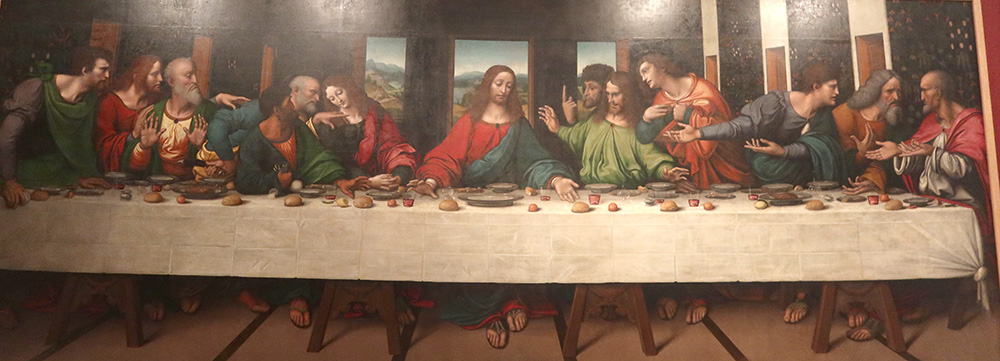
There is a particular kind of value that attaches to a copy made before the original was ruined. In the case of Leonardo da Vinci's The Last Supper, painted between approximately 1495 and 1498 on the refectory wall of Santa Maria delle Grazie in Milan, that ruination began almost immediately. Leonardo's decision to work in tempera and oil on a dry wall rather than in the established tradition of buon fresco was technically ambitious and practically disastrous. Within decades, the paint was flaking. By the time a near-contemporary copy arrived in England in 1817, the original had already faded to a fraction of its former legibility. The copy in question, acquired by the Royal Academy of Arts in London for 600 guineas in 1821, remains one of the most significant documentary records in the history of Western art.
Authorship and Date
The work is attributed, on the basis of stylistic analysis and historical association, to Giampietrino (active approximately 1508–1549) and possibly Giovanni Antonio Boltraffio (c.1467–1516), both of whom were pupils in Leonardo's Milanese workshop. Giampietrino is thought to have joined the workshop in the mid-1490s and may therefore have been present when Leonardo was at work on the original composition. The hypothesis that two hands were involved has led some scholars to suggest that Boltraffio worked on the left-hand side of the canvas before his death in 1516, with Giampietrino completing the remainder. The painting is dated to approximately 1515–1520, placing it among the earliest surviving copies and, critically, before the most severe phases of deterioration in the Milan fresco had occurred.
When the Royal Academy acquired the work, it was attributed to Marco d'Oggiono (c.1467–c.1524), another of Leonardo's documented followers. The current attribution to Giampietrino and Boltraffio reflects more recent scholarly analysis, and debate among art historians continues. The uncertainty of attribution does not diminish the work's documentary and aesthetic standing; it may in fact enrich it, raising questions about collective practice within Leonardo's workshop that remain productive for researchers.
Scale, Medium, and What It Preserves
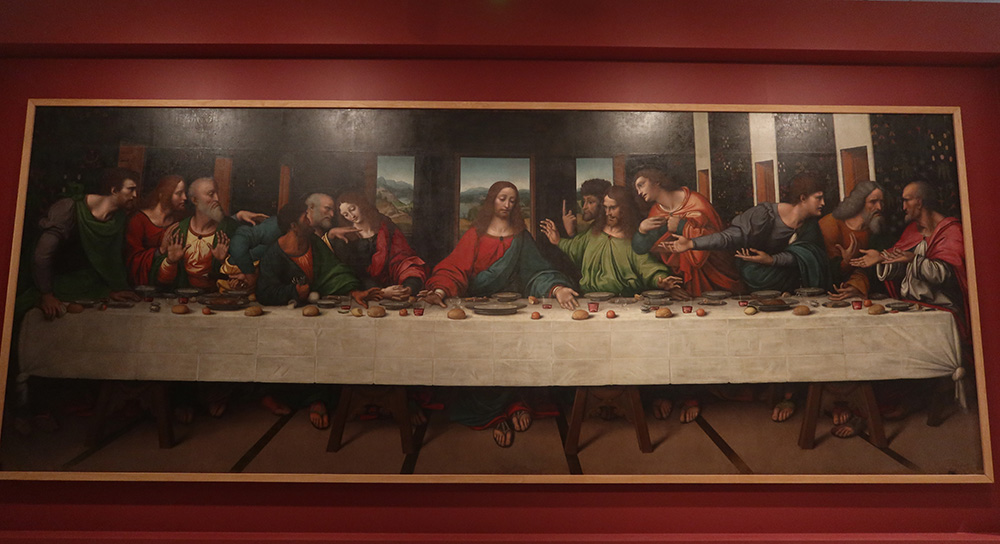
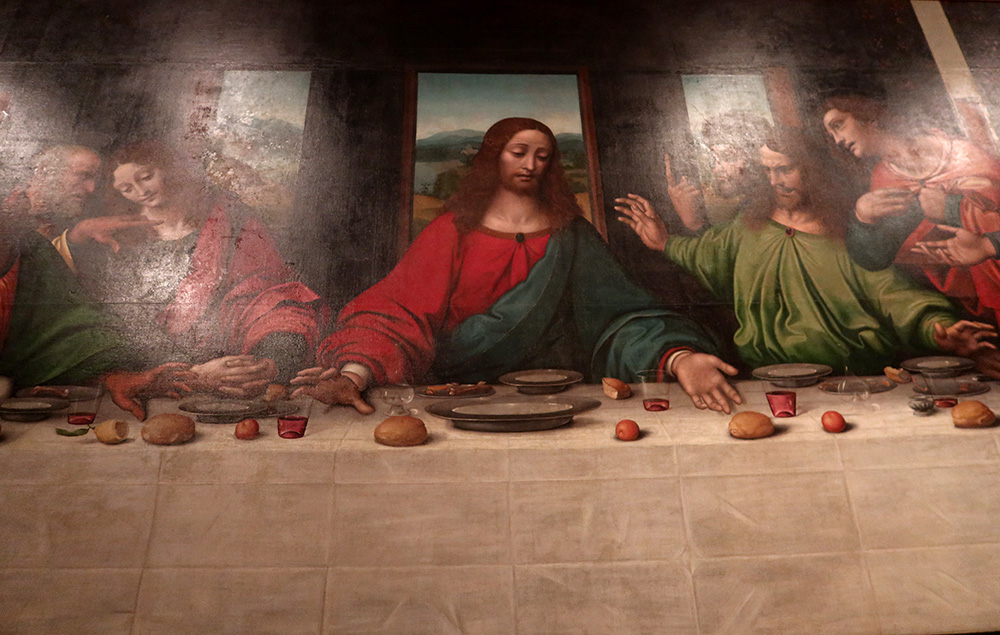
The canvas measures approximately 302 by 785 centimetres, making it close to the dimensions of Leonardo's original, though it lacks the upper third of the composition. That loss aside, the copy preserves details that have entirely vanished from the Milan fresco. Among these are the overturned salt-cellar beside Judas's right arm — a deliberate iconographic element, since spilled salt was widely regarded as an ill omen in sixteenth-century Europe — and the feet of Christ, which were obscured in the original when a doorway was cut through the refectory wall in 1652. The medium of oil on canvas has proved far more stable than Leonardo's experimental application to plaster, and the colours, gestures, and subsidiary details that survive in the Royal Academy's copy have provided an irreplaceable reference for scholars and conservators alike.
The compositional intelligence of the original is considerably more legible in the copy than in its current state in Milan. The twelve apostles are arranged in four groups of three, and the network of gestures — which Leonardo considered integral to narrative expression — can be traced with clarity. A seventeenth-century guidebook described the copy as being as beautiful as the original, a judgment that, while framed in the terms of its age, reflects the esteem in which even early viewers held this work as something more than a reproduction.
Provenance and Acquisition
The painting's recorded history begins in 1591, when it was sold to a Carthusian monastery in Pavia. It remained there for roughly two centuries until the Austrian suppression of the Carthusian monasteries led to its dispersal around 1793. It was subsequently displayed at the Brera Academy in Milan before being sent to England in 1817 for sale. The acquisition was not straightforward. Many Royal Academicians who went to view the work were united in their admiration, but the purchase required a special meeting of the institution's membership to approve the expenditure, which at the time made it by far the most expensive object in the Royal Academy's collection. The painter and then-President Sir Thomas Lawrence played a decisive role in securing it. Henry Fuseli, who had used an earlier viewing of the copy to inform his lectures as Professor of Painting at the Academy, later described Lawrence's intervention as having rescued the work from an uncertain fate.
The Copy as Pedagogical Instrument
The Royal Academy acquired the work with specific pedagogical intent. It was to be a model for students at the Royal Academy Schools — an exemplar of compositional organisation, psychological characterisation, and narrative economy drawn from one of the defining works of the Renaissance tradition. Fuseli had already demonstrated the value of this approach when, in 1825, he delivered his eleventh lecture as Professor of Painting directly in front of the copy, inviting students what he described as the opportunity to contemplate and brood over the ideas embedded in one of the Renaissance's most demanding compositions. This use of a copy as a primary teaching resource reflects an attitude to the relationship between original and reproduction that differs markedly from contemporary expectations, and which institutions involved in art education may find worth revisiting.
Conservation Resource and Digital Access
The copy's function has extended beyond pedagogy into active conservation work. During the major restoration of Leonardo's original fresco between 1979 and 1999, the Royal Academy's canvas was lent to Milan as a reference document, its legible surfaces informing decisions about the treatment of the deteriorated plaster. This is a significant institutional footnote: a student copy produced in the early sixteenth century became an authoritative guide to a fifteenth-century masterwork during one of the most consequential conservation projects of the modern era.
In partnership with Google Arts and Culture, the Royal Academy subsequently made the work available in gigapixel resolution — a scan running to over one billion pixels — allowing scholars and the public to examine details at a level of magnification impossible in the gallery. This digitisation initiative, which also encompassed nineteen other works from the RA collection, has meaningfully extended the copy's reach as a scholarly resource and demonstrates the practical value of applying high-resolution imaging to works of documentary as well as aesthetic significance.
The Copy in the Context of the Collection Gallery
The copy forms part of the Royal Academy's Collection Gallery, which brings together works spanning the institution's 250-year history alongside holdings assembled by its founding Academicians. Admission to the Collection Gallery is free, placing this work within reach of a broad public. The gallery is currently undergoing expansion and is expected to reopen in its extended form in early 2027.
For professionals working in collecting, conservation, art education, or the interpretation of Renaissance material, the Royal Academy's copy of The Last Supper merits attention that goes beyond its status as a distinguished example of workshop practice. It is a functional document of a work that no longer fully exists, acquired with institutional purpose, maintained as a conservation reference, and now accessible in forms that would not have been conceivable at the time of its purchase. The building in which it is housed at Burlington House, Piccadilly, remains itself a working institution — one where the relationship between artistic tradition, pedagogical purpose, and public access continues to be negotiated in ways that this particular object has helped to define.
Further information about the collection and current exhibitions at the Royal Academy of Arts can be found at
.jpg "Click to enlarge image 10-RA_Last-Supper-sy- (10).jpg")
.jpg "Click to enlarge image 11-RA_Last-Supper-sy- (11).jpg")
.jpg "Click to enlarge image 12-RA_Last-Supper-sy- (12).jpg")
.jpg "Click to enlarge image 13-RA_Last-Supper-sy- (13).jpg")
.jpg "Click to enlarge image 14-RA_Last-Supper-sy- (14).jpg")
.jpg "Click to enlarge image 15-RA_Last-Supper-sy- (15).jpg")
.jpg "Click to enlarge image 16-RA_Last-Supper-sy- (16).jpg")
.jpg "Click to enlarge image 17-RA_Last-Supper-sy- (17).jpg")
.jpg "Click to enlarge image 18-RA_Last-Supper-sy- (18).jpg")
.jpg "Click to enlarge image 19-RA_Last-Supper-sy- (19).jpg")
.jpg "Click to enlarge image 20-RA_Last-Supper-sy- (20).jpg")
.jpg "Click to enlarge image 21-RA_Last-Supper-sy- (22).jpg")
.jpg "Click to enlarge image 23-RA_Last-Supper-sy- (23).jpg")
.jpg "Click to enlarge image 4-RA_Last-Supper-sy- (4).jpg")
.jpg "Click to enlarge image 5-RA_Last-Supper-sy- (5).jpg")
.jpg "Click to enlarge image 6-RA_Last-Supper-sy- (6).jpg")
.jpg "Click to enlarge image 7-RA_Last-Supper-sy- (7).jpg")
.jpg "Click to enlarge image 8-RA_Last-Supper-sy- (8).jpg")
.jpg "Click to enlarge image 9-RA_Last-Supper-sy- (9).jpg")