

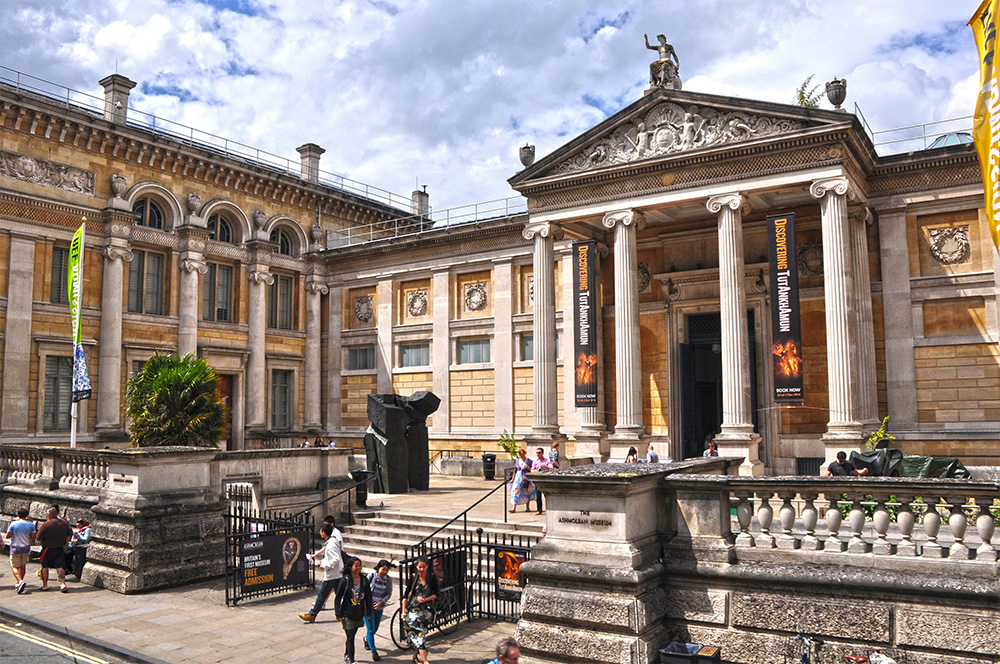
The Ashmolean Museum on Beaumont Street in Oxford occupies a singular position in the landscape of British institutions: it is, by most reckonings, Britain's first public museum, having opened in 1683 to house the cabinet of curiosities assembled by the gardeners and travellers John Tradescant the Elder and his son, and subsequently acquired by the antiquarian Elias Ashmole. Its present neoclassical building, designed by Charles Cockerell and completed in 1845, underwent a transformative £61 million redevelopment completed in 2009 — designed by Rick Mather Architects — which doubled the display space and reorganised the collections across five floors into approximately 39 galleries. The Ashmolean repays sustained attention not only for the quality of individual works but for the curatorial framework it imposes on them: the overarching concept of "Crossing Cultures, Crossing Time" deliberately situates objects in comparative conversation across civilisations, a methodology with implications for anyone thinking about how collections are displayed and interpreted.
Admission to the permanent collection is free, and the museum is open everyday 10am to 5pm
Lower Ground Floor
The lower ground floor is organised around thematic rather than geographic or chronological principles, making it somewhat unusual and conceptually interesting for museum professionals. The galleries here address universal human activities — money, textiles, reading and writing — and trace them across very different cultures simultaneously.
The Money Gallery is among the more intellectually provocative spaces in the building. It brings together coinage, trade objects, and representations of economic exchange from across the ancient and medieval worlds. The Heberden Coin Room, which houses one of the foremost numismatic collections in the world, feeds directly into this context and includes material from ancient Greece, Rome, the medieval Islamic world, and beyond. Numismatists and scholars of economic history regard the coin collection as a primary resource; for art historians it is most relevant as evidence of portraiture conventions, iconographic programmes on state objects, and the political semiotics of representation at scale.
The Textiles Gallery draws on the museum's holdings across Eastern and Western collections, presenting fabric and dress as carriers of meaning, status, and cross-cultural exchange. The Reading and Writing Gallery similarly connects ancient Near Eastern cuneiform tablets with medieval manuscripts and Eastern calligraphic traditions.
Also on this floor, the Conservation Gallery is a working demonstration space — one of the few publicly visible conservation facilities in a British museum — offering transparency into the processes of care and technical examination that underpin curatorial practice.
Ground Floor
The ground floor is principally devoted to ancient civilisations, organised so that travel, trade, and material exchange among early cultures becomes the unifying thread. This floor brings together Egypt, the ancient Near East, Greece, Cyprus, and China under one broad interpretive canopy.
The Life after Death in Ancient Egypt Gallery and associated Egypt and Nubia galleries together constitute one of the most significant collections of pre-Dynastic Egyptian material in Europe, and the most important such collection outside Cairo. The range extends from pre-Dynastic ceramics and sculpture through to Coptic artefacts. The Narmer Macehead — a carved ceremonial object from around 3000 BCE associated with the unification of Upper and Lower Egypt — is among the most historically significant objects in the museum. The Egypt galleries also benefit from the presence of the Griffith Institute, Oxford's dedicated centre for Egyptological research, which holds the archive of Howard Carter and the complete photographic record of the excavation of Tutankhamun's tomb.
The Ancient Near East Gallery presents material from Mesopotamia and the wider region, including cylinder seals, cuneiform tablets, and early Bronze Age ceramics.
The Greece and Rome Gallery and associated Cyprus Gallery contain ceramics, sculpture, and small objects from the ancient Mediterranean. The Minoan collection — the only substantial Minoan collection in Britain — derives largely from the bequest of Sir Arthur Evans, the archaeologist who excavated Knossos and served as Keeper of the Ashmolean from 1884 to 1908. For art historians concerned with the origins of Aegean visual culture and the development of figurative representation in the ancient world, this material is primary.
The Cast Gallery, housed in one of the original Cockerell spaces and one of the few sections of the pre-2009 building retained in the redevelopment, contains one of the oldest and best-preserved collections of plaster casts from ancient monuments in existence. Casts of the Parthenon frieze, the Laocoön, the Elgin Marbles, and many other works sit here in a late-Victorian pedagogical environment that has itself become an object of historiographical interest. The gallery is an important resource for understanding how the study of classical sculpture was taught in British universities and is still used for teaching at Oxford.
Also on the ground floor, the China and South Asia Gallery presents early Chinese bronzes, ceramics, and jades alongside material from South Asian cultures, establishing connections that are picked up in more depth on the floors above.
First Floor
The first floor moves into the medieval and early modern periods, with particular emphasis on the Mediterranean world and the Islamic Middle East.
The Medieval Europe Gallery and England 400–1600 Gallery contain the museum's Anglo-Saxon treasures, which are among the greatest in any collection outside the British Museum. The Alfred Jewel — a ninth-century gold and enamel object bearing the inscription "AELFRED MEC HEHT GEWYRCAN" (Alfred ordered me made) and almost certainly associated with King Alfred the Great — is the centrepiece. It is one of the most studied objects in early medieval art history, significant not only for its craftsmanship but for what it reveals about the function of portable luxury objects in Anglo-Saxon kingship. The Minster Lovell Jewel and the Warminster Jewel, similar in type to the Alfred Jewel, are also here.
The Islamic Middle East Gallery covers art and material culture from the seventh century onwards, with ceramics, metalwork, manuscript pages, and architectural elements representing the courts of the Abbasid, Fatimid, and later Islamic dynasties. The collection is particularly strong in Persian and Ottoman material.
The India from AD 600 Gallery and Mughal India Gallery present sculpture, painting, and decorative arts from across the Indian subcontinent, including Mughal miniature paintings of considerable quality. The Medieval Cyprus Gallery reflects the history of the island as a crossroads between the Latin West, the Byzantine East, and the Islamic world.
Second Floor
The second floor is where the visual arts of East Asia and the Western tradition from the Renaissance through the eighteenth century come into productive proximity.
The Japan Gallery holds what is widely considered the most important collection of Japanese art in Britain outside London, including screens, lacquerwork, ceramics, netsuke, prints, and paintings spanning many centuries. The China Gallery complements this with Chinese ceramics, paintings, and objects. The Chinese Painting Gallery — a dedicated gallery for Chinese paintings inserted into the Cockerell building in 2000 by van Heyningen and Haward Architects — is the only gallery in Britain devoted exclusively to Chinese paintings. The Ashmolean's collection in this area is described as the foremost collection of modern Chinese paintings in the Western world.
On the same floor, the Western Art galleries present European painting from roughly 1300 to the mid-eighteenth century. For art historians, this section represents one of the most substantive collections outside London and the major national galleries of Europe.
The European Art Gallery (Gallery 44) includes Paolo Uccello's The Hunt in the Forest (c.1470), one of the most significant surviving large-scale secular paintings of the Quattrocento and an essential text for any study of the development of pictorial perspective. The painting's nocturnal compression of space, its experimentally receding tree trunks, and its ambiguous relationship to Albertian theory have generated substantial critical literature, and it remains one of the works most frequently sought out by scholars visiting the collection. Also in the European galleries are paintings by Piero di Cosimo, Dosso Dossi, Titian, Veronese, Tintoretto, Guercino, and Claude Lorrain, whose large canvas Landscape with Ascanius Shooting the Stag of Sylvia (1682) is a late masterpiece of ideal landscape painting.
Seventeenth-century Northern European painting is represented by works from Rubens and Van Dyck, as well as Dutch and Flemish cabinet paintings. The collection of drawings and prints held by the Western Art department — approximately 25,000 drawings and over 250,000 prints — is accessible through the Print Room by appointment for study purposes, though selected works are displayed in the galleries. The Raphael drawings deserve particular mention: the Ashmolean holds the largest and most important group of drawings by Raphael in the world, a collection that came to the museum in 1845 following a public appeal after the dispersal of the Lawrence collection. For scholars of the Italian Renaissance, this is among the three or four most important reasons to visit Oxford specifically.
Third Floor
The third floor is devoted to art of the nineteenth to twenty-first centuries, and contains several collections of considerable importance to art historians working in this period.
The Pre-Raphaelites Gallery (Gallery 66) is one of the most significant concentrations of Pre-Raphaelite work in existence. The collection derives principally from the bequest of Thomas Combe, Superintendent of the Clarendon Press at Oxford, and his widow. Works by Holman Hunt — including A Convert's Dream and The Return of the Dove to the Ark — by Millais, Rossetti, and Ford Madox Brown are displayed alongside decorative arts including the Prioress's Tale Cabinet, designed by Philip Webb and painted by Edward Burne-Jones as a wedding present for William Morris in 1858. The cabinet is regarded as among the most significant examples of Victorian painted furniture. The Great Bookcase, designed by William Burges and described by the museum itself as the most important example of Victorian painted furniture ever made, is also in this section of the building.
The Pissarro Gallery (Gallery 65) reflects one of the collection's most distinctive strengths. The Ashmolean holds the Pissarro Family Archive and a substantial group of paintings by Camille Pissarro, acquired through a long relationship between the museum and the artist's descendants. The collection is particularly strong in Pissarro's mature Impressionist work and in his Pointillist period.
The Sickert and his Contemporaries Gallery (Gallery 63) and the 19th Century Art Gallery (Gallery 67) together provide a survey of British and European painting across the Victorian era and into the early twentieth century, including works by Sickert, Manet, and John Singer Sargent.
Note: at the time of writing, Galleries 63, 65, 66, and 67 are closed for essential environmental improvement work until September 2026. During this period, selected works from these galleries — including Turner's High Street, Oxford and Millais's portrait of John Ruskin — have been transferred temporarily to Gallery 44 on the second floor.
The Modern Art Gallery on the third floor remains open during the closure period and represents the museum's collection of twentieth and twenty-first century art.
Priority Galleries
The galleries with the strongest claim on a visiting art historian's time will depend on specialism, but several areas stand out as collections of national or international significance that cannot be readily seen elsewhere.
The Raphael drawings are the single most important reason for a specialist visit. No other institution outside Rome holds a comparable concentration of Raphael's graphic work, and the collection covers all periods of his career, including preparatory studies for the Stanza della Segnatura frescoes. Access to study the drawings in person, beyond the rotating selection on public display, can be arranged through the Print Room.
The Uccello Hunt in the Forest is one of a small number of Quattrocento secular paintings outside Italy, and its condition and scale make it an essential primary source for scholars of early Renaissance pictorial theory. The Alfred Jewel remains the most discussed object in Anglo-Saxon art history and is not lent. The Minoan collection is the only one of its scale in Britain and derives from controlled archaeological excavation rather than the art market. The Pre-Raphaelite holdings, particularly the Combe bequest, include works in unusually good condition with well-documented provenances. The Chinese Painting Gallery offers access to modern Chinese painting that is otherwise nearly inaccessible to Western scholars outside specialist East Asian collections.
Researchers should also be aware of the Bodleian Art, Archaeology and Ancient World Library, formerly the Sackler Library, which opened in 2001 and is closely affiliated with the Ashmolean. It concentrates on classical civilisation, archaeology, and art history and holds the museum's library collections, accessible to Oxford researchers and by arrangement to visiting scholars.
The Ashmolean is, in sum, a collection of collections: the accumulated private gifts, bequests, and targeted acquisitions of three and a half centuries have produced an institution with unusual depth in certain areas and an institutional character that differs markedly from that of a purpose-built national gallery. For the professional visitor, this history of accretion is as informative as the objects themselves — the museum's identity as a university institution shaped by individual scholarly enthusiasms, from Arthur Evans's Minoan obsession to the Pissarro family's sustained relationship with the curators, gives it a texture that repays careful attention across multiple visits.