

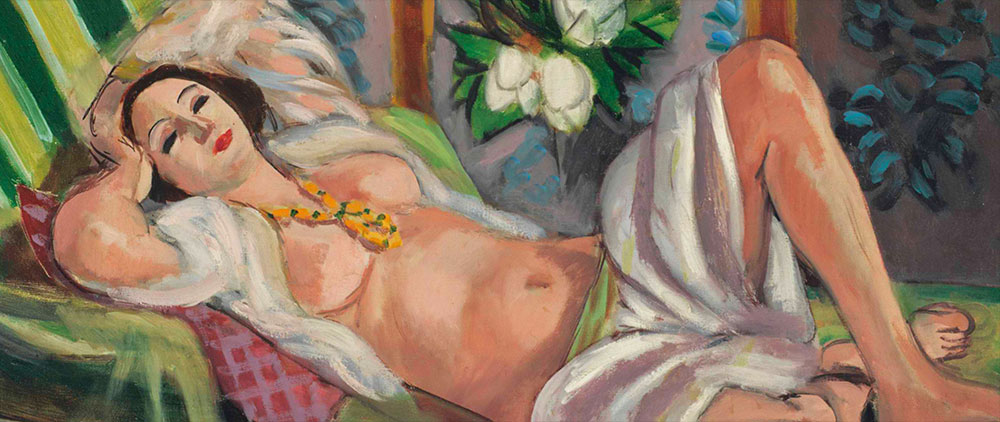
Matisse: The Pursuit of Harmony opens at Acquavella Galleries in New York on 9 April 2026 and runs through 22 May. The exhibition brings together fifty paintings, works on paper, and sculptures drawn from museums, foundations, and private collections, making it the gallery's first exhibition devoted solely to Henri Matisse since 1973 — a significant occasion for a gallery that has dealt in the artist's work for over six decades.
The premise of the exhibition is worth noting at the outset, because it positions Matisse's sculpture not as a side interest or curiosity but as a discipline that was structurally inseparable from his painting. The presentation traces Matisse's investigation of form in two and three dimensions, from works made at the start of the twentieth century through the following five decades of his career. For those accustomed to encountering Matisse primarily through the lens of colour, this emphasis on the formal dialogue between his sculpture and painting offers a more complete and analytically useful frame.
Matisse himself was direct on the matter. "I made sculpture because what interested me in painting was the clarification of my ideas. I changed medium and worked in clay as a respite from painting when I had done absolutely all that I could for the moment." That candour describes not a supplementary atelier activity but a methodological necessity — sculpture as a means of resolving problems that the painted surface alone could not settle. Turning to sculpture to work through problems he encountered in painting, he was able to more thoroughly consider mass, volume, and perspective, and this fuller understanding of the figure allowed him to simplify form to its essential rhythms in two and three dimensions.
The exhibition begins with two early sculptures, The Serf (1900–04) and Madeleine I (1901), and the closely related painting Male Model (1900) and drawing Study for Madeleine (c. 1901). Of the more than eighty sculptures Matisse created, more than half date to the first decade of the twentieth century — a radically innovative chapter of the artist's work, during which he undertook an extensive series of figure studies alongside his explorations of colour. Presenting these works in proximity, the exhibition asks viewers to follow the conversation across media rather than treating each discipline in isolation.
That conversation is most clearly visible in Matisse's treatment of the female figure. While working on the ambitious Large Seated Nude (1922–29), Matisse also worked through the dynamic, cantilevered pose of the figure in two dimensions, notably in paintings such as Odalisque couchée aux magnolias (1923) and Odalisque with a Tambourine (1925–26), which are presented in conversation with the sculpture. The logic of the hang matters here: positioning paintings and bronzes in direct dialogue is a curatorial decision that does interpretive work, making legible the iterative nature of Matisse's thinking across media. The theme of the figure viewed from behind also runs through the exhibition, exemplified by the 1917 painting Seated Nude, Back Turned and the four seminal bronze reliefs Back I–IV, made between 1908 and 1930, which encapsulate Matisse's gradual development of form from naturalistic figuration to starker geometries.
For curators and educators, the thematic structure of the exhibition — organised around recurring motifs rather than strict chronology — allows for a range of interpretive approaches. The principle Matisse articulated in his own writing gives the exhibition its title and its conceptual spine: "A work of art must be harmonious in its entirety: any superfluous detail would replace some other essential detail in the mind of the spectator." This is a useful touchstone for thinking about Matisse's reductiveness not as an absence but as a rigorous editorial process. Simplified, rhythmic forms — often inspired by the flowing lines of the arabesque — were integral to his lifelong pursuit of harmony and balance.
The accompanying catalogue warrants particular attention for those interested in the scholarship surrounding the exhibition. The fully illustrated hardcover publication will receive additional distribution through Rizzoli and includes a lead text by John Klein, professor of art history at Washington University in St Louis and a specialist on Matisse. Alastair Wright, author of Matisse and the Subject of Modernism (2006), contributes a text on the dialogue between Matisse's study of nature and his approach to the figure, while the art historian Elizabeth Cowling contributes an essay on Matisse's approach to the nude in the 1920s. The breadth of that scholarly framing suggests a publication of genuine research value, rather than a standard gallery catalogue.
The exhibition features over twenty representations of nudes, presenting the female figure in fluid, dynamic poses in both two and three dimensions, and is drawn from loans across private and institutional collections. The scale and provenance of the assembled works reflects the access that a gallery of Acquavella's standing — a three-generation, family-owned business now a century in operation — is able to bring to a focused thematic exhibition.
Matisse: The Pursuit of Harmony is on view at Acquavella Galleries, 18 East 79th Street, New York, Monday through Friday from 10 am to 5:30 pm and Saturday from 11 am to 6 pm, through 22 May 2026. Further information is available at acquavellagalleries.com