

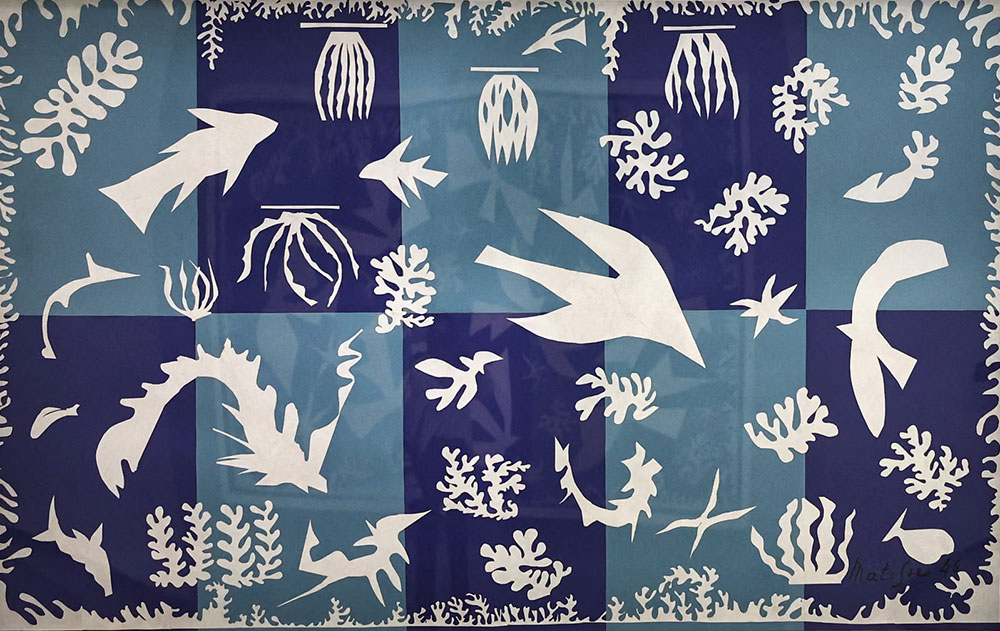
A major collaborative exhibition between the Centre Pompidou and the Grand Palais, Paris, on view through July 26, 2026
There is a myth surrounding Henri Matisse's final years that the great painter, confronted by illness and the physical limitations of age, effectively abandoned painting and retreated into the relatively modest enterprise of cutting coloured paper. The curator of Matisse, 1941–1954, Claudine Grammont, head of the graphic art department at the Centre Pompidou and former director of the Matisse Museum in Nice points out that Matisse produced 75 paintings between 1941 and 1954. The exhibition now on view at the Grand Palais in Paris — one of the most substantive surveys of this period mounted in France — exists in part to correct the record.
Matisse, 1941–1954 is a co-production between the Centre Pompidou and the GrandPalaisRmn, drawing on the Centre Pompidou's rich holdings while the institution's central Paris home remains closed for renovation. That closure, which runs until 2030, has generated an ambitious programme of partnerships and satellite presentations, of which this exhibition is among the most considered. The Grand Palais — itself recently renovated — provides a physical scale appropriate to works that, in several cases, were conceived as near-architectural interventions.
The departure point for the thirteen-year period under consideration is sobering. The nuns who cared for Matisse at a Lyon clinic following emergency surgery on a stomach tumour in early 1941 called him le ressuscité — the man who came back from the dead. He had asked the surgeons for three years; he received thirteen. This was also a period during which the Nazi occupation of France had classified his work as degenerate art. The sustained creative output that followed, under those conditions, is the substance of the exhibition.
The presentation spans more than 300 works — paintings, drawings, cut-out gouaches, illustrated books, textiles and stained glass — drawn from the Centre Pompidou collection and supplemented by significant international loans. These include works from the Hammer Museum in Los Angeles, the Museum of Modern Art in New York, the Metropolitan Museum, the National Gallery of Art in Washington, the Barnes Foundation, and the Fondation Beyeler, among others — a number of which have rarely or never before been exhibited in France.
The exhibition is curated to resist easy categorisation. Rather than presenting the cut-out gouache as the defining mode of Matisse's final years — as the 2014–15 Tate Modern and MoMA survey understandably did — Grammont positions it as one thread within a broader and more complex atelier. Painting, the exhibition argues, remained at the heart of Matisse's approach throughout this period, unfolding with increasing spatial ambition, intensity and chromatic concentration. The cut-out gouache was not a substitute for painting but a parallel and increasingly sovereign visual language — one that Matisse developed when confined largely to bed or wheelchair, working at night on account of chronic insomnia.
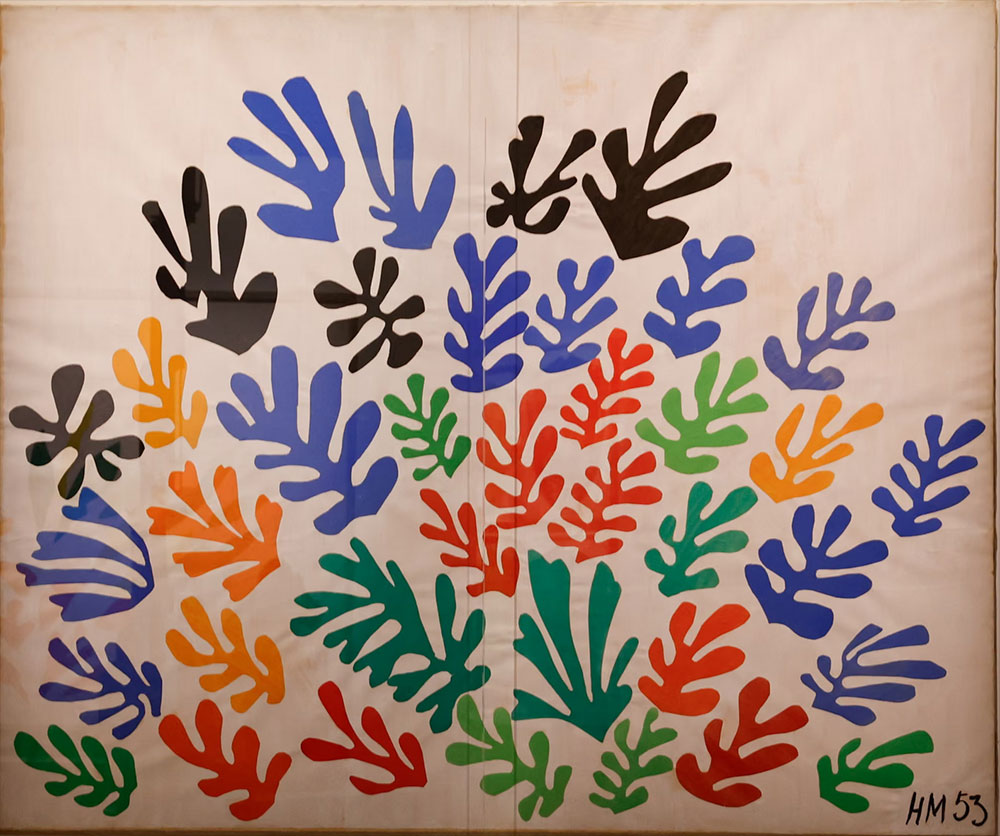
Among the key bodies of work on display are the maquettes and pochoir prints for Jazz (1943–47), which served as the generative project for the cut-outs; the improvisatory drawings from Thèmes et Variations (1941–43); the great interiors and figure paintings produced at Vence between 1946 and 1948, alongside the brush-and-ink works that accompanied them; and the drawings and window designs for the Chapelle du Rosaire in Vence — the project completed in 1951 that Matisse himself considered his greatest achievement.
The exhibition also brings together four of the monumental cut-out figures: La Tristesse du roi, Zulma, La Danseuse créole and the four panels of the Nus bleus series, assembled here for the occasion. The Nus bleus series includes one work not seen in France since 1970, alongside rarely exhibited pieces on loan from the National Gallery of Art in Washington, and one further work — Acrobates — appearing in France for the first time.
The question of perception and apparent ease runs throughout the exhibition's intellectual framework. Grammont notes that in France, Matisse has long been understood primarily as the master of the odalisque — the painter of effortless sensuality from his Nice years. The perception of ease, she observes, is hard to shake. And yet, she argues, that apparent ease is the result of intense struggle. The transcendence found in the late work was shaped by physical constraint, anxiety and sustained effort: artistry maintained against considerable odds.
The installation design addresses this dimension directly. The exhibition recreates something of the atmosphere of Matisse's atelier as it actually functioned — a space of continuous transformation, often animated through the night, with pinned and re-pinned cut-out forms in constant dialogue with painted canvases. Curator Grammont has described the ambition as placing visitors face to face with the works in a condition of genuine immersion — not the studio reconstructed as historical diorama, but the studio as a generative environment of colour, form and chromatic decision-making.
For Grammont, the period from 1941 to 1954 represents Matisse's apotheosis — a state of detachment and nonchalance that marks a moment of grace in the artist's seven-decade career. Matisse developed what she describes as a new iconographic vocabulary through the cut-out form, one that gave his art a genuinely monumental scope.
For art institution and gallery professionals, the exhibition offers several points of professional interest beyond the works themselves. The institutional arrangement — a major national collection presenting its holdings through a partnership venue during a period of structural closure — is a model of increasing relevance. The interpretive framework chosen by Grammont, which challenges a well-established critical narrative through careful object selection and installation sequencing rather than polemical argument, reflects a mature curatorial methodology. And the international loan agreements assembled for this presentation, drawing on collections across North America and Europe, demonstrate the kind of sustained institutional relationship-building that informs exhibition-making at this scale.
The accompanying catalogue, Colour Unbound: Matisse 1941–54, published by Thames and Hudson at nearly 500 pages with 300 images, constitutes a substantial scholarly resource in its own right and is available in English.
Matisse, 1941–1954 is on view at the Grand Palais, Paris, through July 26, 2026
grandpalais.fr/en/program/matisse-1941-1954