

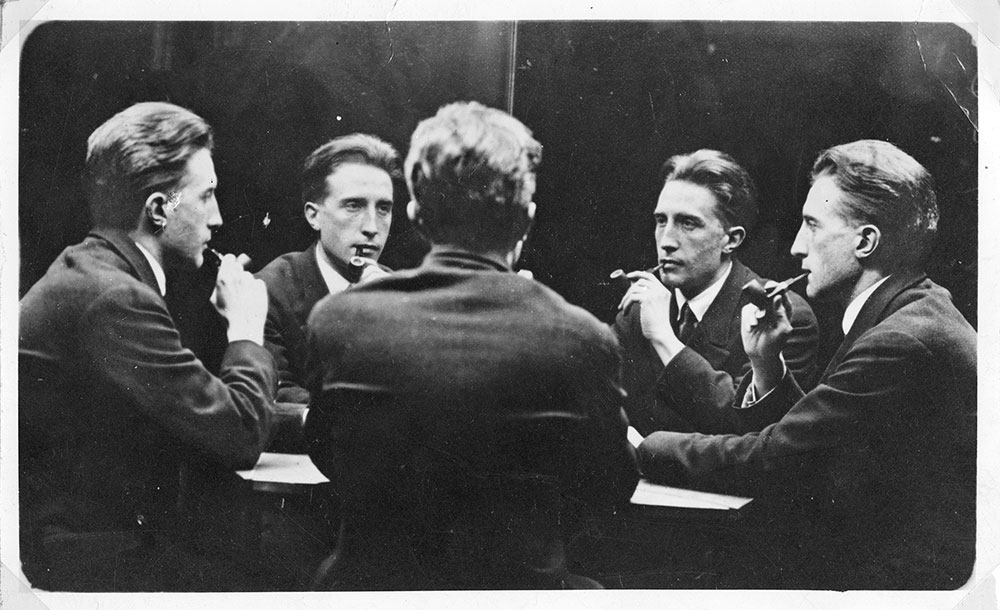
Multiple Portrait of Marcel Duchamp, Broadway Photo Shop, New York, 1917 ©2026 Artists Rights Society (ARS), New York/ADAGP, Paris/Estate of Marcel Duchamp/Private Collection
The Question That Would Not Go Away: MoMA's Marcel Duchamp Retrospective Opens 12 April 2026
On 12 April 2026, the Museum of Modern Art opens Marcel Duchamp, on view through 22 August, presents some 300 artworks and marks the first retrospective of the artist's work in the United States since 1973. That gap of more than half a century is not incidental. It frames the entire curatorial argument: that scholarship, critical reassessment, and the accumulating weight of Duchamp's influence have continued to shift in the intervening decades, and that the moment to take stock has arrived.
The exhibition is organised by Ann Temkin, The Marie-Josée and Henry Kravis Chief Curator of Painting and Sculpture at MoMA; Michelle Kuo, Chief Curator at Large and Publisher; and Matthew Affron, the Muriel and Philip Berman Curator of Modern Art at the Philadelphia Museum of Art. The institutional relationship between these two museums and Duchamp's legacy is a long one. MoMA was the first museum to acquire a work by Duchamp, and included his art in early landmark exhibitions such as Fantastic Art, Dada, Surrealism in 1936 and The Art of Assemblage in 1961. The Philadelphia Museum of Art is the largest repository of his oeuvre, as the permanent site of two monumental works, The Large Glass (1915–23) and Étant donnés (1946–66).
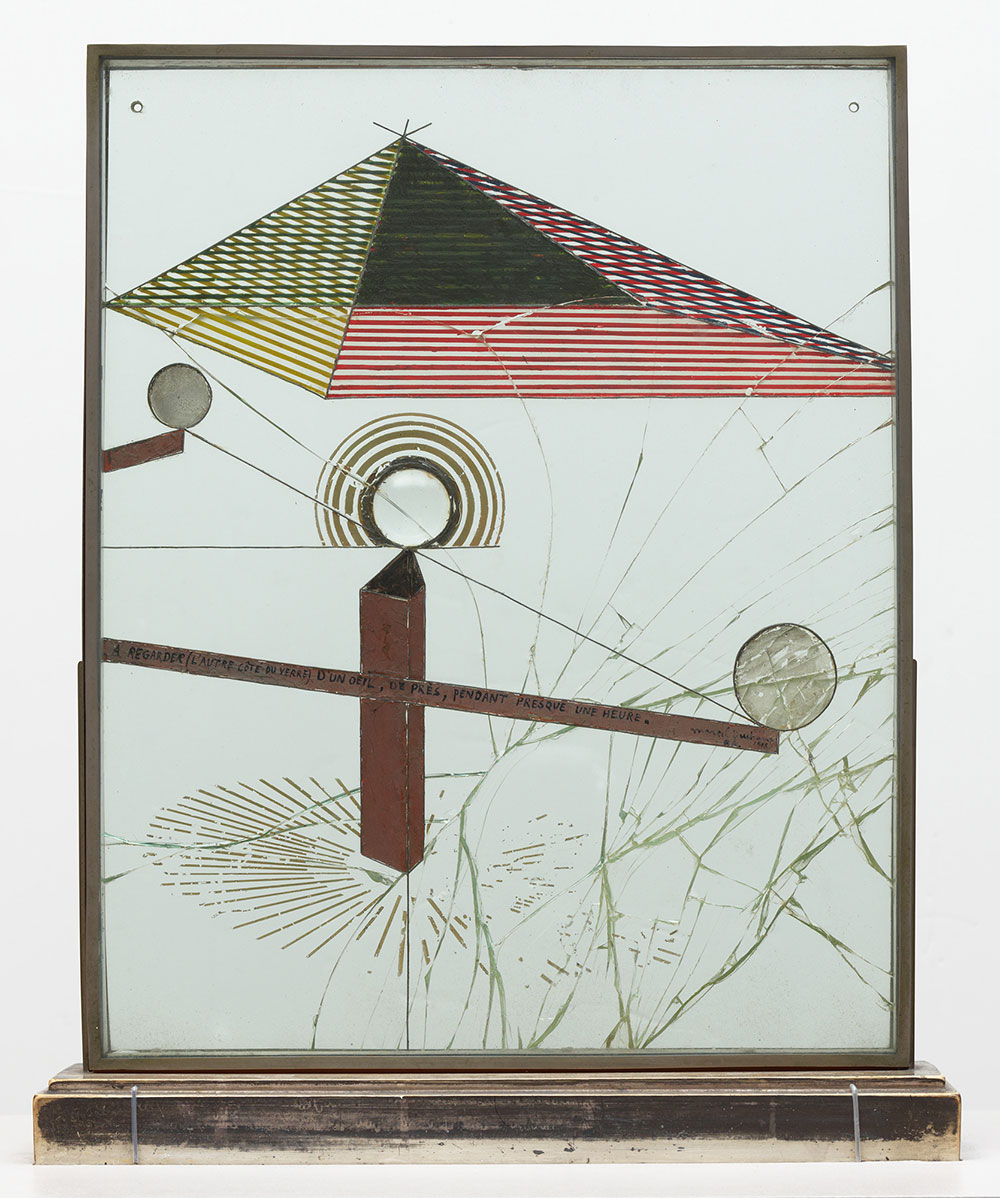
Marcel Duchamp, To Be Looked at (from the Other Side of the Glass) with One Eye, Close to, for Almost an Hour, 1918.
The exhibition is housed in the Steven and Alexandra Cohen Center for Special Exhibitions and presents work across six decades of the artist's career, spanning all mediums, including painting, sculpture, film, photography, drawings, and printed matter. The organisational logic is straightforward and, by the curators' own description, deliberately so. Moving methodically from the early 1900s to the late 1960s, the curatorial team takes a just-the-facts approach, declining to impose a narrative arc over this elusive artist. They have described the methodology, in a characteristically Duchampian turn of phrase, as "deadpan accuracy."
The exhibition begins with a selection of Duchamp's early drawings and cartoons as well as paintings submitted to French salon exhibitions, culminating with his legendary Cubist masterpiece Nude Descending a Staircase (No. 2) (1912), which was last shown at MoMA in 1974. That painting, owned by the Philadelphia Museum, carries considerable institutional memory. At the 1913 Armory Show in New York, it helped to catalyse American modernism — a fact that gives its return to Manhattan a particular resonance.
A further key section of the exhibition addresses Duchamp's invention of the readymade, which he described in 1961 as "the most important single idea to come out of my work." While several of the original readymades are now lost, the exhibition gathers those still in existence. Duchamp developed his readymades in tandem with the preparation of The Bride Stripped Bare by Her Bachelors, Even (The Large Glass) (1915–23), which liberated painting as a medium from both the canvas and the wall.
The central gallery is devoted to what the curators consider the exhibition's structural and conceptual heart. This is Duchamp's Box in a Valise (1935–41), his portable museum, for which the artist painstakingly reproduced in miniature his life's work up to that point. This will be the most extensive presentation of the Box in a Valise to date, with deluxe copies from the 1940s and subsequent editions shown alongside never-before-exhibited preparatory materials. The decision to present these objects alongside archival studio materials opens a productive line of inquiry for professionals interested in questions of reproducibility, authorship, and the artist's own relationship to retrospection as a mode of production.

Marcel Duchamp. Why Not Sneeze, Rose Sélavy?, 1921. Painted metal birdcage, wood, marble cubes, a pair of white glass dishes, thermometer, cuttlebone, 4 7/8 x 8 3/4 x 6 3/8 inches (12.4 x 22.2 x 16.2 cm). Philadelphia Art Museum: The Louise and Walter Arensberg Collection
The exhibition will also present Duchamp's transatlantic participation in New York and Paris Dada in the 1920s, including L.H.O.O.Q. (1919), his irreverent defacement of a postcard-sized reproduction of Leonardo da Vinci's Mona Lisa. His experiments with motorised optical devices and filmmaking, including the radical film Anémic Cinéma (1926), and the appearances of his feminine alter ego Rrose Sélavy, will also be included.
For gallery professionals working with contemporary artists whose atelier extends into conceptual, post-object, or institutional-critique territory, the exhibition's later galleries hold particular interest. Audiences may be surprised by how much art Duchamp continued to produce during what has traditionally been characterised as his chess-playing chapter. The assumption that Duchamp abandoned art-making for the chessboard after 1923 has long circulated as settled biographical fact. The exhibition tests that received idea carefully.
The exhibition will also gather studies that informed the making of Étant donnés (1946–66), Duchamp's final work, which was installed at the Philadelphia Museum of Art a year after his death. That posthumous installation has always stood slightly apart from the canonical Duchamp narrative. Bringing its preparatory materials into the exhibition proper invites a reconsideration of how his later artistry has been discussed — and perhaps underestimated — in the scholarly literature.
The curators have been candid about the organisational difficulty. Michelle Kuo described the challenge plainly: "The difficulty level is at a 15 out of 10, because everything he made is designed to confound the traditional systems of art as we know them." That observation carries weight beyond the logistics of installation. It points to a fundamental problem for any institution presenting Duchamp: that the art consistently resists the frames museums use to contain it. The decision to proceed chronologically, without overlaying a thematic argument, is a reasonable response to that difficulty.
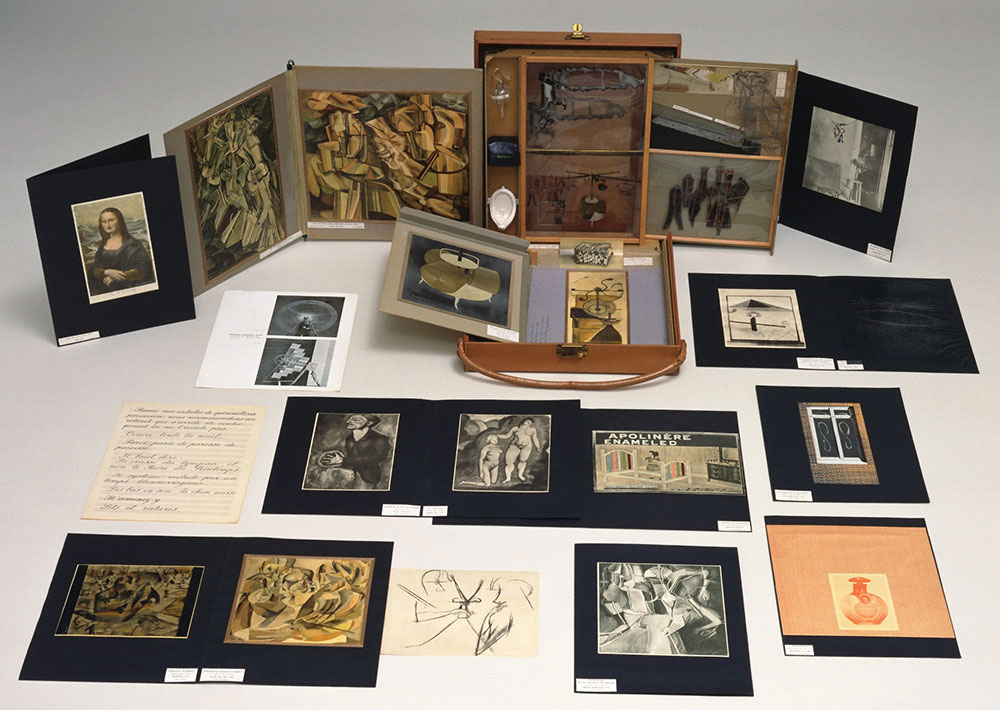
Marcel Duchamp, Box in a Valise (From or by Marcel Duchamp or Rrose Sélavy), 1935-41.
Ann Temkin has noted that Duchamp's influence touches questions of chance, skill and deskilling, the art market, the role of the human and the machine, and the definition of originality and authorship. These are not historical problems. They are questions that art institutions and commercial galleries deal with in practical terms every week — in acquisition discussions, in attribution disputes, in the increasing complexity of works that exist as instructions, editions, replicas, or propositions rather than singular objects. Duchamp's contribution to making those questions unavoidable is reason enough to take this retrospective seriously.
Duchamp is widely acknowledged as a forerunner to artists as varied as Jasper Johns and Cameron Rowland, and he developed ideas — appropriation, self-referentiality, the artist-as-prankster — that extended through generations of subsequent work. Yet as Kuo has observed, the totality of his output remains less well known than its reputation suggests. "What is talked about most often is only the tip of the iceberg, and his diverse body of work leaves much to be investigated."
The exhibition is accompanied by a richly illustrated hardcover catalogue of 340 pages, edited by Matthew Affron, Michelle Kuo, and Ann Temkin, as well as a separate paperback volume, Duchamp on Tape: The Janis Family Interviews, edited by Temkin. Both publications are likely to enter the reference holdings of any serious research library concerned with twentieth-century art.
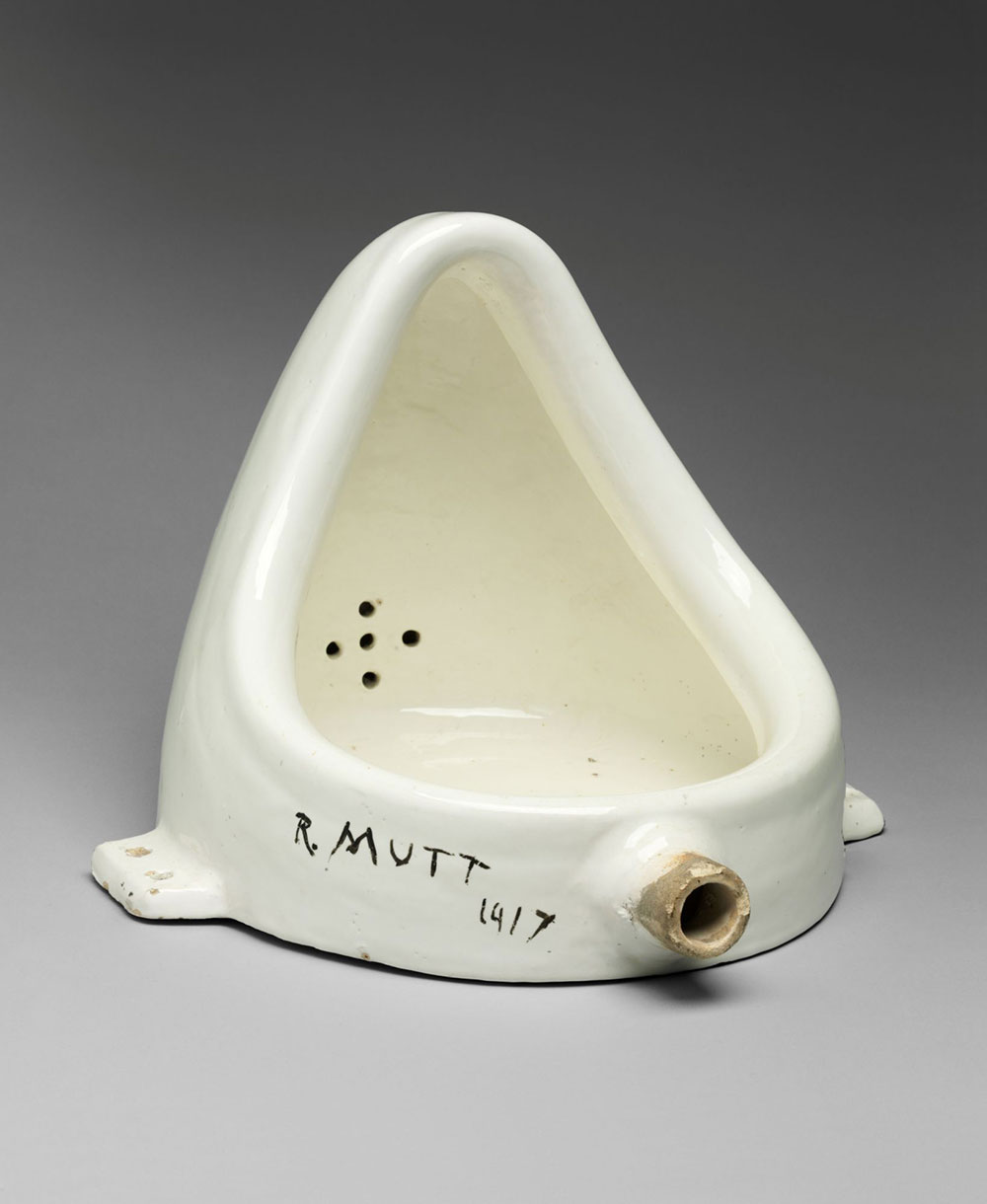
Marcel Duchamp, Fountain, 1950 (replica of 1917 original) Philadelphia Art Museum
Following its New York presentation, the exhibition travels to the Philadelphia Museum of Art from 10 October 2026 through 31 January 2027, and subsequently to the Grand Palais in Paris in spring 2027. The Paris iteration is co-produced with the Centre Pompidou, which is currently closed for renovation. As a travelling exhibition of this scale and institutional ambition, it will be among the most discussed shows of the next two years.
The exhibition is on view at the Museum of Modern Art, 11 West 53rd Street, New York, from 12 April through 22 August 2026. Further information is available at moma.org/calendar/exhibitions/5820
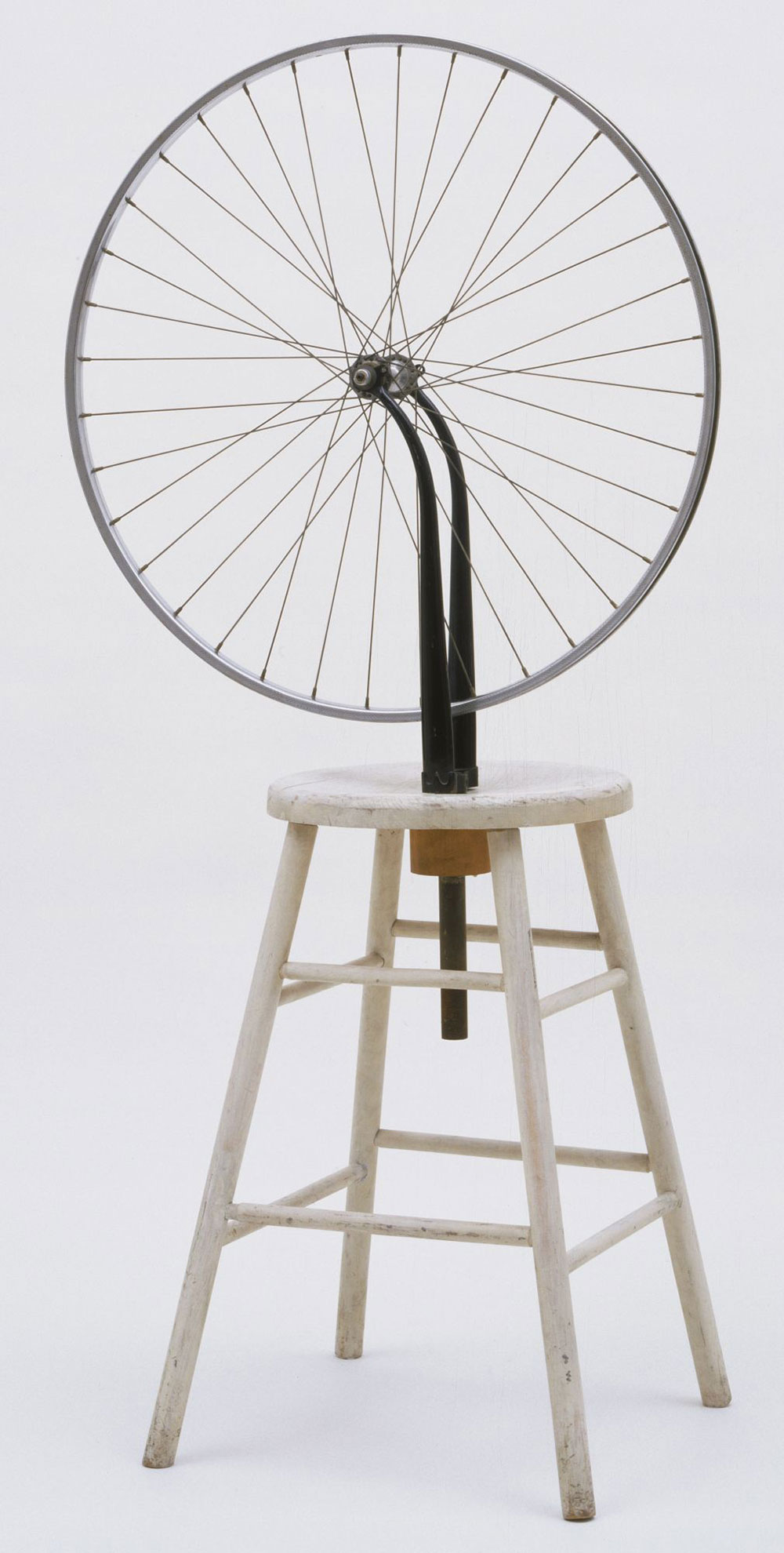
Marcel Duchamp, Bicycle Wheel, 1951 (third version, after lost original of 1913). Metal wheel mounted on painted wood stool, 51 x 25 x 16 ½” (129.5 x 63.5 x 41.9 cm). The Museum of Modern Art, New York
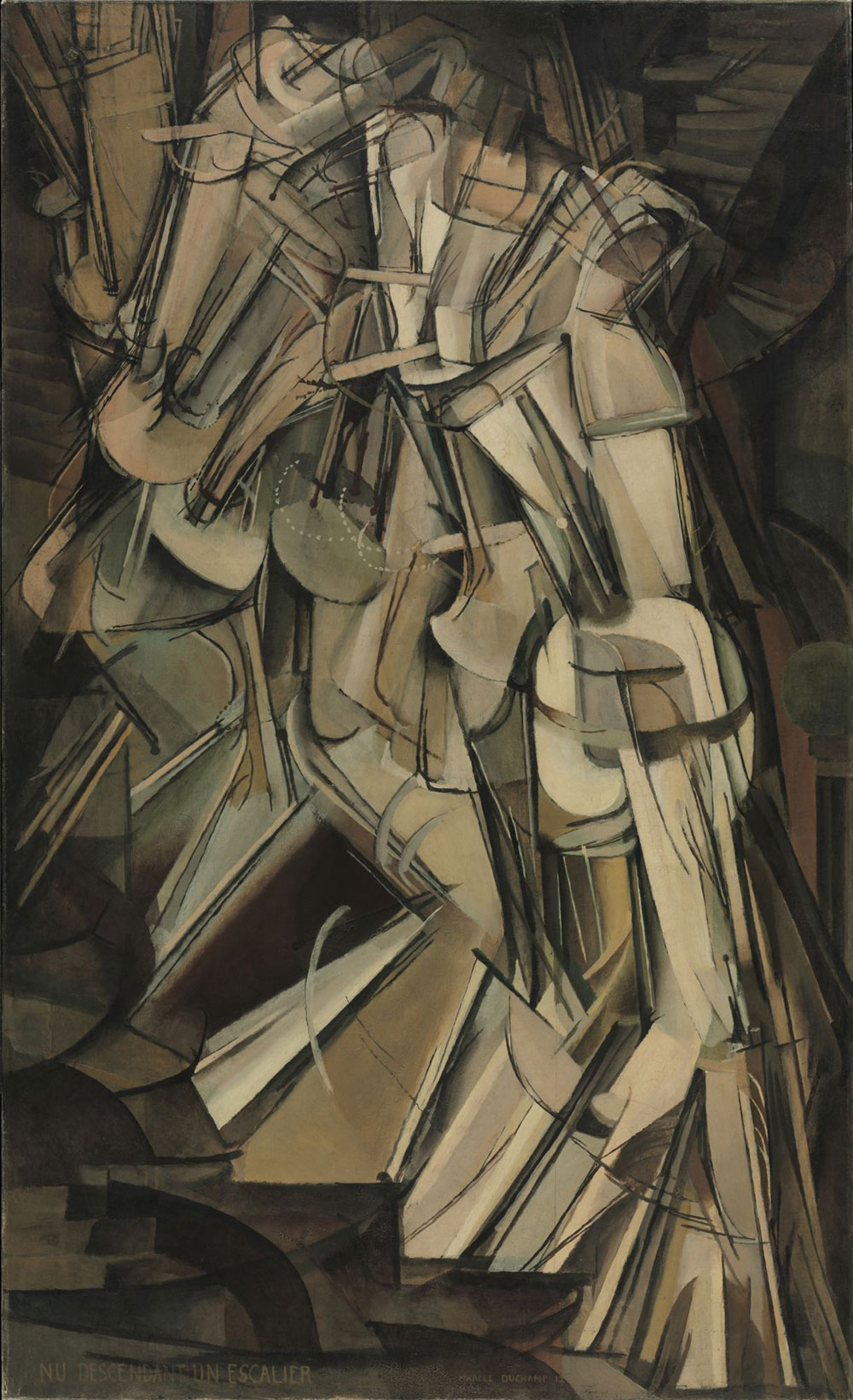
Marcel Duchamp. Nude Descending a Staircase (No. 2), 1912. Oil on canvas, 57 ⅞ x 35 ⅛ inches (147 x 89.2 cm). Philadelphia Art Museum: The Philadelphia Museum of Art: Louise and Walter Arensberg Collection.