

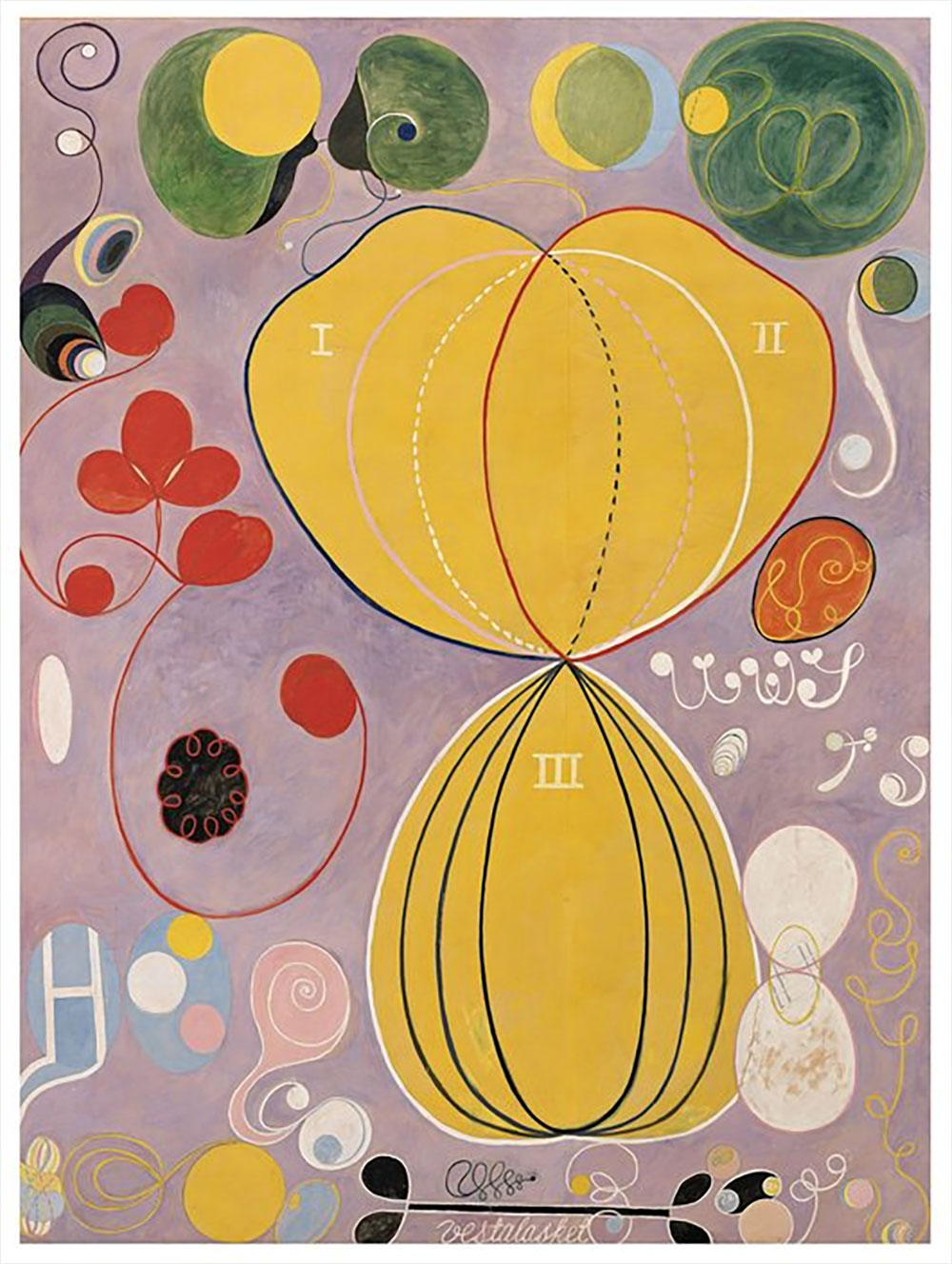
Hilma af Klint at the Grand Palais: A Long-Overdue Encounter 6 May – 30 August 2026, Galerie 8, Grand Palais, Paris Co-produced by GrandPalaisRmn and the Centre Pompidou
France has waited a long time for this. Despite the considerable international reassessment of Hilma af Klint's place in the history of abstraction — anchored by the landmark retrospective at the Guggenheim in New York and the sustained attention of the Moderna Museet in Stockholm — no major monographic exhibition of her work has, until now, been presented in France. That gap is addressed this summer, when the Grand Palais and the Centre Pompidou co-present the first substantial survey of af Klint's art on French soil, curated by Pascal Rousseau, Professor at the University of Paris 1 Panthéon-Sorbonne.
The exhibition makes a considered curatorial argument: that af Klint's work disrupts the conventional chronology of modern art. Born in Stockholm in 1862 and trained at the Royal Academy of Fine Arts, she led what might be described as a divided artistic life. Professionally, she produced the figurative portraiture and botanical illustration expected of a woman of her standing and era. In parallel, and largely in private, she pursued an entirely different body of work — one that, in formal terms, preceded the abstract painting for which Kandinsky, Malevich and Mondrian would later receive credit.
As early as 1906, af Klint was producing paintings of remarkable formal confidence, combining geometry, fields of vivid colour and organic motifs that anticipated the major currents of twentieth-century art. That this atelier output remained unseen by the wider public for decades was not accidental. Af Klint chose not to reveal her abstract work to her contemporaries, stipulating in her will that the paintings remain sealed for twenty years after her death. It was a decision that, whatever its reasoning, effectively removed her from the canonical narratives being constructed around European modernism during the first half of the last century.
It was not until 1986, during The Spiritual in Art: Abstract Painting 1890–1985 in Los Angeles, that her abstract paintings were shown to the public for the first time, marking the beginning of her international recognition. The decades since have seen her reputation grow steadily, particularly as art history has undertaken a broader reconsideration of the women artists who shaped the modern movement but were written out of it.
The intellectual and spiritual context for her artistry is central to how this exhibition frames her work. Her engagement with the Theosophical Society, and the séances she conducted within a small group of women who shared her utopian vision, provided the conditions in which she found the creative freedom to work outside convention. Spirals, circles, biomorphic forms and luminous fields of colour were not purely aesthetic decisions; they were the visual language of a sustained inquiry into cosmic harmony, invisible forces and the relationship between the material and the spiritual.
The centrepiece of the Grand Palais presentation is the Paintings for the Temple cycle (1906–1915), a series of 193 works in which af Klint, through large formats and an unprecedented visual language combining geometric abstraction and esoteric symbolism, explored duality and the evolution of the soul. Within this cycle, the monumental Ten Largest series — each canvas measuring 315 by approximately 235 centimetres — commands particular attention. The scénographie places particular emphasis on the vertiginous scale of certain works, while offering intellectual grounding through her notebooks.
Beyond the retrospective dimension, the exhibition draws out the multiple sources of inspiration informing her work — esotericism, folklore and folk art, scientific culture — and raises questions about the ways in which art history long overlooked women artists and their contributions to the foundational movements of modernity. This curatorial framing is timely and professionally relevant. For institutions engaged with collection interpretation, acquisition strategy or public programming that addresses canon formation and representation, the exhibition offers a useful reference point.
Af Klint remains little seen in French museums, even as the world increasingly positions her as a central figure in the early history of abstraction. This exhibition does not simply restore her to a chronology from which she was absent; it asks more probing questions about how such absences occur and what conditions sustain them.
Hilma af Klint, Grand Palais, Paris 8e. 6 May – 30 August 2026. A co-production of GrandPalaisRmn and the Centre Pompidou. Curated by Pascal Rousseau, University of Paris