
Presence and Responsibility
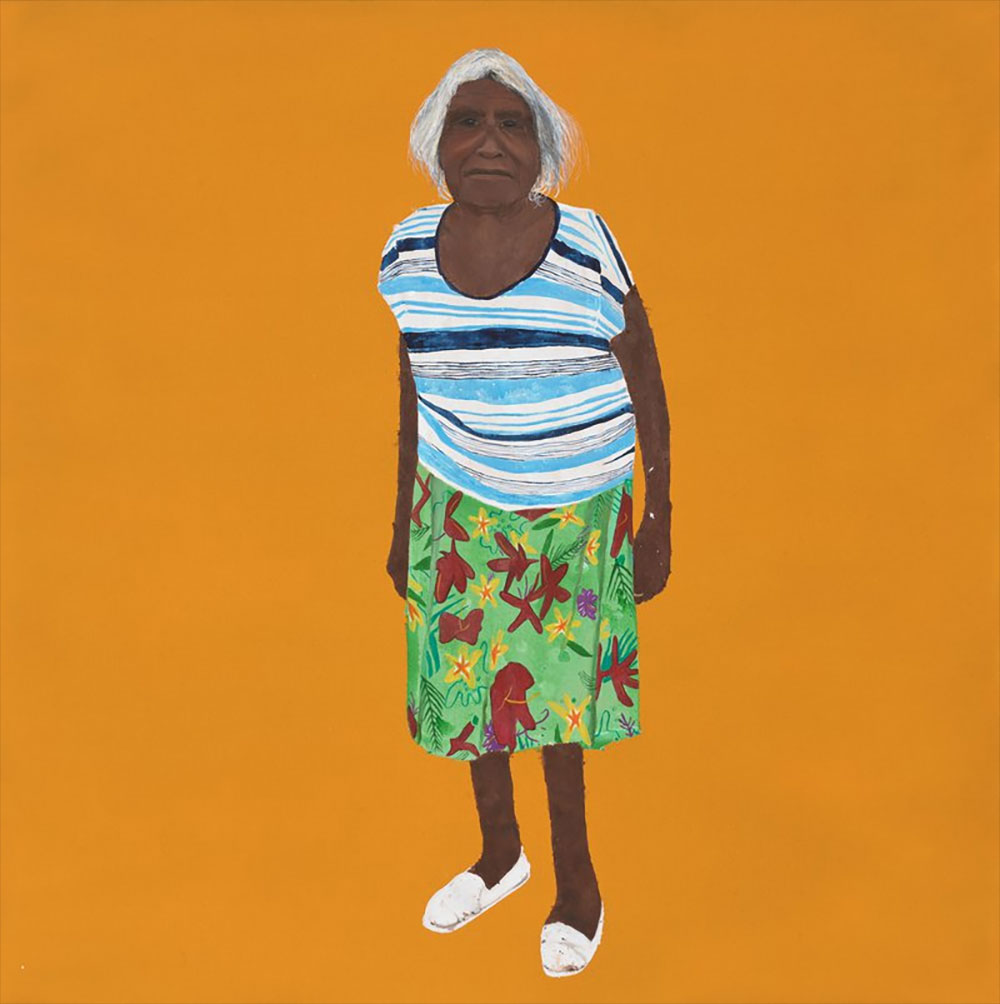
On 8 May 2026, the Art Gallery of New South Wales announced Melbourne-based artist Richard Lewer as the winner of the Archibald Prize 2026, Australia's most prestigious portrait award, for his work Iluwanti Ken — a life-size portrait of Pitjantjatjara Elder, senior artist and ngangkari (traditional healer) Iluwanti Ken. The announcement came as the gallery opened the Archibald, Wynne and Sulman Prizes 2026 exhibition, which runs from 9 May to 16 August 2026 at the Art Gallery of New South Wales on Gadigal Country, Sydney, before a touring exhibition travels to six venues across New South Wales and Victoria through August 2027.
The winning work — synthetic polymer paint on canvas, measuring 198 x 198 cm — was selected by the Art Gallery's Board of Trustees from 1034 entries, with 59 finalists represented in the exhibition. Lewer, a six-time Archibald finalist, receives the prize sum of $100,000.
The Portrait and Its Making
The decision to paint Iluwanti Ken was not incidental. Lewer and Ken had known one another for several years through shared exhibitions — including the 2023 NGV Triennial where works by both artists appeared alongside those of Betty Muffler. Lewer travelled late in 2025 to Amata in the Aṉangu Pitjantjatjara Yankunytjatjara (APY) Lands of South Australia to spend time with Ken at her art centre, Tjala Arts. Being on Country together, as Lewer has described it, deepened his understanding of the responsibilities she carries to kin, community and culture. Their conversations encompassed family, loss and the fragility of cultural knowledge — themes that give the finished portrait its weight.
The work presents Ken at life-size. As Lewer explains, the scale ensures that her presence meets the viewer directly, without mediation or reduction. The yellow ochre ground evokes the heat and intensity of the APY Lands, and Ken's love of vivid clothing — rendered here in a blue-and-white striped shirt and floral green skirt — is treated not as incidental detail but as an extension of her character. Traces of paint on her arm, as if she has just stepped away from the studio, acknowledge her as a working artist in her own right.
Ken herself is a senior practitioner whose paintings, ceramics and drawings centre on the walawuru tjukurpa — the story of the eagles — in which birds appear as teachers of care, protection, provision and resilience, particularly for women and children. Lewer has spoken of recognising an urgency in Ken's artistry that he identifies with in his own work, and these teachings shaped his approach to the portrait: he sought to convey her strength and attentiveness, to reflect the way she watches over others.
"In person, Iluwanti is a small woman, but she carries immense, quiet authority," Lewer has said. "I painted her life-size, so her presence meets the viewer directly."
The Subject: Iluwanti Ken
Iluwanti Ken is not only the subject of the winning portrait — she is herself a significant figure in Australian contemporary art. A Pitjantjatjara Elder and ngangkari, she lives and works in the APY Lands, where she is affiliated with Tjala Arts in Amata. Her artistry spans painting, ceramics and ink works, with the eagle — or walawuru — a recurring presence across all her output.
Ken is also, notably, a finalist in the 2026 Wynne Prize, a recognition that situates her simultaneously on both sides of the portraiture and landscape conversation that the Archibald and Wynne prizes collectively represent. The fact that the subject of the winning Archibald portrait is herself exhibited as an artist in a companion prize at the same institution is a circumstance that carries quiet significance for how the Australian art world understands cross-cultural artistic relationships.
Richard Lewer: Background and Atelier
Born in Aotearoa New Zealand in 1970, Lewer has lived and worked in Melbourne since 1996. He studied at the Elam School of Fine Arts in Auckland and the Victorian College of the Arts in Melbourne, and maintains a wide-ranging atelier that encompasses painting, drawing, printmaking, sculpture and video. His work is characterised by an unflinching engagement with human vulnerability — with failure, care, resilience and the ordinary texture of lives lived in full.
His record in the major prizes is substantial. He has been an Archibald finalist in 2017, 2020, 2021, 2022, 2025 and now 2026, and a Sulman Prize finalist in 2019 and 2023. Among the awards he has received are the Basil Sellers Art Prize (2016), the Blake Prize (2014), the Paul Guest Prize for Drawing (2020), the APW Collie Print Trust Fellowship (2020) and the National Works on Paper Drawing Award (2010). His work is held in major public and private collections across Australia and New Zealand, including the Art Gallery of New South Wales. He succeeds Brisbane-based artist Julie Fragar, who won the 2025 Archibald Prize for her oil painting Flagship Mother Multiverse (Justene).
The Trustees and Gallery Response
The Board of Trustees, which determines both the Archibald and Wynne Prize winners each year, responded to the work with immediacy. Board president Michael Rose noted that all trustees were drawn immediately to Lewer's portrait of Ken, describing it as a powerful and energetic work by an accomplished artist that conveys the depth of admiration and respect between painter and subject.
Art Gallery of New South Wales director Maud Page offered a more technical reading, pointing to the controlled spontaneity of Lewer's handling of paint — an approach that appears instinctual while demonstrating masterful command of the medium. Page observed that Ken seems to emerge from the ochre ground without recourse to conventional perspective, yet her presence as artist, healer and matriarch is nonetheless powerfully realised. She drew particular attention to the eyes: direct, warm and conveying what she described as strength.
The 2026 Packing Room Prize
The 2026 Packing Room Prize was awarded to Melbourne artist Sean Layh for his oil on board portrait The tragicall historie of Hamlet, Prince of Denmarke (114.1 x 150.2 cm), depicting Australian actor Jacob Collins in the title role of Iain Sinclair's 2024 production of Shakespeare's Hamlet at fortyfivedownstairs theatre in Melbourne. The title, with its Elizabethan spelling drawn from the play's earliest printed editions, was agreed upon jointly by artist and sitter.
A first-time Archibald finalist, Layh is a figurative painter whose atelier is shaped by close engagement with European art of the nineteenth and early twentieth centuries, from Romanticism through Impressionism — a sensibility formed largely through sustained attention to the National Gallery of Victoria's permanent collection. The composition references Albert Maignan's The last moments of Chlodobert (1880), also held at the NGV. Layh was drawn to Collins's performance after attending a candlelit production in a compressed physical space, describing it as blending the character's dark introspection with the supernatural atmosphere of the play. He subsequently asked Collins to reprise the role specifically for the portrait sitting.
The Packing Room Prize, now in its 35th year, is selected by the Art Gallery staff responsible for receiving, unpacking and hanging the entries — a constituency that includes a number of artists among its ranks, a fact Layh acknowledged in his response to the award.
The Exhibition
The Archibald, Wynne and Sulman Prizes 2026 exhibition is on display at the Art Gallery of New South Wales from 9 May to 16 August 2026, presented by ANZ in its seventeenth year of support for the prizes. The exhibition encompasses all 59 Archibald finalists, 52 Wynne finalists and 26 Sulman finalists selected by guest judge Del Kathryn Barton. The 2026 prize year attracted 2524 combined entries across the three prizes — the second-highest combined total in the prizes' history.
The Archibald Prize 2026 finalist exhibition will subsequently tour to six venues across New South Wales and Victoria, with the regional tour running through to 22 August 2027.
The Art Gallery of New South Wales is located at Art Gallery Road, The Domain, Sydney NSW 2000. Further information is available at artgallery.nsw.gov.au