
Landscape, Legacy and the Living Image
Two of Australia’s most enduring art prizes — the Wynne and the Sir John Sulman — have announced their 2026 winners, with this year’s results offering a considered cross-section of contemporary Australian artistry, from Yolŋu cultural memory to quiet domestic advocacy.
The Wynne Prize 2026: Country, Songline and Etched Steel
The Wynne Prize holds a particular distinction in the Australian cultural calendar as the country’s oldest art prize, first awarded in 1897 following the bequest of Richard Wynne, and timed to coincide with the formal opening of the Art Gallery of New South Wales at its present site on the Domain. Judged each year by the Gallery’s Board of Trustees, it is awarded for the best landscape painting of Australian scenery in oils or watercolours, or for the best example of figure sculpture by an Australian artist — criteria broad enough to have attracted some of the most varied and searching responses to the Australian environment over more than a century.
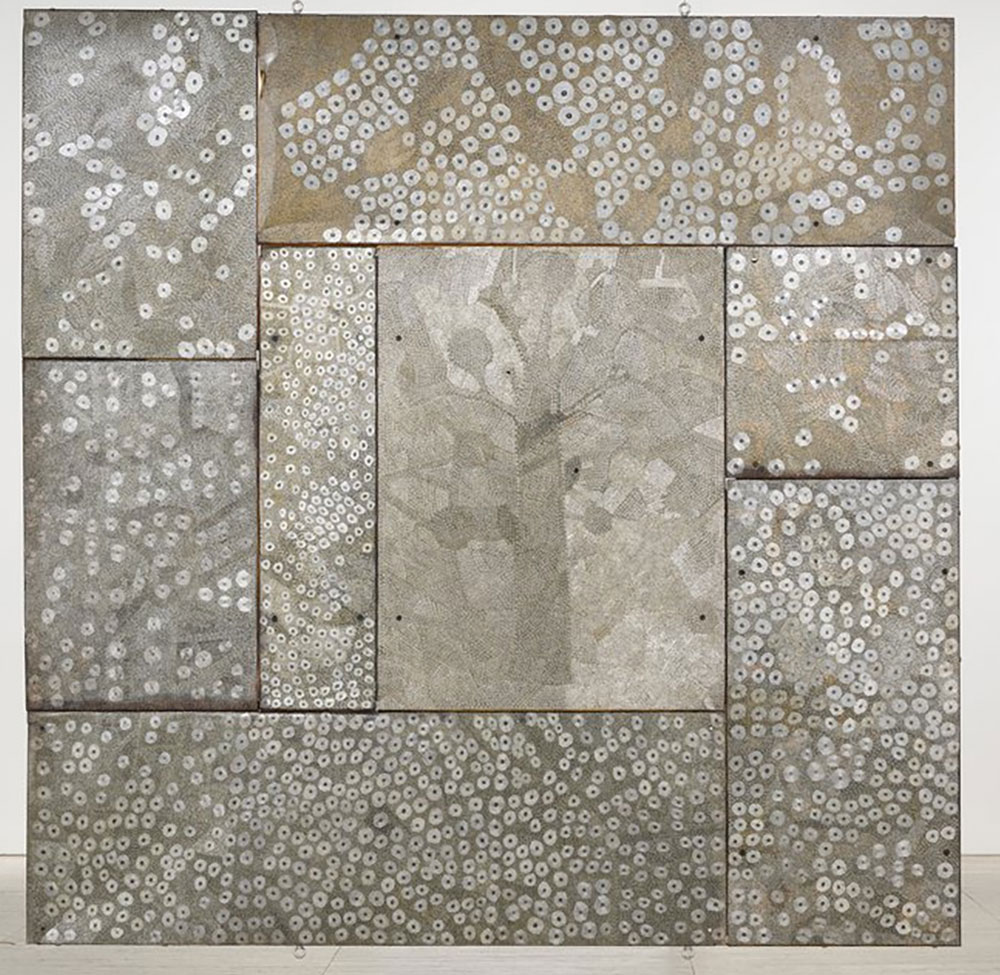
This year, 773 works were entered; 52 were selected as finalists. The 2026 prize of $50,000 was awarded to Yolŋu artist Gaypalani Waṇambi for The Waṇambi tree — a large-scale double-sided work executed in spray paint on etched steel, measuring 240 x 240 centimetres. The work was Waṇambi’s first appearance as a Wynne finalist, a distinction that makes the win all the more striking.
Waṇambi, who is based in Yirrkala in north-east Arnhem Land, works within a tradition of cultural and material innovation rooted in her family’s atelier. The daughter of the late and highly regarded artist Wukun Waṇambi — a founding member of the Found group of artists, who etched and engraved discarded road signs as part of a broader commitment to repurposing industrial waste from their region — Gaypalani grew up learning to paint and etch alongside her father and brothers. After his passing in 2022, cultural protocol guided her away from his specific designs, and she began to work through the epic song poetry of Wuyal, the ancestral honey hunter and first man of the Marrakulu clan.
The winning work draws on these songlines directly. On its front face, the surface carries intricate etchings of bees, honey and the blossoming stringybark — species central to the life cycle of Wuyal’s journeys and to the freshwater Country of her homeland. On its reverse, the work reveals its material origins: a mosaic of discarded road signs, the very found industrial substrate that her father’s generation made culturally and artistically significant. Exhibition curator Beatrice Gralton suspended the work from the ceiling of the Art Gallery to allow visitors to move around it and perceive both sides — a decision that registers the layered nature of the work, where ancestry and contemporary material conditions are inseparable.
When informed of her win, Waṇambi spoke through a video message from Yirrkala. Gallery board president Michael Rose, who made the call to community members in East Arnhem Land to share the news, was told that the very Waṇambi trees depicted in the work had at that moment begun to flower. The detail, almost novelistic in its aptness, lent the announcement a resonance unlikely to have been engineered.
The decision was, by the board’s own account, an unusually close one. In a rare occurrence, a highly commended honour was also awarded to Sanné Mestrom for her sculpture What the body knows, acknowledging the strength of competition across the 52 finalists. Among those finalists was a further indicator of the prize’s increasingly broad reach: Iluwanti Ken, a senior Pitjantjatjara artist from the AP Lands — who also features as the subject of the 2026 Archibald Prize winner — was represented in the Wynne alongside collaborators LeShaye Swan and Justine Anderson with a work combining clay, wood, woven fibre and emu feathers.
The 52-strong shortlist reflects the expanded sense of what constitutes landscape in Australian art. Alongside representational works, the selection includes responses to Country through geometry and abstraction, culturally encoded pattern, experimental installation and mixed-media assemblage. Artists from across Australia are represented, including established figures such as Elisabeth Cummings, Gunybi Ganambarr, Noel McKenna, Guan Wei and Tom Carment, as well as a significant cohort of First Nations artists whose art is grounded in the specific geography, ancestral knowledge and visual languages of their Country. The Trustees’ Watercolour Prize 2026 — sometimes referred to as the Pring Prize, and open to the best watercolour work entered across the Wynne — was awarded to Jennifer Mills in collaboration with Darcy Luker for ET home, a watercolour and pastel on paper work.
The Sir John Sulman Prize 2026: Genre, Protest and the Painting of Conviction
Where the Wynne is defined by its relationship to place, the Sir John Sulman Prize occupies a different institutional niche. Established in 1936 under the terms of a bequest from architect, Gallery trustee and president Sir John Sulman — whose family endowed the prize after his death in 1934 — it is awarded annually for the best subject painting, genre painting or mural project by an Australian artist. Its terms encompass genre paintings (works representing aspects of everyday life, which may be figurative, still-life or interior in character), subject paintings (idealised or dramatised works drawing on history, poetry, mythology or religion) and mural projects. The Sulman has long been regarded as a prize that rewards pictorial ambition, and it is notable for its use of a guest judge each year, invited by the Board of Trustees to make the final selection from the finalist works.
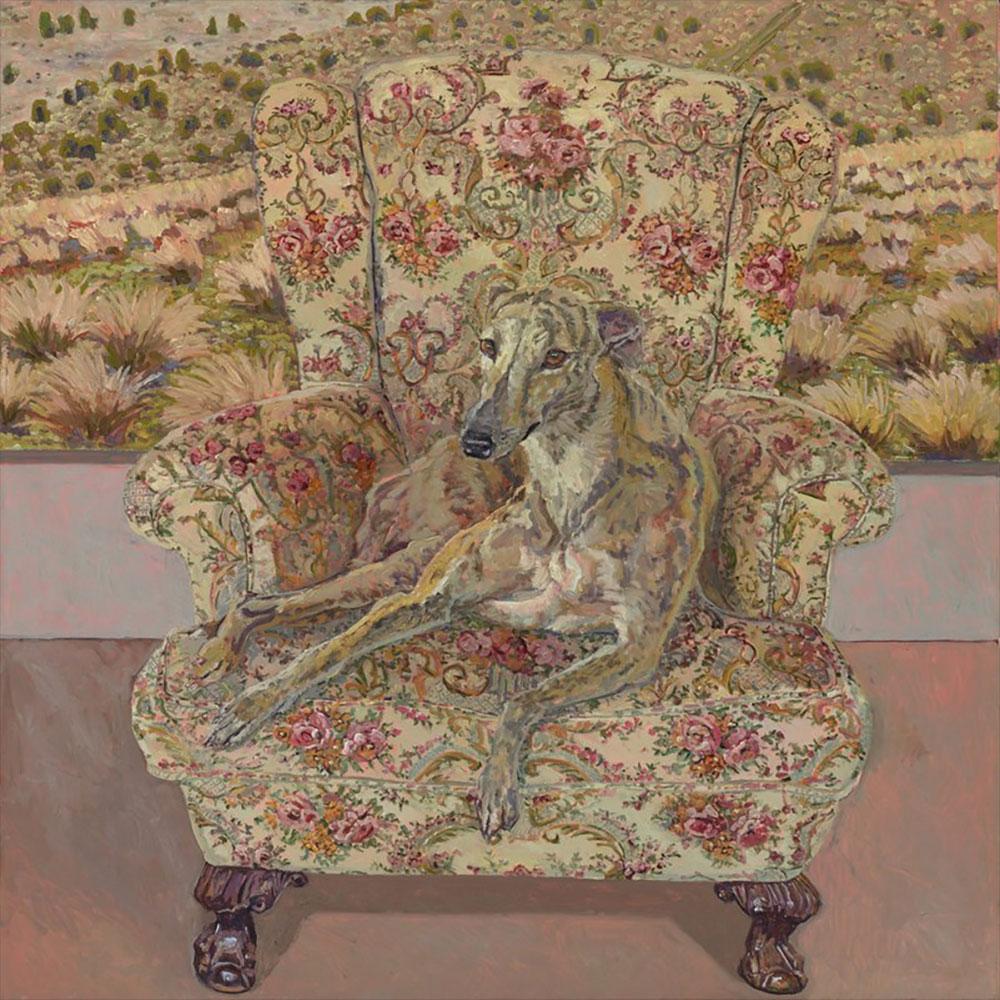
For 2026, the guest judge was Sydney artist Del Kathryn Barton, who selected 26 finalists from 717 entries. The $40,000 prize was awarded to Lucy Culliton for Toolah, artist model, an oil on canvas measuring 137.6 x 137.1 centimetres. It was Culliton’s seventh time as a Sulman finalist; this is her first win.
The painting depicts Toolah, one of seven greyhounds who share Culliton’s property in the Snowy Monaro region of New South Wales, all of which have come from the greyhound racing industry. Toolah is shown seated on an ornately decorated armchair, an arrangement Culliton has described as a deliberate assertion of the animal’s right to comfort and dignity over confinement. Behind the figure hangs a large landscape by Culliton that was recently shown in an exhibition concerning climate change. The palette of soft pinks and yellowy greens, in which subject, chair and background landscape seem to bleed and merge, draws Culliton’s advocacy for animals and her concern for the natural environment into a single pictorial field. In her own words, the painting constitutes “my quiet protest against greyhound racing.”
Barton’s citation was direct and affirmative. Describing the painting as technically accomplished and pictorially ambitious, she wrote that it offered audiences what she called a tender moment of gorgeousness from Culliton’s life — a response to a work that is unambiguously personal in its origins, yet formally resolved in its delivery. Culliton trained at the National Art School in Sydney and has exhibited professionally since the late 1990s, with a body of work spanning landscapes, still life and animals. The painting’s subject — a greyhound on an armchair, by an artist with a declared position on industrial animal use — places it squarely within the genre painting tradition, while the formal integration of landscape, interior and figure-like animal suggests a more complex compositional argument.
The 26-strong Sulman shortlist for 2026 again reflects the breadth of what subject and genre painting can accommodate under the prize’s terms. Works by Ron Adams, Suzanne Archer, Karen Black, James Drinkwater, Gunybi Ganambarr, Gareth Sansom, Aida Tomescu and Joan Ross are among the finalists, with several artists representing quite different pictorial approaches — from observational realism and expressive figuration to symbolic accumulation and digital collage. A collaborative work by Fintan Magee and Abdul Abdullah, titled Revisionist statue, brings to the shortlist a current concern with contested public imagery and historical representation. Adrian Jangala Robertson appears in both the Wynne and Sulman this year, a further indication of how artists working across cultural and geographic registers are engaging simultaneously with landscape and narrative traditions.
Exhibition and Touring
All finalist works in both prizes are on display alongside the Archibald Prize 2026 in the exhibition Archibald, Wynne and Sulman Prizes 2026 at the Art Gallery of New South Wales from 9 May to 16 August 2026. The exhibition is presented with the support of ANZ as presenting partner. Entry to the Gallery remains free.
Following the Sydney exhibition, the Archibald Prize finalists will tour to regional venues in New South Wales and Victoria: Shepparton Art Museum, Bank Art Museum Moree, Griffith Regional Art Gallery, Bathurst Regional Art Gallery, Penrith Regional Gallery and the Tweed Regional Gallery and Margaret Olley Art Centre. The touring program is supported through Create NSW’s Blockbusters Funding initiative.
A Note on the Field
Viewed together, the 2026 Wynne and Sulman results illuminate how the Art Gallery of New South Wales’ long-standing prizes continue to function as a meaningful index of Australian visual art — not because they are comprehensive, but because their long institutional histories mean that changes in the finalist field and in judging decisions are themselves telling. The increasing visibility of First Nations artistry within both prizes, a trend sustained across several years now, reflects ongoing shifts in the broader landscape of Australian art collecting and critical attention. The selection of a first-time Wynne finalist as its winner, and a seven-time Sulman finalist taking the prize for the first time, also points to the unpredictable arc of recognition that these competitions represent.
The prizes serve a purpose beyond their announcement function. They offer, in concentrated form, a publicly accessible and annually renewed survey of what Australian artists are making, how they are thinking about their materials and subjects, and how national and regional institutions are framing that work for audiences. The full finalist lists for both the Wynne and Sulman prizes, along with details of each exhibited work, are available through the Art Gallery of New South Wales.
Archibald, Wynne and Sulman Prizes 2026 — Art Gallery of New South Wales, Art Gallery Road, The Domain, 9 May – 16 August 2026