
Art, Patronage, and the Survival of a Medieval Monumen
Few objects in the history of European art ask as much of their viewer as the Apocalypse Tapestry in Angers. Woven in Paris between 1377 and 1382, it remains the largest surviving set of medieval tapestries in the world, running to approximately 103 metres in its current state and originally extending close to 140 metres across six joined sections. Its scale alone would distinguish it. What makes it genuinely singular, however, is the combination of artistic ambition, theological complexity, political intent, and sheer survival against odds that, by any reasonable calculation, should have destroyed it long ago.
Commission and Context
The tapestry was commissioned around 1373 by Louis I, Duke of Anjou, one of the four sons of John II of France and brother to Charles V. Louis was among the most significant patrons of his generation, moving within a circle of collectors that included his brother Jean, Duke of Berry, for whose court the Très Riches Heures would later be produced. The Anjou dukes and their Burgundian and French counterparts were the primary engine of the great tapestry industry that flourished from the mid-fourteenth century onward, and their collections ran to hundreds of works apiece. The Apocalypse Tapestry is almost the sole clear survivor from those collections.
The commission was placed through the Paris merchant Nicholas Bataille, who acted as financier and intermediary for the workshop run by Robert Poinçon, and the designs were entrusted to Jean Bondol, a Flemish artist known also as Hennequin de Bruges, who held the position of court painter to Charles V. Bondol worked from an illuminated Anglo-Norman Apocalypse manuscript held in the royal library, probably producing relatively small-scale models that were subsequently enlarged into full cartoons for the weaving teams. The total cost of the commission was 6,000 francs, and production required an estimated fifty to eighty-four person-years of labour from the workshop's weavers.
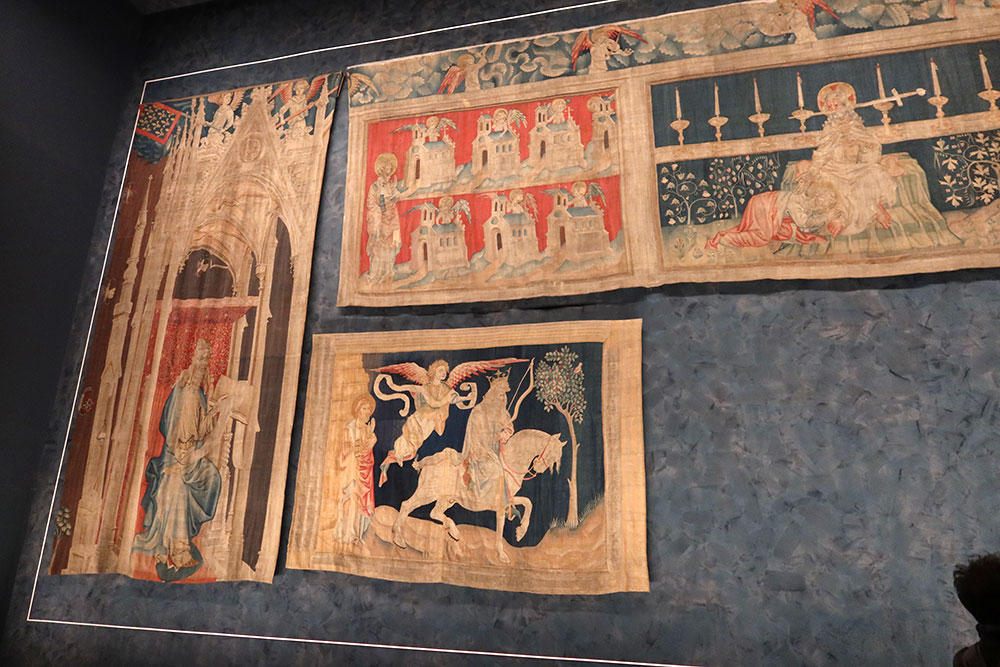
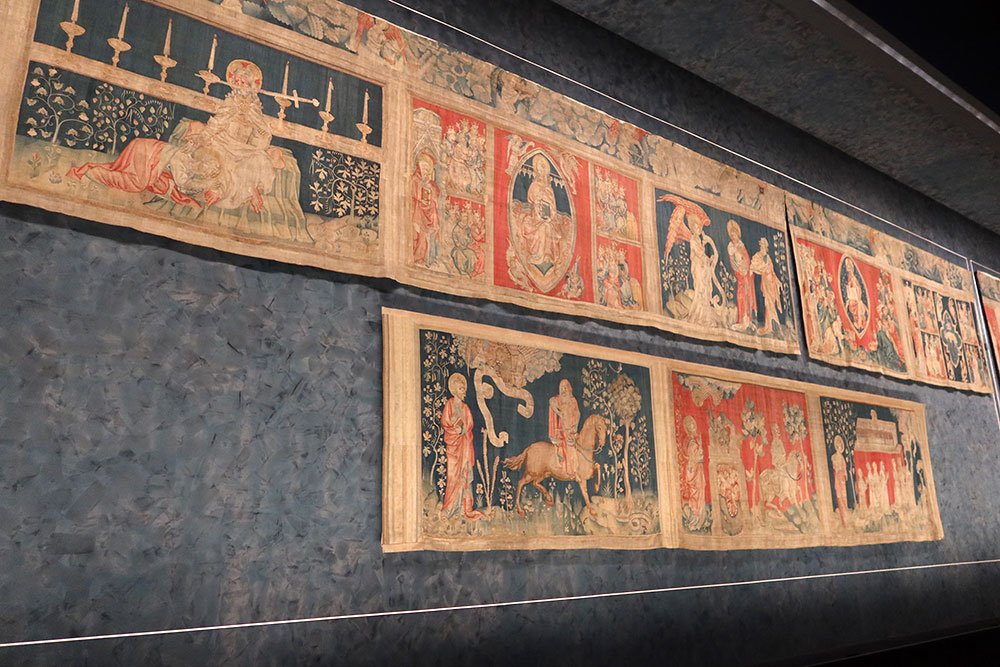
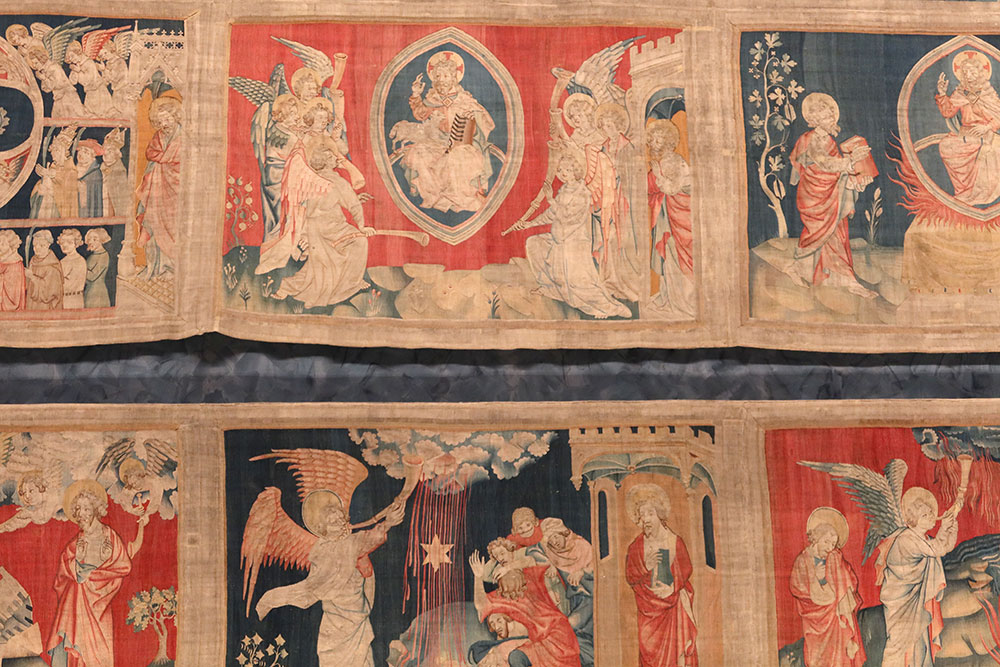
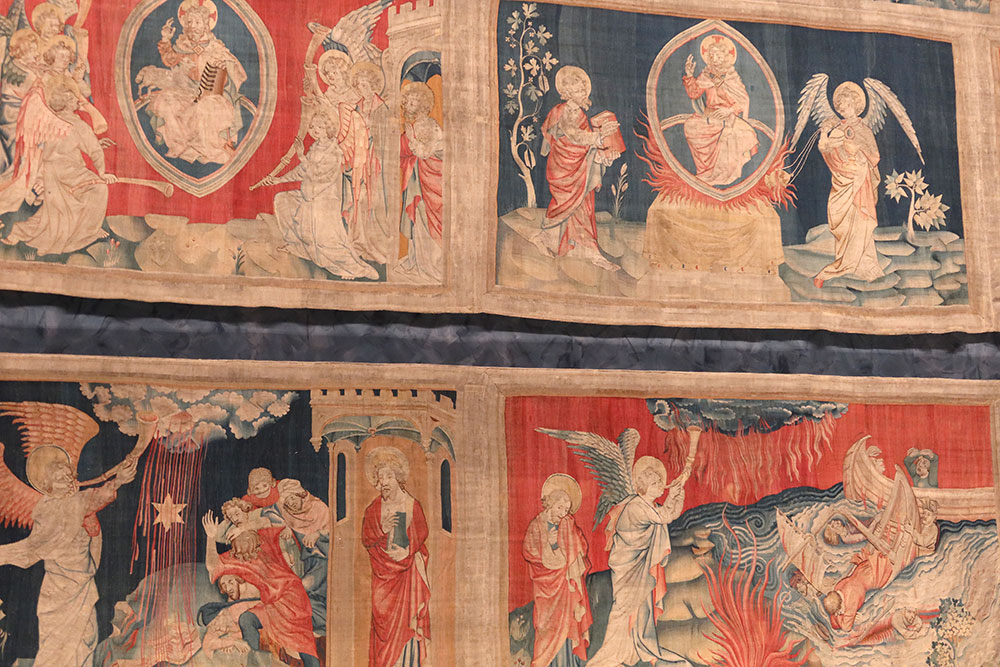
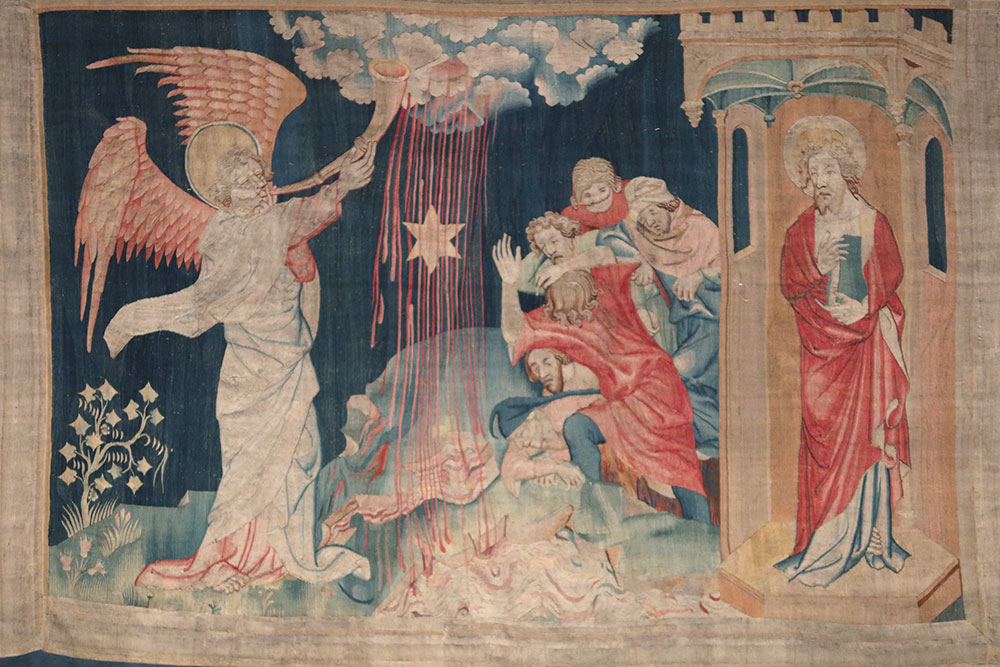
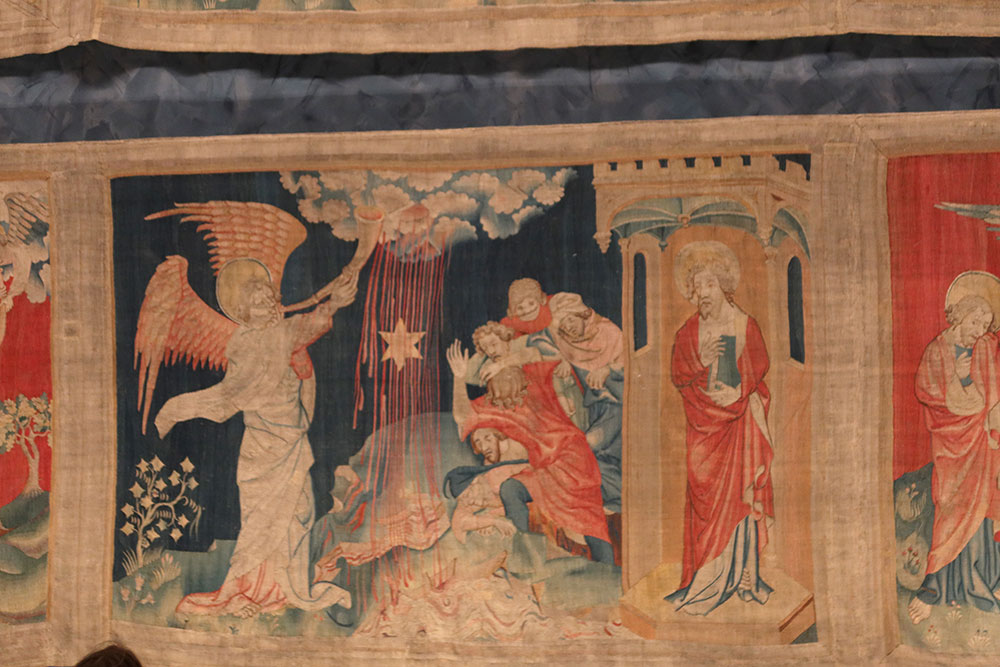
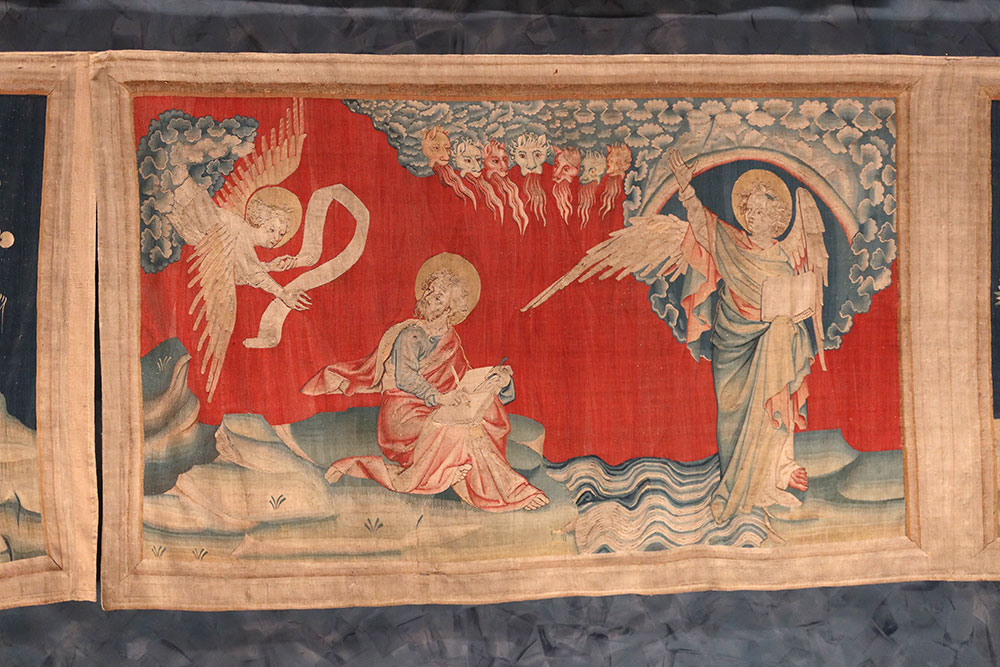
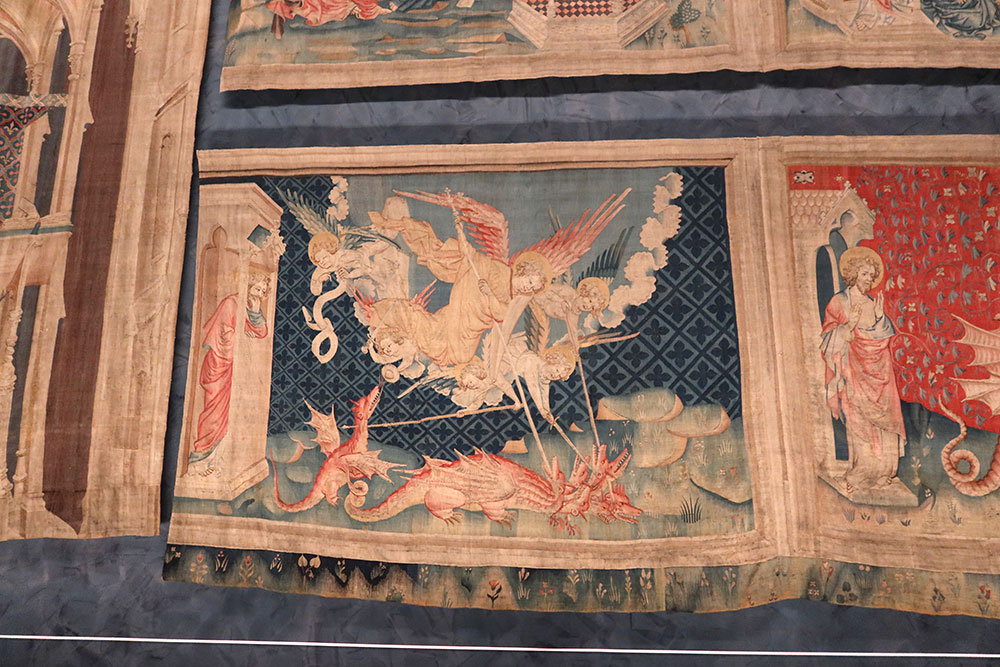
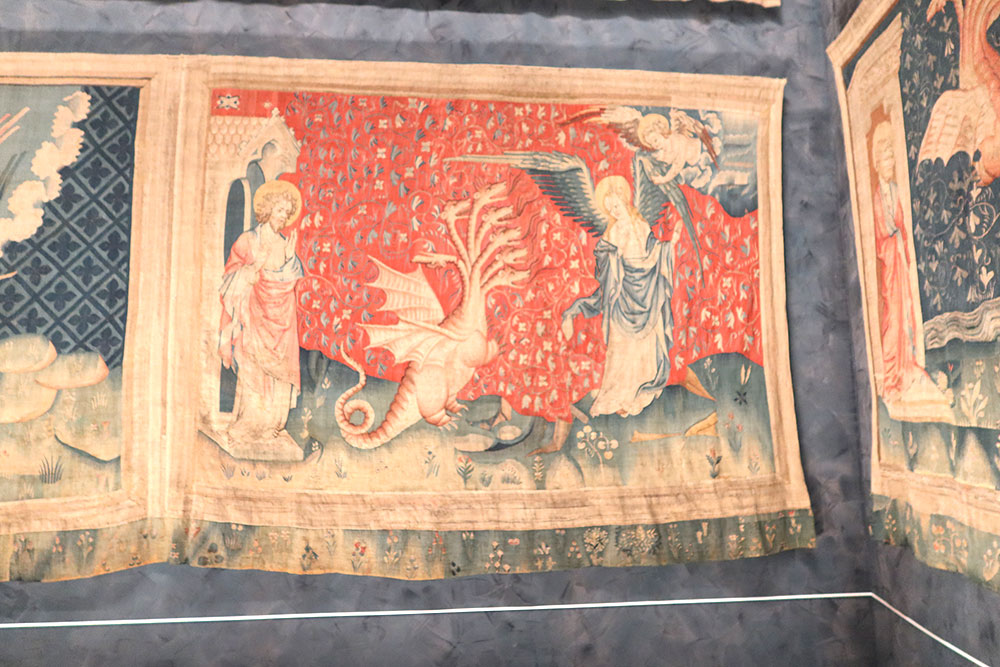
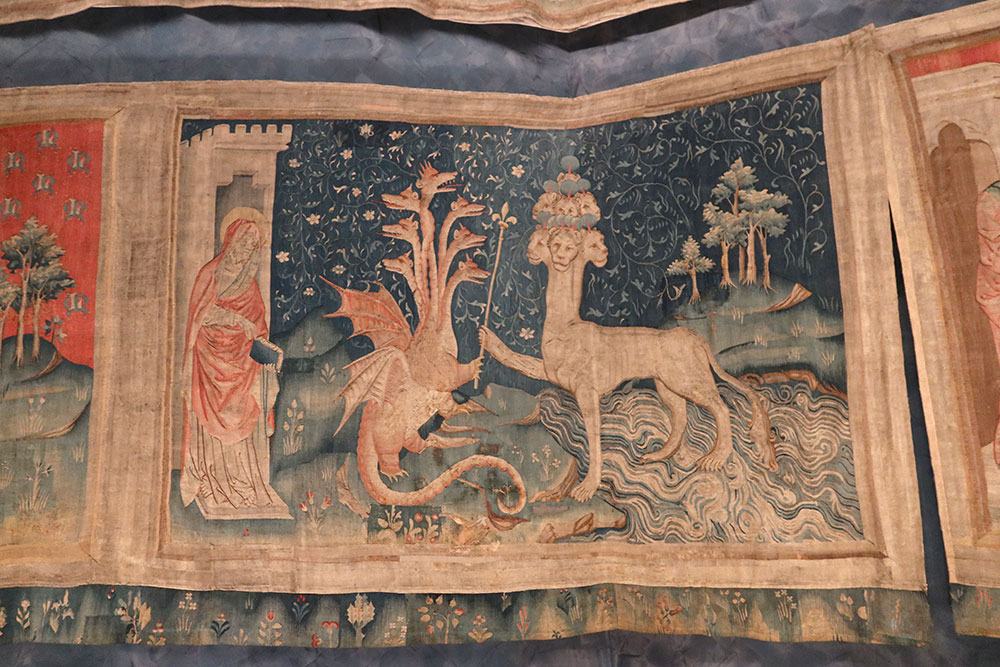
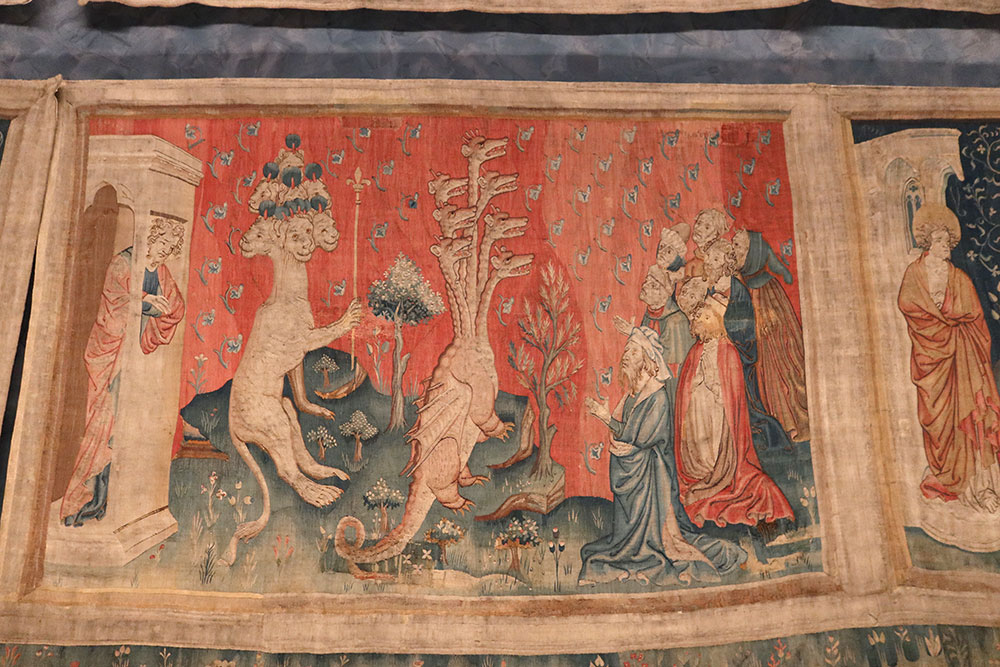
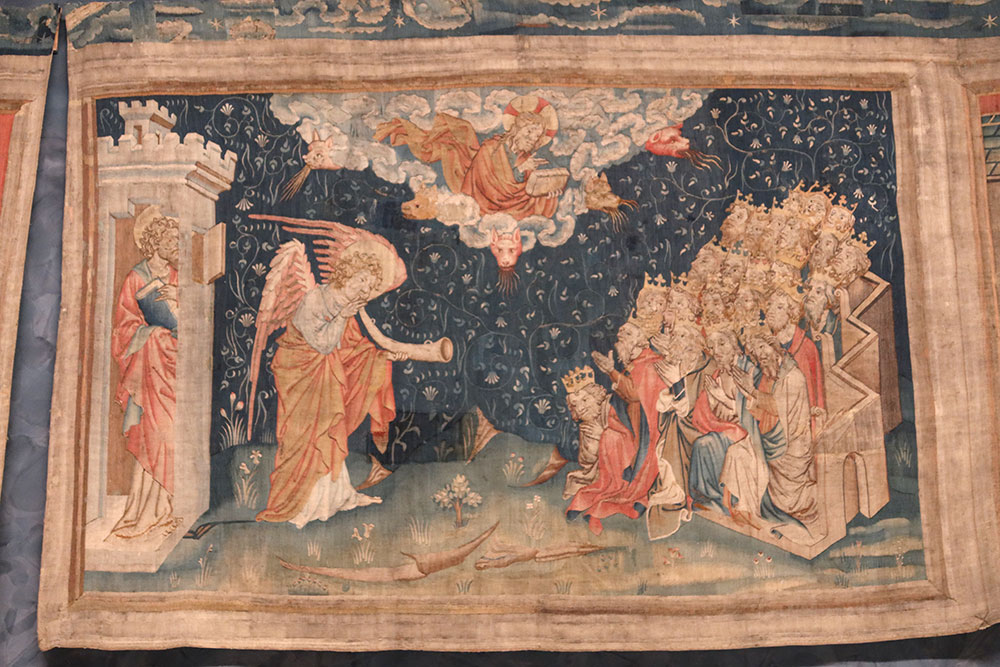
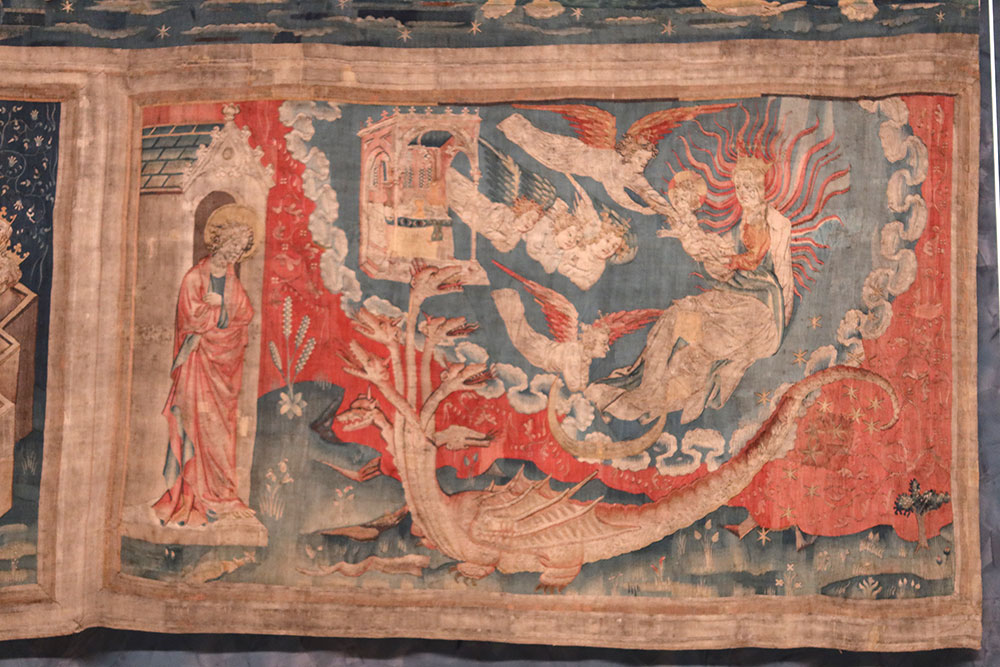
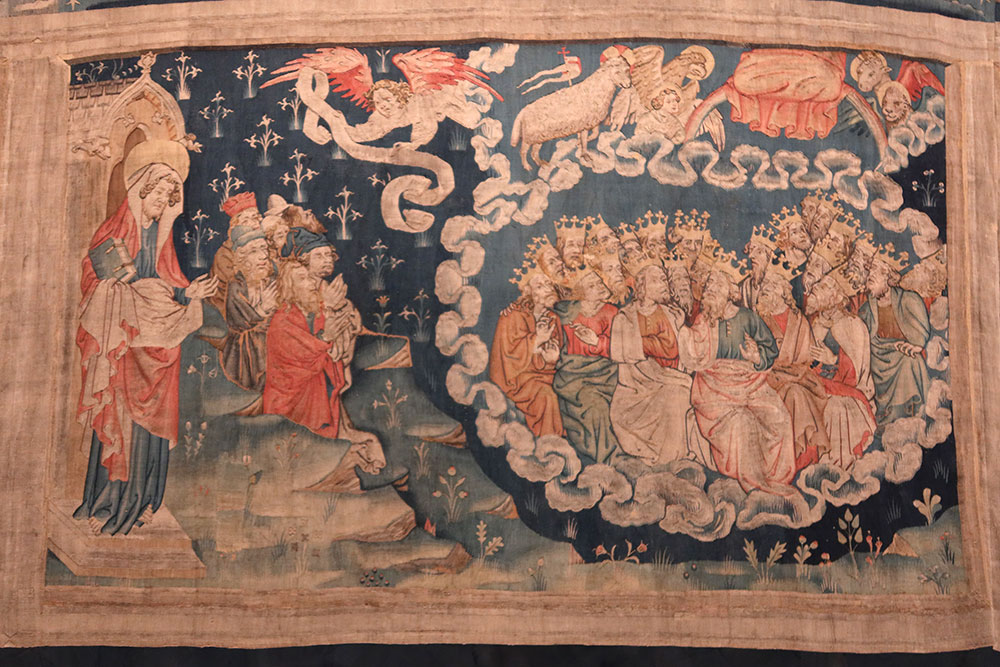
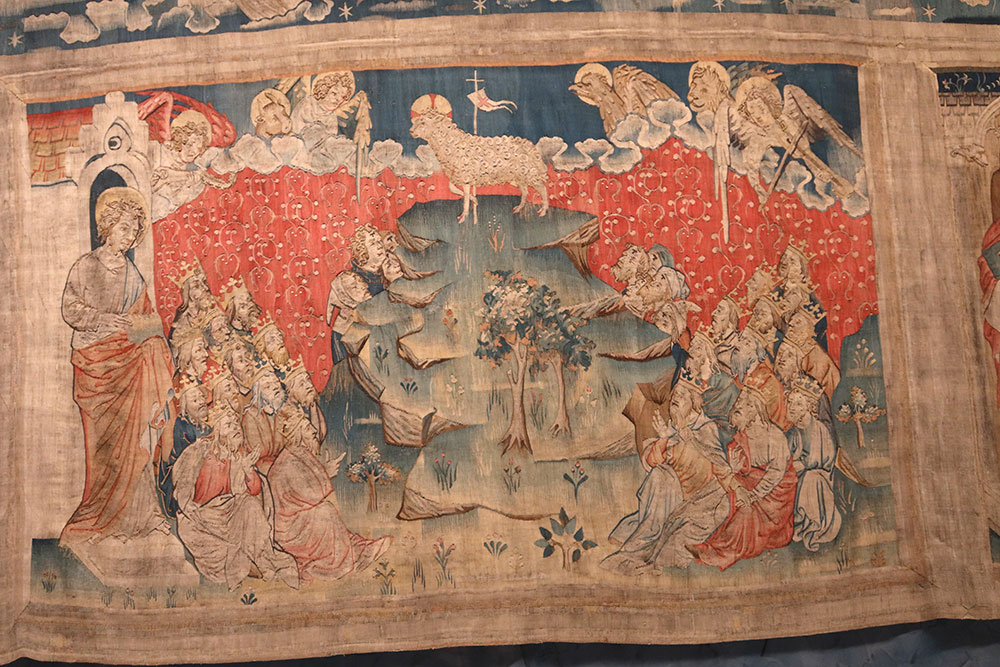
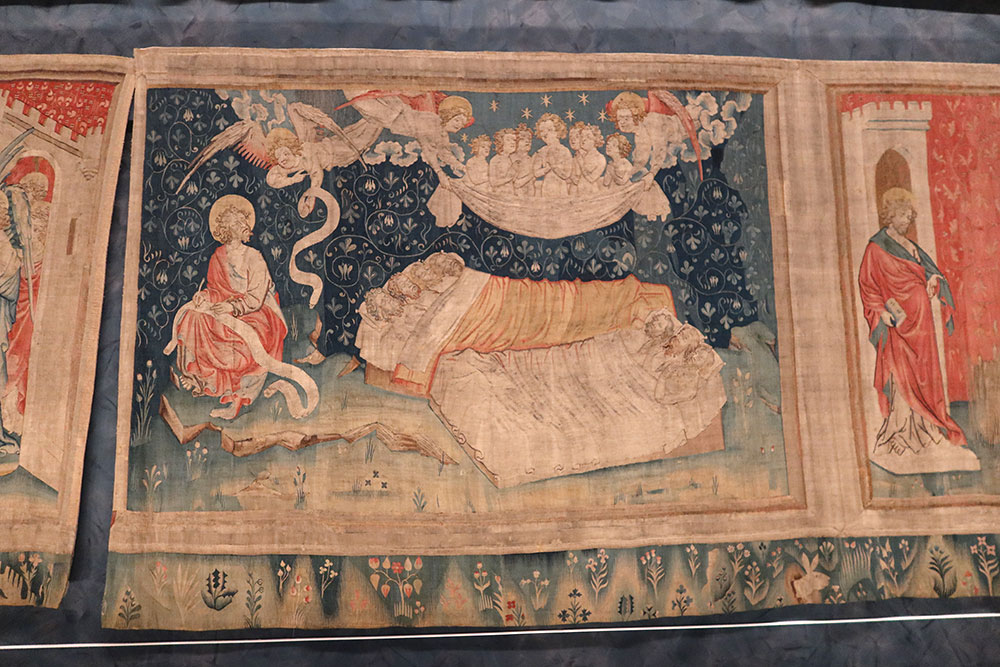
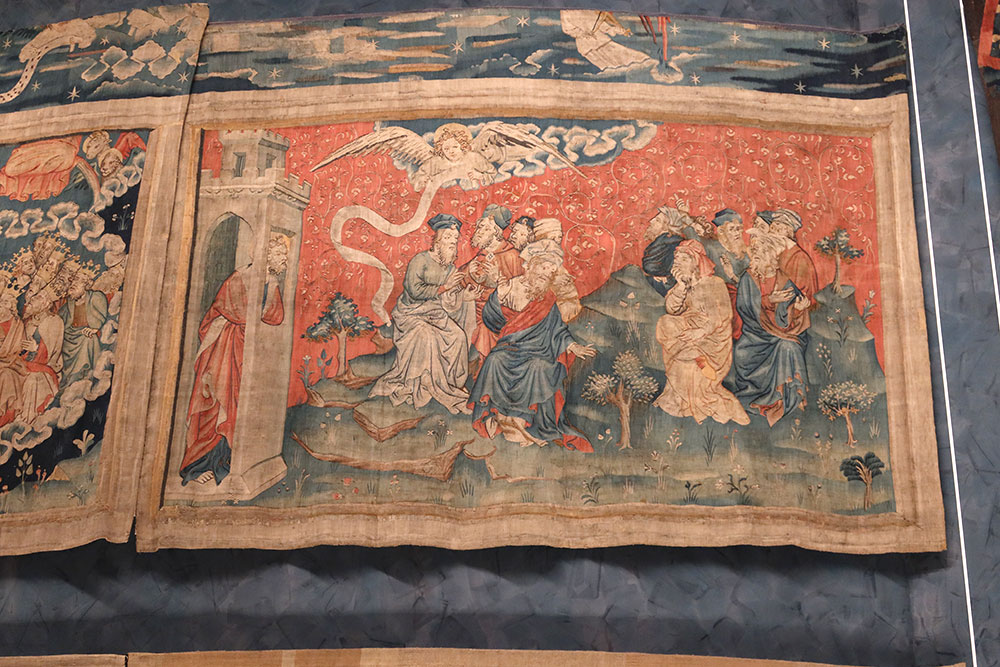
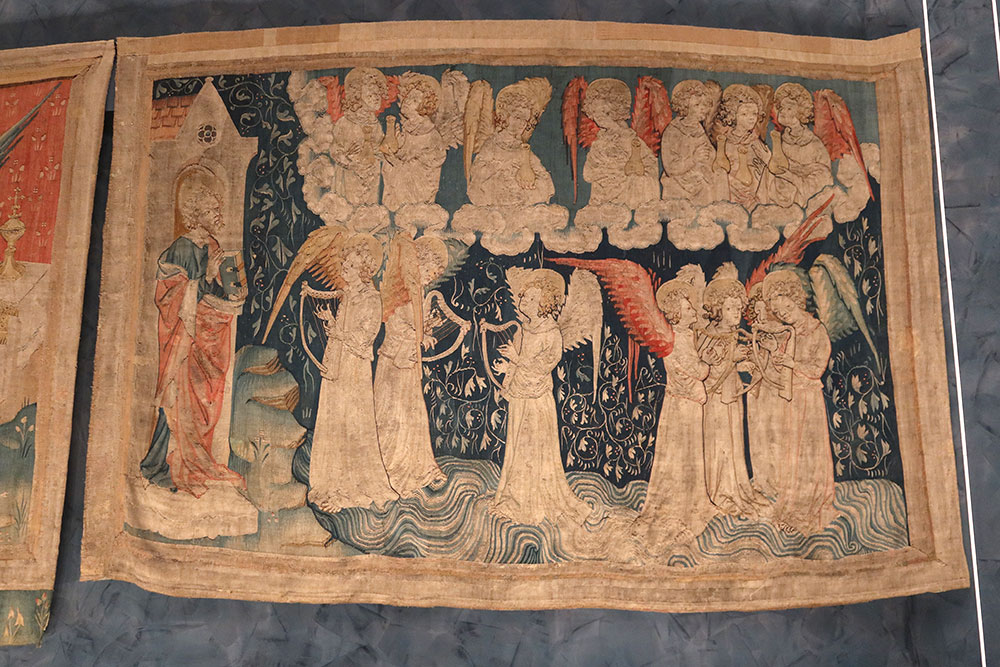
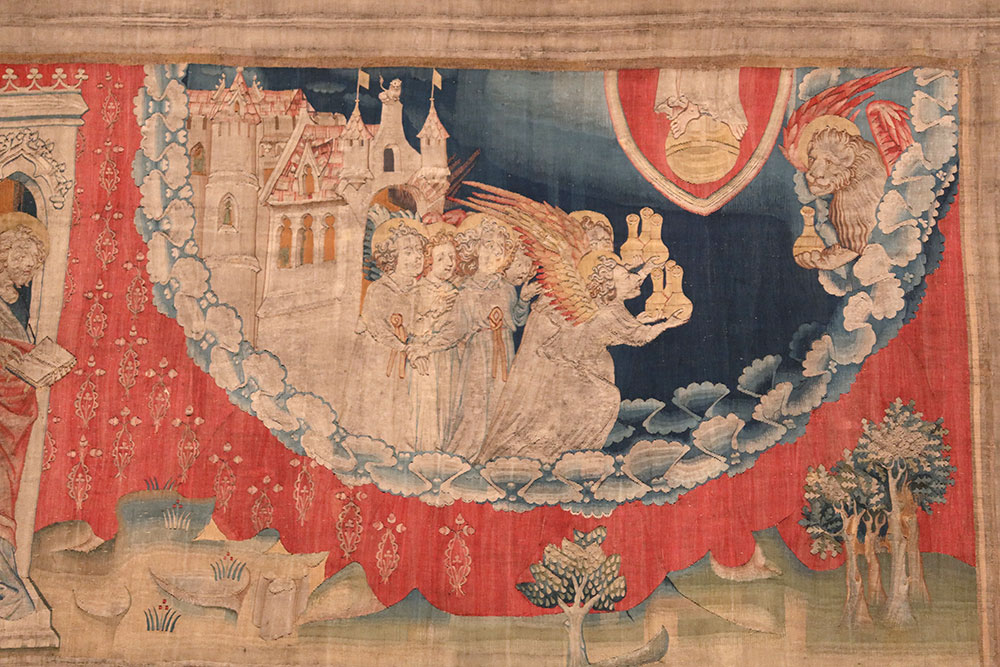
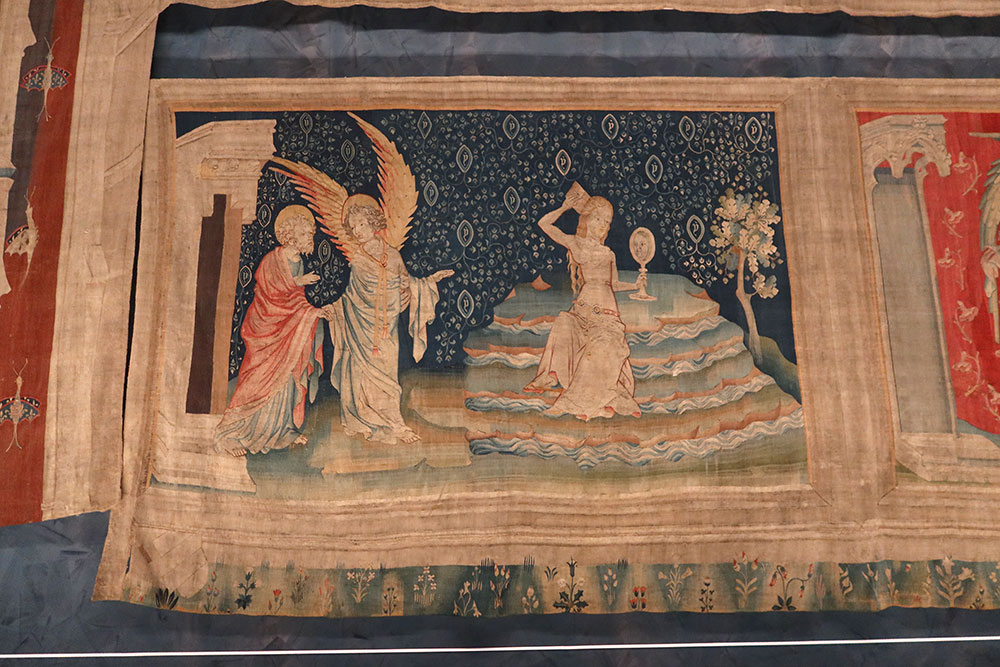
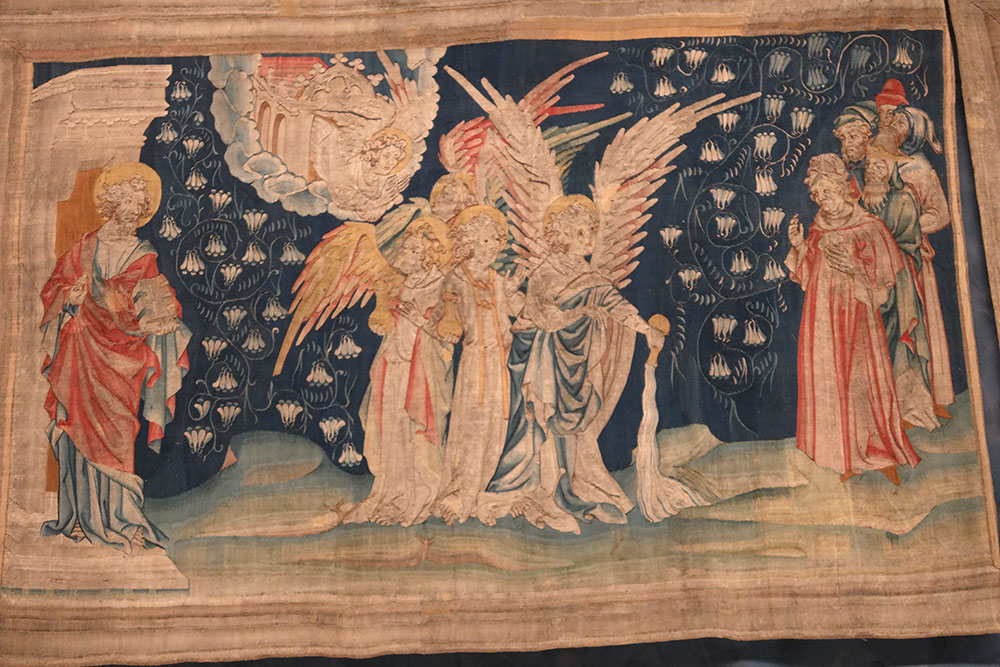
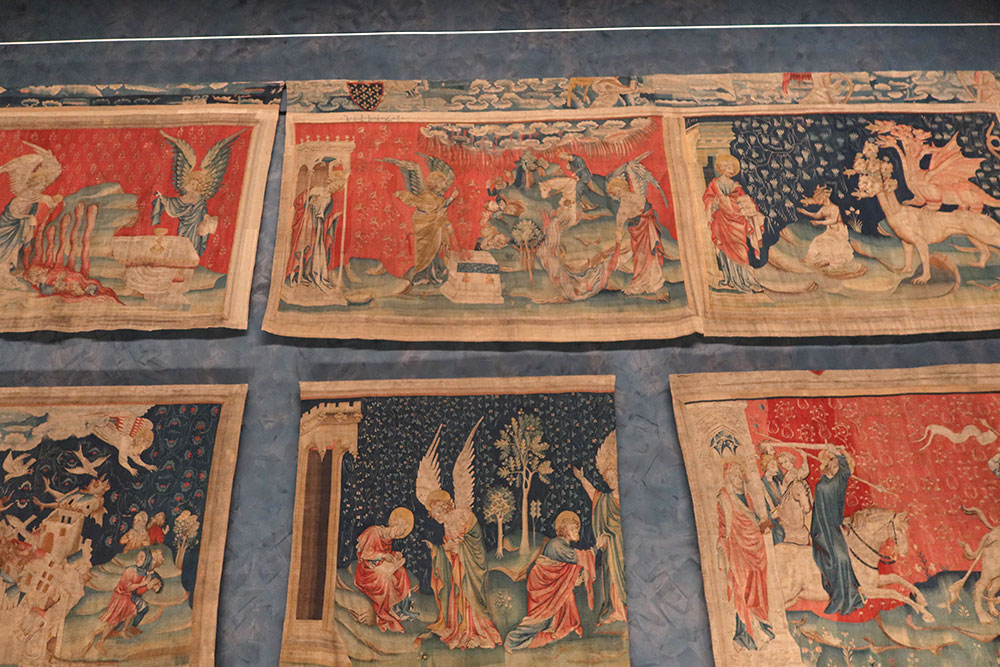
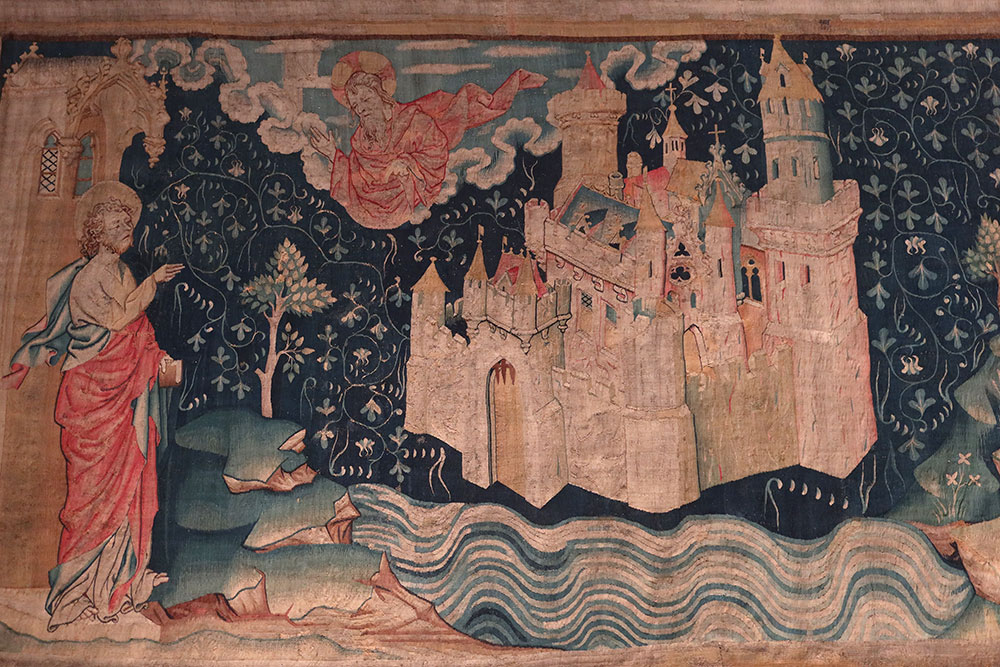
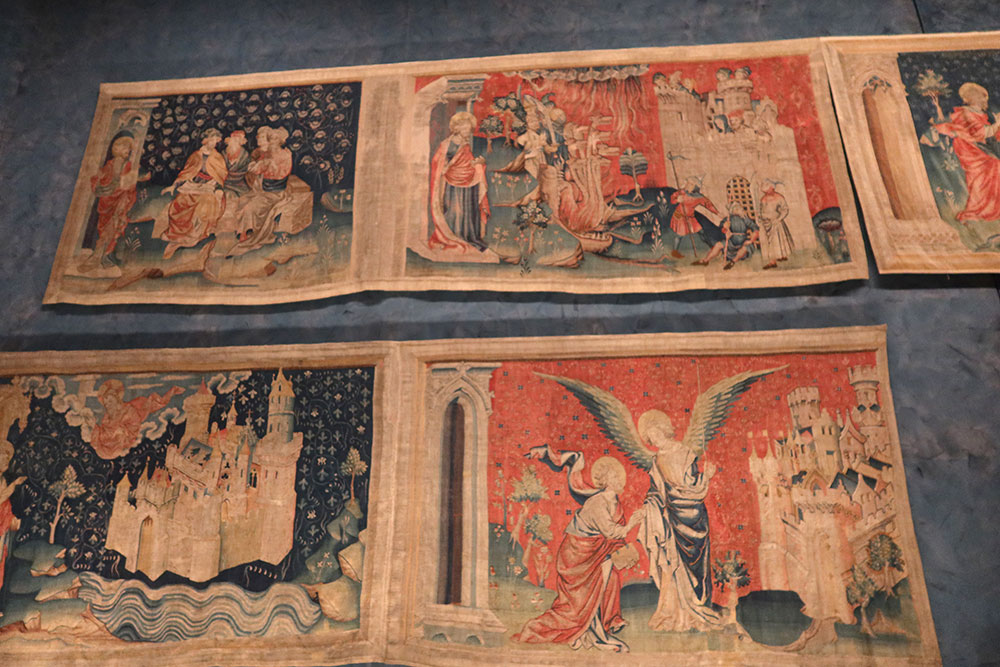
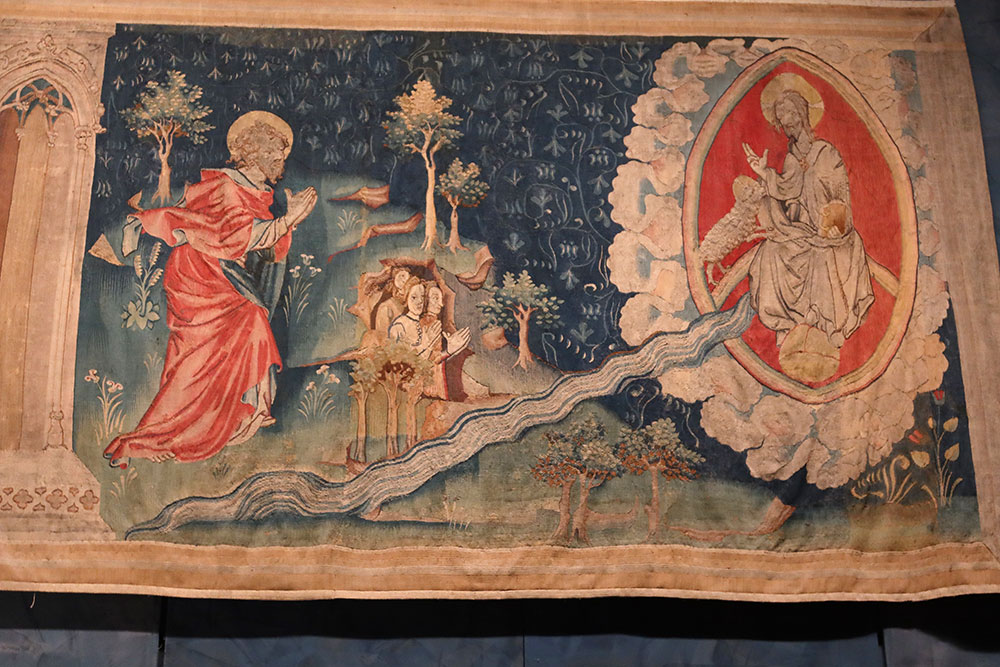
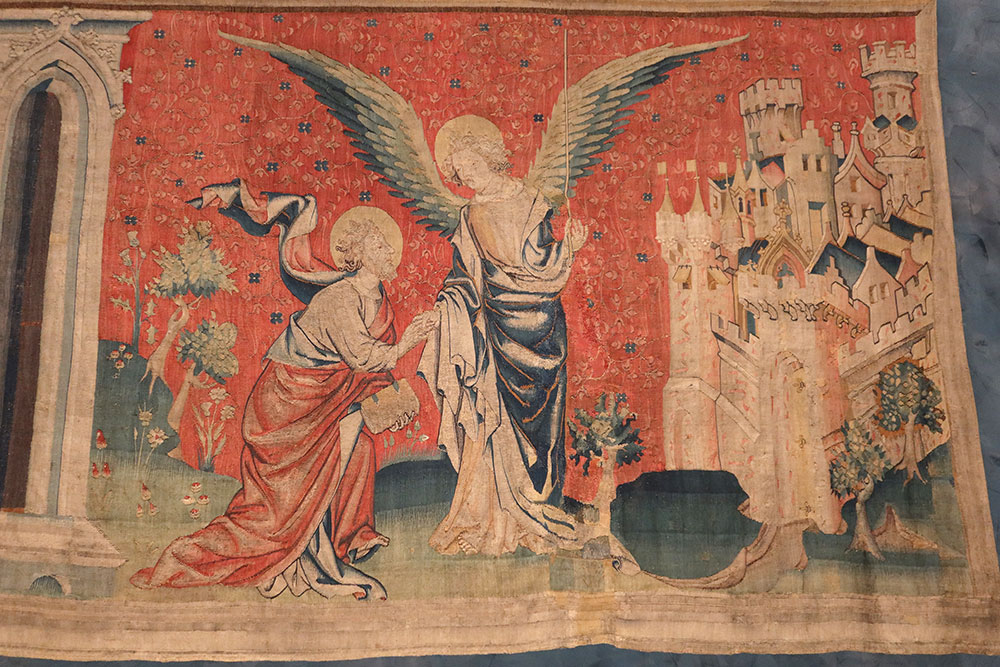
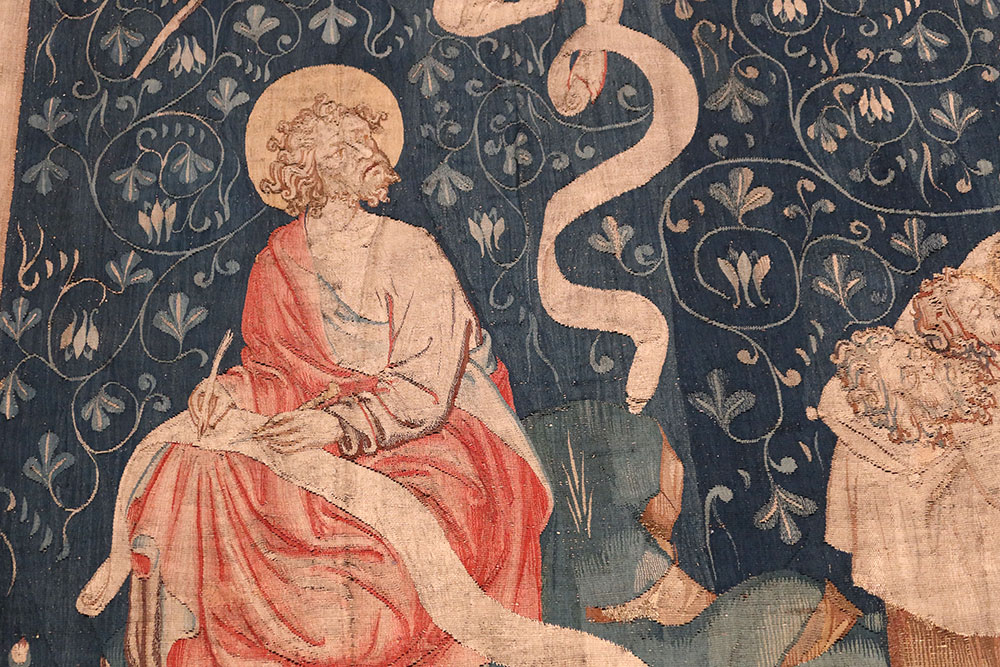
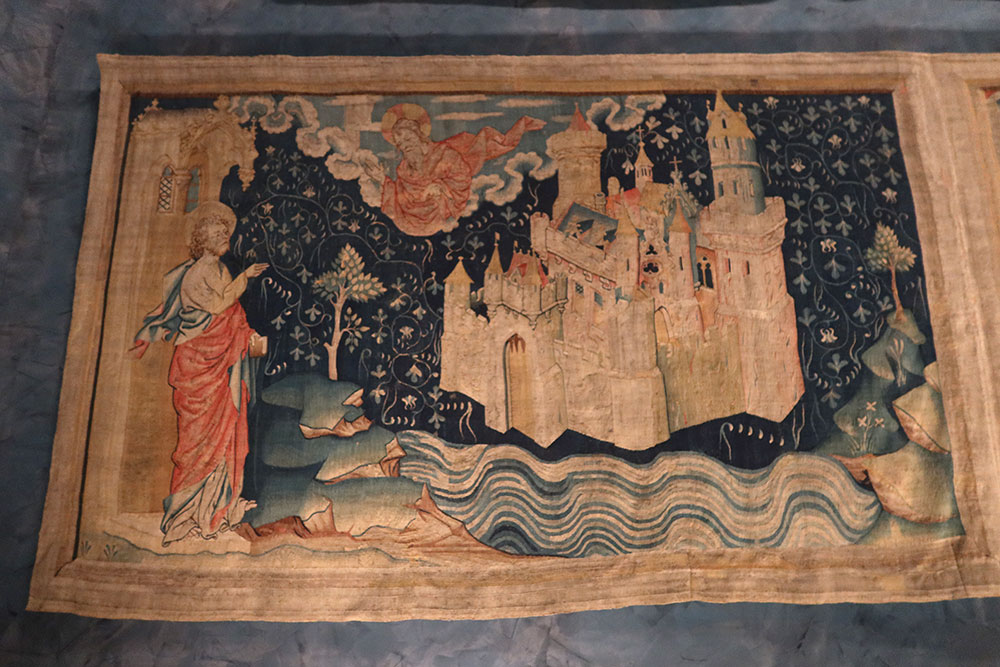
The choice of subject was unusual. Tapestry patrons of the period generally favoured secular themes drawn from romance, mythology, or history. An extended meditation on the Book of Revelation, comprising ninety individual scenes arranged across six sections each roughly twenty-four metres wide and six metres high, was without direct parallel among contemporary commissions. Each section alternated between red and blue grounds, a device that gave the ensemble a formal coherence even when displayed in parts, and each scene was anchored at its left edge by a small architectural structure sheltering the figure of Saint John, who witnesses and records the visions before him. This recurring compositional device served simultaneously as a narrative marker, a structural rhythm, and a reminder to the viewer of the act of interpretation that the tapestry itself demanded.
The Art of Jean Bondol and the Franco-Flemish Tradition
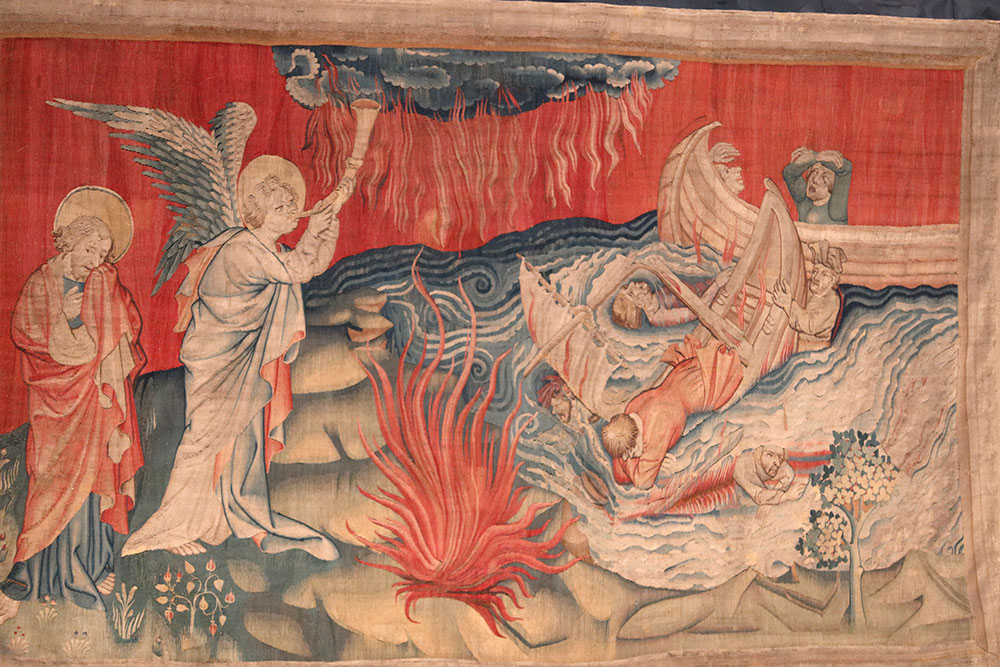
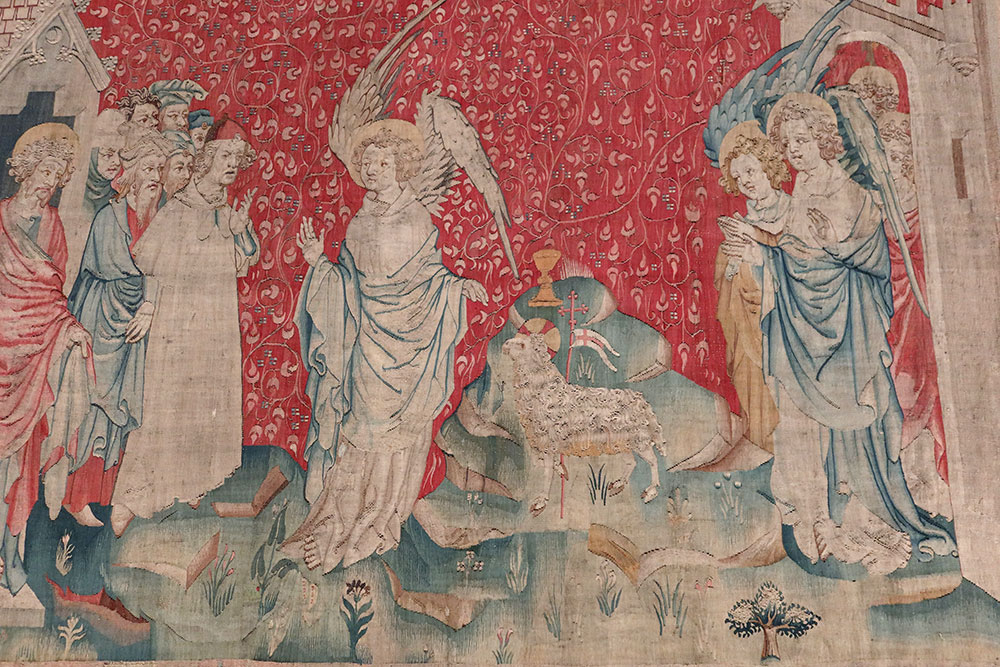
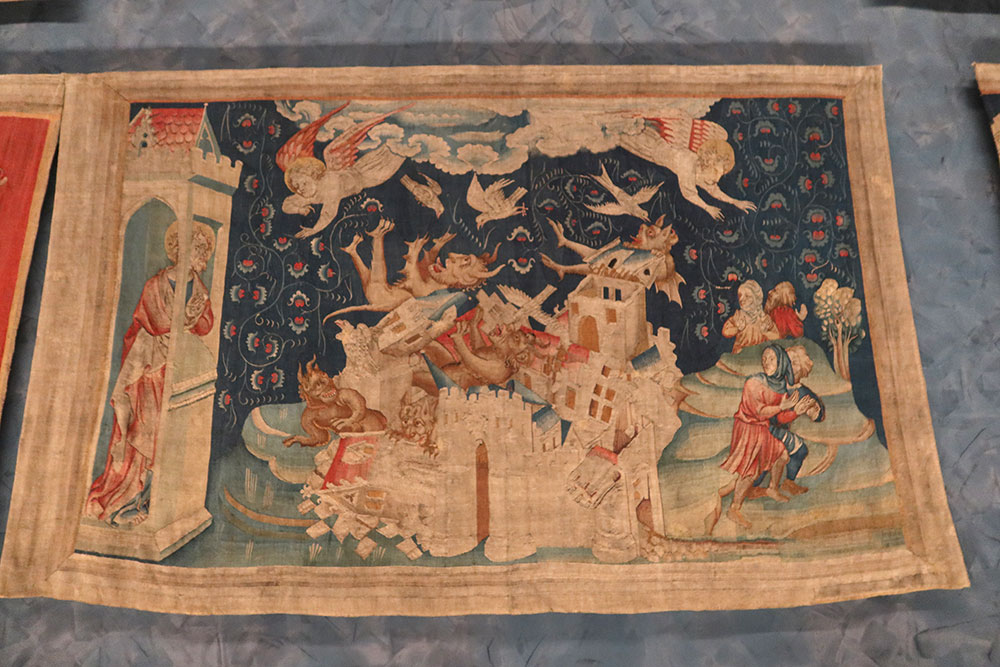
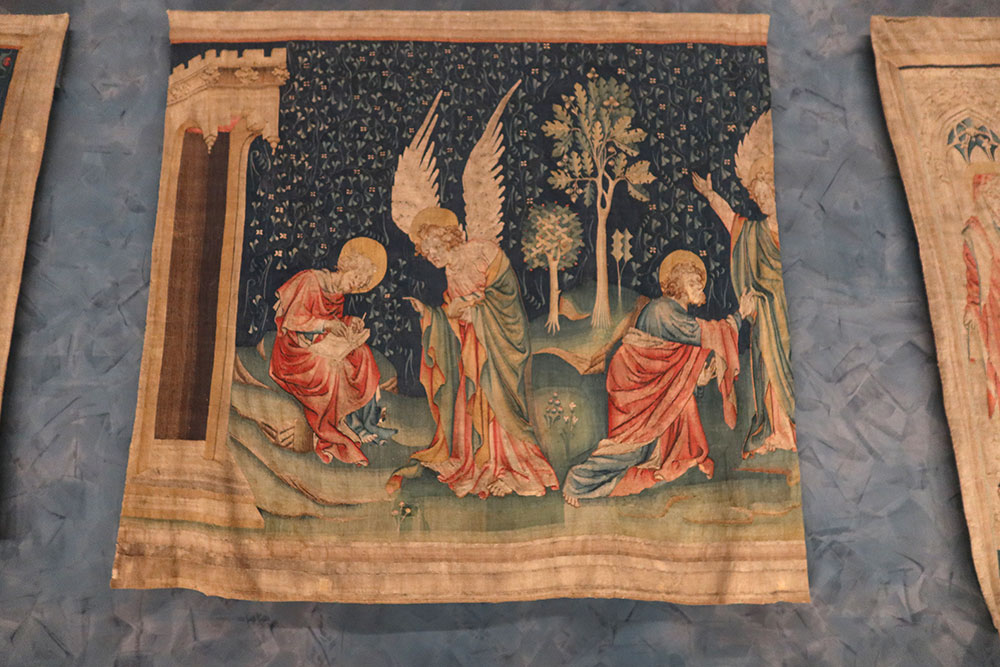
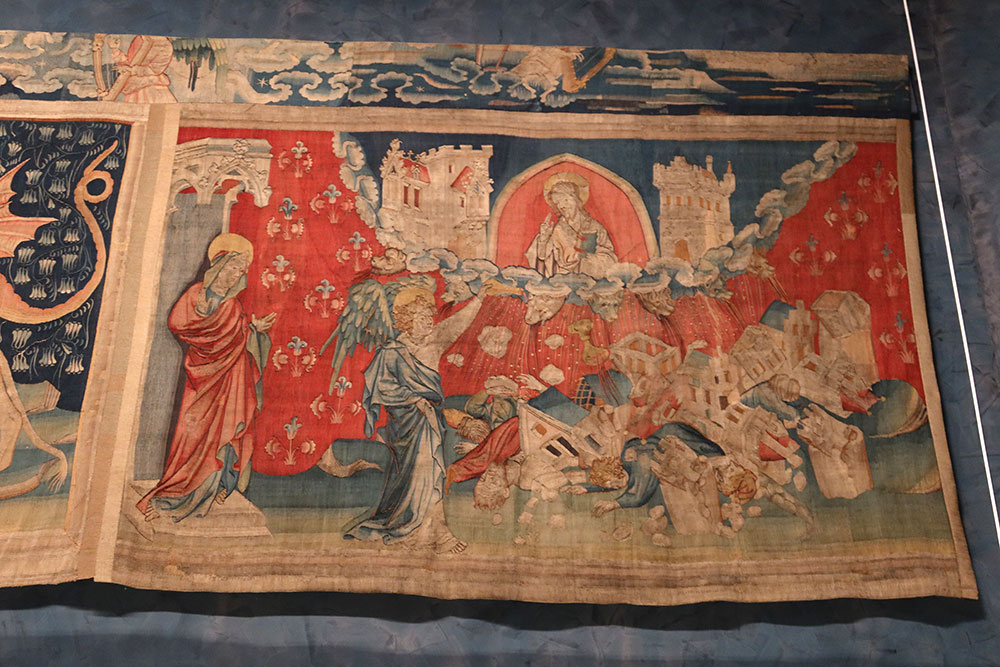
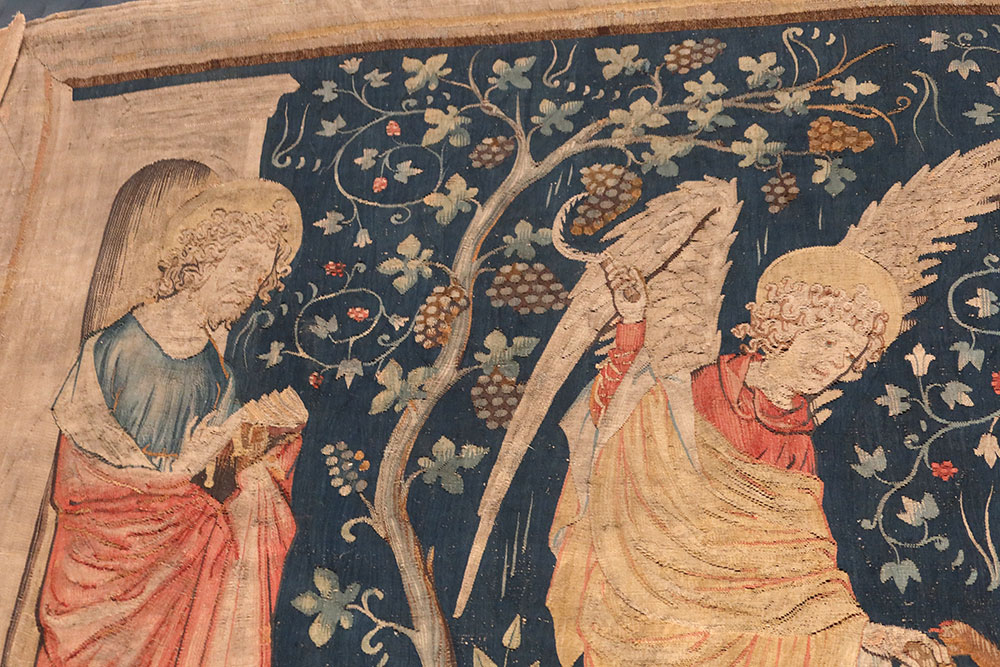
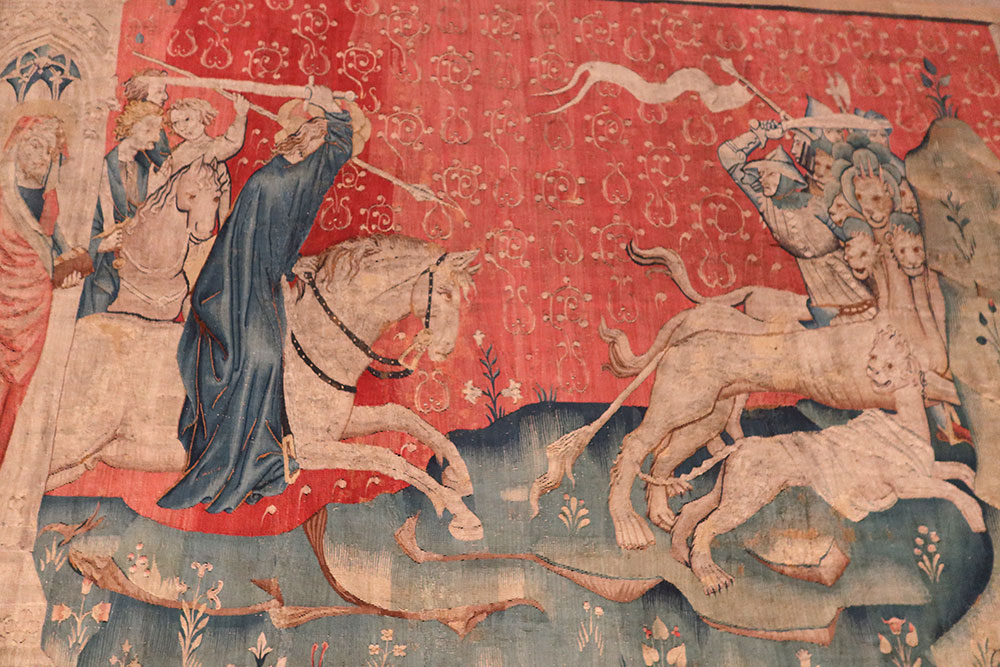
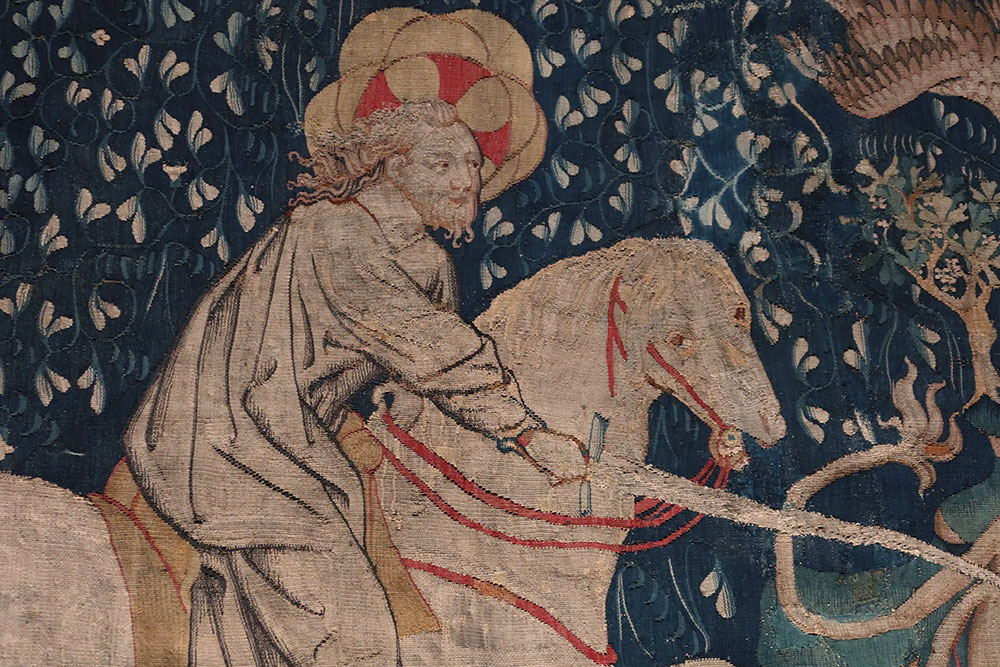
Bondol's designs belong to the Franco-Flemish school, characterised by fluid, realist figure drawing, rich surface incident, and a clarity of compositional structure capable of reading from a distance. His approach to the Apocalypse imagery was not purely traditional in its iconography: while he drew on established visual conventions for scenes such as the Woman Clothed with the Sun, the Beast from the Sea, and the Four Horsemen, his treatment introduced a degree of naturalistic particularity — in the rendering of armour, drapery, architectural detail, and the physiognomy of figures — that reflects the wider concerns of court art in the period. The result is a sustained visual programme that operates on at least two registers simultaneously: the cosmic and eschatological narrative drawn from Revelation, and the material world of fourteenth-century France rendered in wool, silk, gilt thread, and silver.
That dual register was not incidental. Louis I was pursuing a claim to the Kingdom of Sicily and Jerusalem throughout the 1370s and 1380s, and the tapestry's imagery of divine judgment, dynastic authority, and the eventual triumph of the righteous carried a political charge that would have been legible to his contemporaries. His own monogram appears woven into the background of several scenes. The tapestry was almost certainly intended for display at outdoor public occasions — weddings, diplomatic assemblies, festivals — where its six sections could be arranged around the viewer in a disposition that contemporary accounts suggest may have evoked the spatial organisation of a jousting field. Seen in that context, the scale of the work was itself a political statement, a demonstration of resources and ambition that no painting or manuscript could have matched.
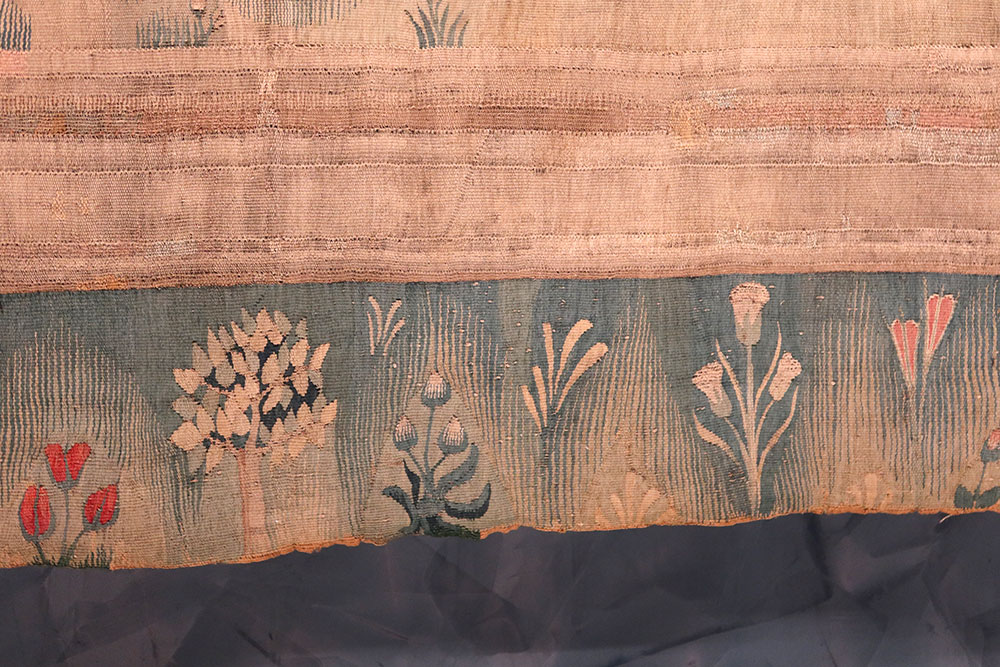
The chromatic programme of the tapestry, now considerably faded on its exposed face, was originally composed of deep blues, reds, and ivory, supported by orange and green, with gilt and silver woven into the wool and silk ground. The backs of the surviving panels retain much of this original intensity and give a clear indication of how the work would have appeared to its first audiences. The visual effect — warm metallic threads catching whatever light was available, figures moving at near-life-size across alternating grounds of saturated colour — would have been substantially different from the more muted impression the tapestry makes today, an important consideration for institutions approaching it either for study or for exhibition context.
From Anjou Cathedral to the Brink of Destruction
After a century in the ownership of the Anjou dukes, René of Anjou bequeathed the tapestry to Angers Cathedral in 1480. There it was displayed on ceremonial occasions, stored in conditions that offered partial protection, and gradually came to be regarded as a possession of the institution rather than an object of active artistic attention. It was almost certainly shown in full at the marriage of Louis II of Anjou and Yolande d'Aragon in Arles in 1400, one of the few recorded occasions on which the entire work was exhibited at a single event.
The French Revolution brought the tapestry to the edge of permanent loss. Dispersed and cut into sections, the panels were put to uses that would be difficult to contemplate in any present-day institutional context: as floor mats, as insulating covers for orange trees, as material for blocking gaps in buildings, and as lining for horse stables. A significant number of scenes were destroyed outright, either through deliberate disposal or through the melting down of gold and silver thread. The nineteen scenes lost from the original ninety are a direct consequence of this period. Most of what survived was recovered and subjected to a restoration campaign in the mid-nineteenth century, principally through the efforts of Canon Joubert, and returned first to the cathedral before being transferred in 1954 to a purpose-built gallery within the Château d'Angers, where it remains on permanent display.
Display, Conservation, and the Question of Presentation
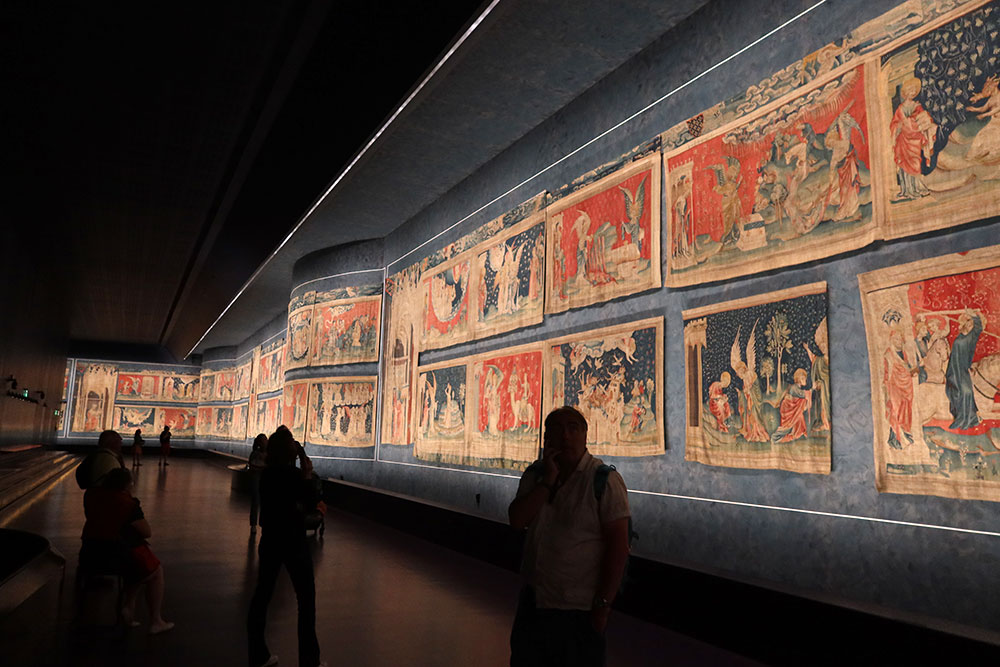
The gallery at the Château d'Angers was designed by the French architect Bernard Vitry and has been modified over subsequent decades to address the conservation requirements of a textile of this fragility and scale. The current installation maintains the environment at approximately 19°C year-round, with controlled lighting levels intended to retard further fading of the wool fibres. Visitors move through a semi-darkened space along the full extent of the surviving panels, a presentation that gives some sense of the tapestry's spatial ambition while necessarily departing from the conditions under which it was originally experienced.
A comprehensive restoration and condition survey was initiated in 2016 by the French Ministry of Culture, involving detailed examination of the tapestry centimetre by centimetre using scaffold access, vacuuming of accumulated surface dust, and full documentation of the reverse. Four panels were temporarily removed for in-depth treatment while the remainder remained on view. The project produced a detailed condition report and contributed to the revision of display protocols ahead of the tapestry's inscription on UNESCO's Memory of the World Register in May 2023, a recognition that places it alongside the Declaration of the Rights of Man and the Bayeux Tapestry as a document of heritage significance to humanity as a whole.
For professionals working in collection care, the Angers tapestry presents instructive parallels and contrasts with the challenges facing textile holdings more broadly. Its reversible low-warp weave technique, in which the design reads identically from both faces, means that the reverse offers an almost complete record of the original colour palette, a circumstance that has significantly assisted both scholarly study and restoration decision-making. The combination of wool and silk with metallic thread introduces the differential degradation rates familiar from other mixed-fibre medieval textiles, with the metallic elements having caused localised damage to adjacent organic fibres over centuries of contact.
Influence and Legacy
The tapestry's influence on later textile art has been periodically direct and periodically diffuse. When the artist Jean Lurçat visited Angers in 1938 and encountered the Apocalypse Tapestry, it prompted him to undertake his own large-scale tapestry cycle, Le Chant du Monde, conceived as a modern counterpart addressing the threat of nuclear destruction. That work is now displayed at the Musée Jean Lurçat et de la Tapisserie Contemporaine in Angers, housed in a twelfth-century hospital a short distance from the château, and the two cycles together make Angers an unusual site of sustained engagement with the monumental tapestry tradition across six centuries.
The Apocalypse Tapestry also holds a particular importance as evidence for a moment in art-historical time that is otherwise thinly documented. It is, as art historians have noted, essentially the only clear survival from the first generation of the large-scale tapestry industry's development, a period when the workshops of Paris represented the most technologically advanced and commercially significant centre of production in Europe, and when the medium was, by any reasonable assessment, the most socially and politically consequential art form available to a royal patron. Paintings, however prestigious, could not command a space in the way that a 140-metre tapestry could. The destruction of most of the comparable commissions from the same period — through the usual processes of war, fire, dispersal, and neglect — makes the survival of the Angers tapestry, however incomplete, a matter of genuine scholarly importance.
Visiting and Research Access
The Château d'Angers is located in the city of Angers in the Maine-et-Loire department of western France, and is managed by the Centre des Monuments Nationaux. The tapestry gallery is accessible to the general public as part of the château visit, with audio guide provision, immersive digital interpretation media, and adapted resources for visitors with visual impairments. A Tapestry Pass providing combined access to the château and the Musée Jean Lurçat is available. Research access and institutional enquiries may be directed through the château's website at www.chateau-angers.fr, which also provides current visitor information, ticketing, and details of the interpretive programme. Scholars requiring access to the conservation documentation produced in connection with the 2016–2020 restoration project should approach the Centre des Monuments Nationaux through the same contact points.
For art institution professionals and curators considering the Apocalypse Tapestry as a case study in medieval textile presentation, long-term conservation practice, or the intersection of patronage and political iconography, the Angers installation offers a model that has been refined over seventy years of public display. Its inclusion in the UNESCO Memory of the World Register brings formal international recognition to what has long been understood within specialist circles: that this is among the most consequential surviving objects of the medieval European world, and one whose study continues to reward sustained attention.
The Apocalypse Tapestry is housed at the Château d'Angers, Place Kennedy, Angers, France. Further information: www.chateau-angers.fr