
Fondazione Prada’s Richard Prince and Arthur Jafa show
The 61st International Art Exhibition of La Biennale di Venezia, In Minor Keys, runs from 9 May to 22 November 2026, with its central presentation spread across the Giardini and the Arsenale. Yet for visitors navigating the city with limited time, the exhibitions dispersed across Venice's palazzi, museums, foundations, and churches constitute an itinerary of considerable depth, one that operates independently of the national pavilions and stands on its own terms.
Thirty-one official Collateral Events, admitted by the curators and promoted by non-profit national and international institutions, are distributed across several locations in Venice. Beyond those, a further constellation of exhibitions at civic museums, private foundations, and independent spaces extends the programme substantially.
At the Civic Institutions
Ca' Pesaro — Venice's International Gallery of Modern Art — anchors the city-wide programme with a major presentation of Jenny Saville. Running from 28 March to 22 November 2026 and curated by Elisabetta Barisoni with the support of Gagosian, the exhibition brings together around thirty paintings tracing Saville's career from the early 1990s to the present. Early monumental canvases such as Propped (1992) and Hybrid (1997) open the show, while the final room debuts a new series of paintings inspired by Venice and the works of Titian. At Ca' Pesaro, Saville's monumental canvases enter dialogue with the great Venetian artists of the past, creating an encounter between contemporary painting and the city's artistic heritage. It is her first major exhibition in Venice.
At the Gallerie dell'Accademia, Marina Abramović presents Transforming Energy, coinciding with the artist's eightieth birthday. The exhibition seeks to establish a dialogue between her performance art and the Renaissance masterpieces that have shaped the cultural identity of Venice.
The Private Foundations
The Pinault Collection operates across its two Venetian institutions, Palazzo Grassi and Punta della Dogana. Palazzo Grassi presents a major exhibition dedicated to Michael Armitage, curated by Jean-Marie Gallais in collaboration with Hans-Ulrich Obrist, Caroline Bourgeois and Michelle Mlati, bringing together more than 150 works including historical pieces and new productions. The show runs from 29 March 2026 to 10 January 2027. Armitage's language — poised between figuration and dreamlike imagery, drawing on Kenyan history and mythology — makes for a sustained encounter across the palazzo's generous rooms.
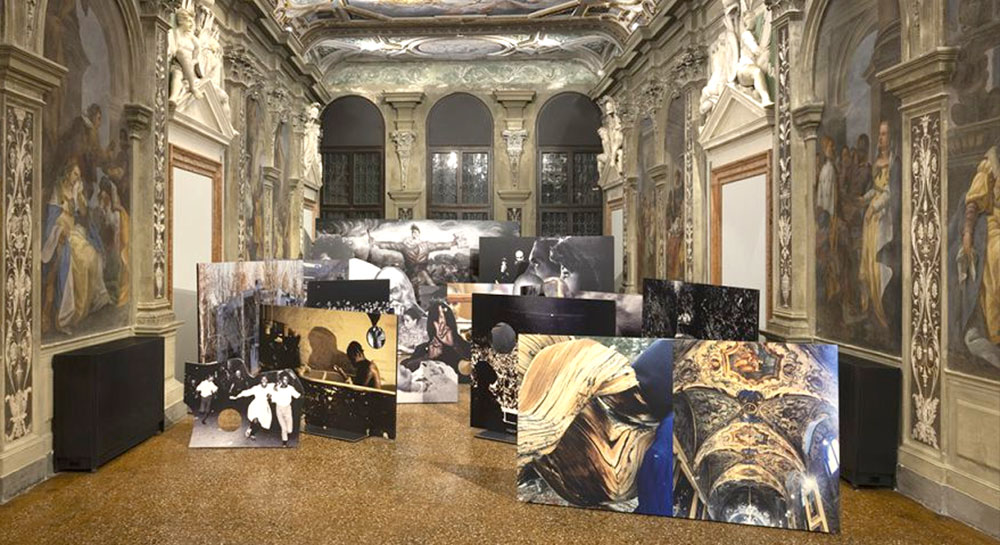
Fondazione Prada's Venetian space presents Helter Skelter: Arthur Jafa and Richard Prince, curated by Nancy Spector. The exhibition brings into dialogue two of the most influential figures in contemporary art, exploring their radical approach to appropriation and the manipulation of images drawn from American popular culture, including film, pulp fiction, comics, music, media and social networks. The show runs from 9 May to 23 November 2026.
At Palazzo Manfrin in Cannaregio, Anish Kapoor's Foundation opens its restored 16th-century palazzo to the public for only the second time. The exhibition brings together around 100 architectural models documenting projects both realised and unrealised from the past 50 years of Kapoor's work, alongside a series of large-scale installations and stainless-steel works. The restoration project, designed by UNA/UNLESS (Giulia Foscari), involved structural interventions and system upgrades, and the upper floors have been developed in collaboration with Ca' Foscari University Venice as an educational outpost. Two large installations will remain at the foundation permanently following the show's close on 8 August 2026. Among them, Descent into Limbo (1992) — a work that plays with optical illusion, creating what appears to be a painted circle on the floor but is in fact a chamber approximately two and a half metres deep — becomes a permanent feature of the building.
An entirely new institutional presence in Venice comes with the inauguration of the Fondazione Dries Van Noten. Housed within the historic Palazzo Pisani Moretta overlooking the Grand Canal, the foundation's inaugural presentation, The Only True Protest Is Beauty, celebrates craft as a vital language of cultural identity, bringing together established and emerging voices. The palazzo opened to the public for the first time on 25 April 2026. It is the kind of institutional debut that warrants attention: a private foundation entering Venice with a clear programmatic identity, staking craft and material culture as its ground.
At Fondazione Querini Stampalia, Thomas De Falco presents Fragile Forces W, a large-scale textile installation accompanied by live performances. Structured around the symbolic use of gold, the project brings together body, space and material through the artist's wrapping technique, in which performers and environment are enveloped to form living compositions between tableau vivant and textile sculpture. The programme runs from 18 May to 14 June 2026.
On the island of San Giorgio Maggiore, Fondazione Giorgio Cini presents Georg Baselitz. Eroi d'Oro. The exhibition presents Baselitz's most recent series of monumental paintings, figures — often self-portraits or depictions of the artist's wife Elke — laid against flat gold backgrounds evoking medieval icons and Northern Renaissance painting. Executed with diluted black paint reminiscent of ink, the bodies appear as spectral presences suspended between painting and calligraphy. Curated by Luca Massimo Barbero in partnership with Thaddaeus Ropac Gallery, the exhibition runs from 6 May to 27 September 2026. It carries additional resonance as among the last major presentations of Baselitz's work following his death.
Official Collateral Events Across the City
Among the 31 official Collateral Events admitted by the curator, several merit particular attention from institutional visitors.
Indian artist Nalini Malani, commissioned by the Kiran Nadar Museum of Art (KNMA), transforms the Magazzini del Sale into an immersive installation. Titled Of Woman Born and curated by Roobina Karode, the work brings together 67 animations drawn from over 30,000 iPad sketches, projected across a nine-channel installation. Inspired in part by the Greek myth of Orestes, Malani reimagines cycles of violence and justice through a feminist lens, connecting ancient narratives to present-day conflicts. The exhibition runs from 9 May to 22 November 2026 at Magazzini del Sale, Dorsoduro.
At the Palazzo delle Prigioni in Castello, the Taipei Fine Arts Museum presents Screen Melancholy: Li Yi-Fan, a Collateral Event that runs for the full duration of the Biennale. The exhibition responds to today's overload of information and images, examining how individuals can participate in, understand, and construct the world they inhabit, with particular attention to complex interactions between humanity and technology. It is curated by Raphael Fonseca.
The Starak Family Foundation stages the first showing of the work of Polish artist Tadeusz Kantor at the Biennale Arte since 1960. The exhibition Emballage, Cricotage and Madame Jarema, curated by Ania Muszyńska and held at the Procuratie Vecchie, Piazza San Marco, is devoted to the relationship and collaborative work of Kantor and Maria Jarema. It runs from 9 May to 22 November 2026.
At the Palazzo Nervi Scattolin in Campo Manin, the Pier Luigi Nervi Foundation presents a nocturnal programme. Works by Kandis Williams, Meriem Bennani and Orian Barki, and Tai Shani constitute an encounter between moving image, architecture, and public space on the façade of the building (1963–1972), transforming it into an urban exhibition device. The programme runs from 9 May to 7 June 2026.
The Bangkok Art Biennale Foundation brings The Spirits of Maritime Crossing 2026 to Palazzo Rocca Contarini Corfù in Dorsoduro. Curated by Apinan Poshyananda and gathering artists from Southeast Asia alongside participants from Ireland, Serbia and beyond, the exhibition explores themes of identity, displacement, diaspora, memory and spiritual resilience in a world shaped by migration and global transformation.
The Dia Art Foundation presents a Collateral Event at the San Marco Art Centre, curated by Jessica Morgan, Dia's Nathalie de Gunzburg Director. At the Istituto Santa Maria della Pietà in Castello, the Arts Council of Wales presents Sownd, featuring the work of Manon Awst and Dylan Huw, on view for the full duration of the Biennale.
Beyond the Formal Programme
Several exhibitions operate outside the official Biennale framework but are structurally inseparable from it. At Palazzo Cini, the American artist David Salle presents Painting in the Present Tense, a series of paintings developed using a custom AI model trained on his early Tapestry Paintings from 1990–91. The model produces deformed abstractions printed on canvas that Salle then hand-alters — a process that recalls the studio methods of classical artists such as Rubens. The exhibition runs from 6 May to 27 September 2026.
At Palazzo Diedo, Strange Rules — curated by Mat Dryhurst, Holly Herndon and Hans Ulrich Obrist, with Adriana Rispoli — launches the palazzo as a research space dedicated to Protocol Art, examining the invisible rules underpinning cultural production in the digital age. Through installations, videos, performances and time-based interventions, the exhibition brings together artists and researchers working with algorithms, artificial intelligence, platforms and technological infrastructures.
At Ateneo Veneto, the LAS Art Foundation and Amos Rex present a new multimedia installation by Natasha Tontey. Combining video, sound, light and sculptural elements, the work reimagines the story of Indonesian resistance fighter Len Karamoy through references to Minahasan culture, bodily transformation and contemporary surveillance technologies.
At the Scuola Grande dei Carmini — home to nine ceiling canvases by Giambattista Tiepolo — the Franco-Hungarian artist Anna Peter Breton displays monumental canvases in dialogue with those panels in The Seven Celestial Spheres, the institution's first contemporary art project. Seven diptychs take inspiration from ancient and medieval cosmologies, each focused on a specific planet and corresponding human virtue and chromatic tone.
In the Olivetti Showroom at Piazza San Marco — the Carlo Scarpa-designed space — an exhibition presents around twenty sculptures as part of the Collateral programme, making use of one of Venice's most architecturally precise interiors.
A Note on the Edition's Context
The programme distributed across Venice's streets, fondamente, and campo offers a genuinely wide and considered set of propositions. The central exhibition and national pavilions draw the headlines. The city, as it does every two years, does something quieter and perhaps more durable: it makes the whole of Venice into an argument about what art is for.
The 61st International Art Exhibition — La Biennale di Venezia, In Minor Keys — is open to the public from 9 May to 22 November 2026. Full programme information is available at labiennale.org.