
The year 2026 marks a significant moment in the development of cultural infrastructure globally. Across multiple continents, new institutions and substantially reconfigured existing ones are opening their doors, reflecting sustained public and private investment in the built conditions of contemporary art. What follows is a considered survey of the most consequential openings, written for professionals working within or alongside art institutions.
Lucas Museum of Narrative Art — Los Angeles, USA
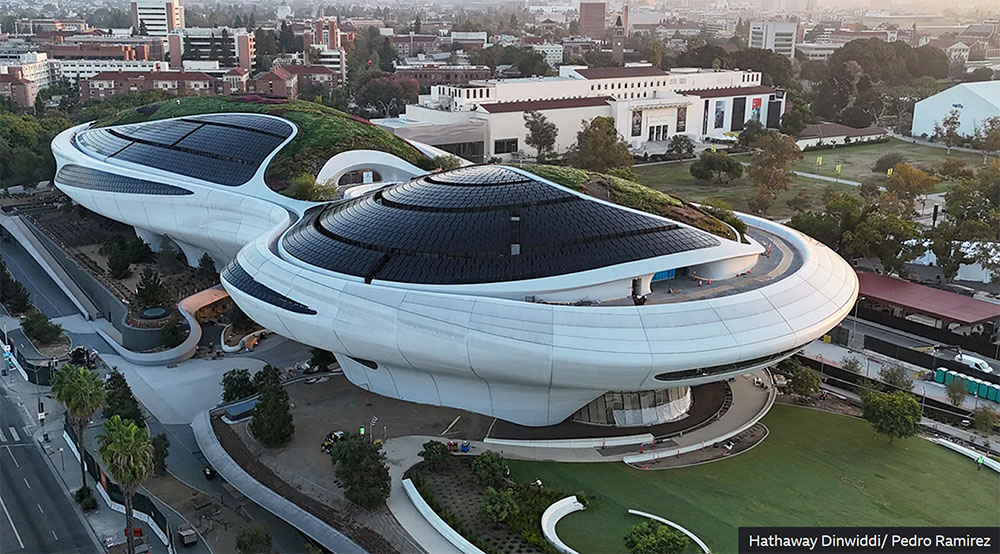
George Lucas's long-anticipated museum devoted to narrative art and image-making opens in Exposition Park, Los Angeles in 2026. Designed by Ma Yansong of MAD Architects, the building's organic, cloud-like exterior sets a deliberately different tone from the orthogonal conventions of many civic museums. The collection spans original illustrations, cinema art, paintings and popular imagery across cultures and centuries, guided by the conviction that narrative image-making constitutes a legitimate and underexamined strand of art history. Its proximity to USC and the Natural History Museum places it within an existing cultural district, and it will draw interest from scholars working at the intersection of fine art, graphic tradition and moving image.
Dataland — Los Angeles, USA
Founded by Refik Anadol and Efsun Erkiliç of Refik Anadol Studio, Dataland is the first institution dedicated to AI art, situated within The Grand LA — the Frank Gehry-designed development in Downtown Los Angeles. The space is conceived not as a traditional gallery but as an environment in which digital works respond to and are shaped by the presence of visitors. For those tracking the institutionalisation of digital and new media art, Dataland is a notable case study in how large-scale immersive practice is finding permanent homes outside the temporary exhibition circuit.
David Geffen Galleries at LACMA — Los Angeles, USA
Opening: April 2026
The long-running transformation of the Los Angeles County Museum of Art reaches a defining public milestone with the opening of the David Geffen Galleries in April 2026. Designed by Peter Zumthor, the new building replaces a cluster of ageing mid-century structures with a single, flowing form intended to feel continuous with the surrounding landscape of Hancock Park. Funding has drawn on a combination of public capital from the City of Los Angeles and major private philanthropy. The galleries will present LACMA's encyclopaedic collection across a unified exhibition level, with the ambition of making connections across cultures, periods and media more legible than the previous fragmented campus allowed. For institutions considering how to present permanent collections in a coherent physical environment, LACMA's solution will be closely observed.
Guggenheim Abu Dhabi — Saadiyat Island, UAE
After more than two decades in development, the Guggenheim Abu Dhabi is scheduled to open in 2026 on Saadiyat Island, alongside the Louvre Abu Dhabi which opened in 2017. Designed by Frank Gehry, the building's scale — it will be the largest Guggenheim globally — reflects the ambition of Abu Dhabi's cultural district project. The institution intends to focus substantially on art from the Middle East, North Africa and South Asia, alongside an international modern and contemporary programme. Its opening represents a significant moment in the redistribution of major museum infrastructure away from Western capitals, and will be watched carefully by curators, collectors and institutions working in and with the region.
Zayed National Museum — Saadiyat Island, UAE
Also located on Saadiyat Island, the Zayed National Museum is dedicated to the life of Sheikh Zayed bin Sultan Al Nahyan, founder of the UAE, and to the broader history and culture of the Emirates. Designed by Foster + Partners, the building takes its formal cues from a falcon's feathers — an image carrying deep significance in the region. The museum is positioned as a civic and national institution, providing the UAE with a flagship space in which to narrate its own history. For gallery professionals, it represents an important parallel to the international contemporary art venues nearby, addressing the question of how cultural infrastructure serves both local identity and international audiences simultaneously.
https://zayednationalmuseum.ae
Centre for Contemporary Arts Tashkent — Tashkent, Uzbekistan
Opening: 21 March 2026
Opening on 21 March 2026, the Centre for Contemporary Arts Tashkent is the first permanent contemporary art institution in Central Asia, housed within a restored early-twentieth-century industrial building. Developed with support from the Uzbekistan Art and Culture Development Foundation, the Centre combines exhibition spaces with workshops, research facilities and free public programming. Its inaugural exhibition, Hikmah — meaning wisdom — will feature both international and regional artists. For the international art world, the CCA Tashkent is an indicator of the accelerating investment in cultural infrastructure across Central Asia, and a point of contact for institutions seeking to develop meaningful engagement with a region that has been peripheral to the dominant Western exhibition circuit.
KANAL – Centre Pompidou — Brussels, Belgium
Opening: 28 November 2026
One of Europe's most anticipated museum openings of recent years, KANAL – Centre Pompidou transforms a vast former Citroën garage in Brussels into a major contemporary art institution. Funded substantially by the Brussels-Capital Region and developed in partnership with Paris's Centre Pompidou, the space will present modern and contemporary art exhibitions alongside research spaces, workshops and public programming across its considerable floorplate. The partnership model — in which a regional government provides infrastructure while an established international institution contributes programming and expertise — is increasingly common and represents an instructive case for institutions navigating similar arrangements. KANAL is positioned to become a significant destination for European contemporary art audiences, complementing rather than competing with institutions such as Tate Modern.
BRUSK — Bruges, Belgium
Opening: 8 May 2026
BRUSK is a new art gallery opening on 8 May 2026 in the heart of Bruges, built on the Garenmarkt site adjacent to the Groeningemuseum. Part of the Musea Brugge network, it is designed as an open civic space rather than a conventional ticketed museum — with a freely accessible ground floor and two large, north-lit exhibition halls above. BRUSK aims to connect the medieval collections of Musea Brugge with contemporary and international programming, operating as both exhibition venue and cultural anchor for the city. Its inaugural programme pairs a Refik Anadol immersive installation with a major historical exhibition on Bruges as a medieval global trading hub. For institutions interested in hybrid public/exhibition models and the integration of heritage and contemporary practice, BRUSK offers a considered recent precedent.
Larrakia Cultural Centre — Darwin, Australia
The Larrakia Cultural Centre in Darwin represents a substantial commitment to First Nations cultural infrastructure in Australia's Northern Territory. The Centre is dedicated to the culture, language and heritage of the Larrakia people, the traditional custodians of the Darwin region. Its opening reflects a broader national conversation about self-determination in cultural representation, and positions Darwin — historically marginalised within Australia's cultural geography — as a site of genuine institutional significance. For professionals working with Indigenous art and communities, the Larrakia Cultural Centre offers a model of community-led cultural infrastructure in a region where such investment has been long overdue.
https://www.larrakiaculturalcentre.com.au
Powerhouse Parramatta — Parramatta, Australia
The Powerhouse Museum's new flagship in Parramatta, Western Sydney, represents one of Australia's largest recent cultural infrastructure investments. The project, supported by the New South Wales Government, relocates the core of the Powerhouse collection from its long-standing home in Ultimo to a purpose-built facility serving Western Sydney's rapidly growing population. The building is designed to accommodate science, design, technology and cultural collections, and positions Parramatta as a genuine cultural destination rather than a secondary node. For those following the decentralisation of major institutional collections, Powerhouse Parramatta is a significant reference point — and also a case study in the political complexities that can attend such relocations.
https://powerhouse.com.au/visit/parramatta
Biennale of Sydney — Sydney, Australia
25th edition: 14 March – 14 June 2026
While not a fixed institution, the Biennale of Sydney returns in 2026 as one of the Asia-Pacific region's most significant recurring survey exhibitions. Free and publicly accessible across multiple venues, the 25th edition is titled Rememory and curated by Hoor Al Qasimi, presenting 83 artists and collectives from 37 countries across sites including the Art Gallery of NSW, White Bay Power Station and Campbelltown Arts Centre. The Biennale reinforces Sydney's position within the international biennial circuit and provides a vital context for galleries and institutions working with contemporary practice in the region. Its distributed model — spreading exhibition activity across the city rather than concentrating it in a single venue — continues to offer an alternative logic to the monolithic museum opening.
https://www.biennaleofsydney.art
Context and Trends
The 2026 openings collectively point to several directions in institutional development that merit attention from professionals working across the sector.
The concentration of major openings in Los Angeles is notable. With the Lucas Museum, Dataland and the David Geffen Galleries at LACMA all opening in the same year, the city is consolidating its position as one of the world's most significant cultural centres, extending well beyond its established strengths in commercial gallery activity and auction markets.
The Saadiyat Island cluster — Guggenheim Abu Dhabi and Zayed National Museum alongside the existing Louvre Abu Dhabi — represents the maturation of one of the most ambitious single-site cultural projects ever undertaken, and tests whether proximity and ambition can together create a genuine destination rather than a collection of prestigious buildings.
The opening of the CCA Tashkent and the ongoing development of cultural infrastructure across Central Asia, the Gulf and the Asia-Pacific reflect a sustained and now unmistakable shift in the geography of the international art world. The dominant model, in which major institutional activity was concentrated in Western Europe and North America, is being substantively altered.
Multi-functionality is increasingly standard in new institutional design. Research centres, public libraries, performance spaces, education facilities and community programmes are no longer supplementary to the exhibition function — they are integral to the institutional proposition, reflecting funding bodies' expectations that cultural infrastructure should serve civic purposes broadly conceived.
Finally, access — both physical and economic — remains a defining criterion. Free admission, inclusive design and community engagement are consistent features of publicly funded openings in 2026, shaping architecture, programme and governance alike.