
Chicago has long carried the distinction of hosting North America's first major art fair. When what is now EXPO CHICAGO began at Navy Pier in 1980, it held the attention of the international art world for two decades. The fair's current incarnation, relaunched in 2012 under Tony Karman, has continued in that tradition — and in 2026, under new directorship, it enters what organisers describe as a considered new chapter.
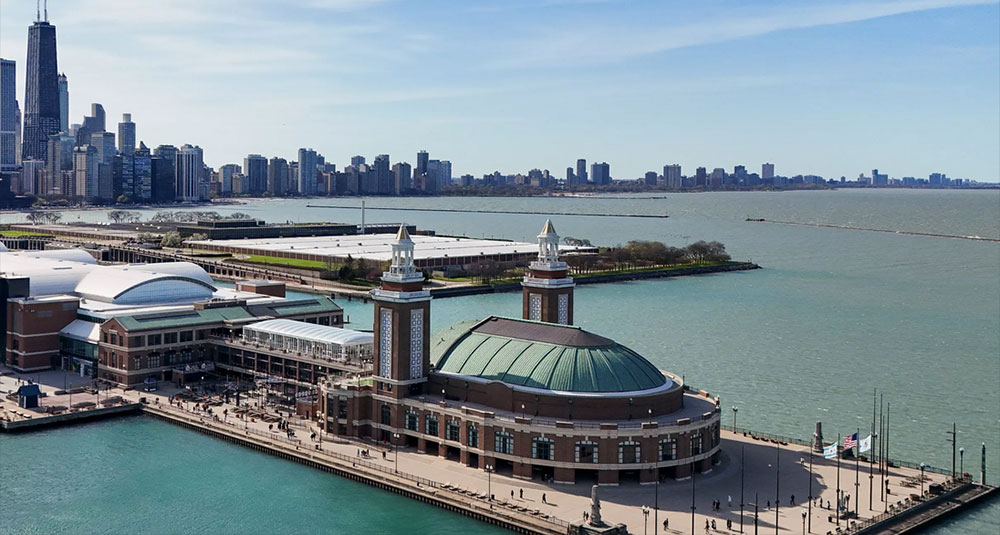
This year's 13th edition runs from 9 to 12 April at Navy Pier's Festival Hall and presents some 130 galleries from around the world. That figure represents a deliberate reduction of roughly 40 participants compared to recent editions, a decision that has allowed the fair's organisers to reconfigure the floor plan into a more open, navigable layout. For directors of institutions and commercial galleries accustomed to the fatigue that sprawling fair formats can produce, that restraint will be noticeable.
A Change in Leadership and Emphasis
The most substantive shift at EXPO CHICAGO 2026 is curatorial. Kate Sierzputowski, formerly the fair's artistic director for five years, has stepped into the role of director, and she has appointed Essence Harden — who co-curated the most recent Made in LA biennial at the Hammer Museum and the Focus section of Frieze Los Angeles — as the fair's curator. Together, they have worked to consolidate the fair's relationship with museums, collections, and independent curators, positioning institutional engagement not as peripheral programming but as a structural priority.
Sierzputowski has been candid about the ambition: to ensure that curatorial rigour and civic collaboration remain at the fair's centre, and that presentations on the floor resonate with institutional priorities rather than simply serving the commercial calendar.
The Fair's Curatorial Sections
The restructured fair organises its exhibitors across several named sections. The main galleries sector brings together a mixture of Chicago-based and international participants, including Gray, McCormick Gallery, Document, Patron, Secrist Beach, and the illuminated manuscript dealership Les Enluminures alongside international exhibitors such as Galería Artizar from Spain, Ebony Curated and Gallery Momo from South Africa, and Wizard Gallery from Italy. Twelve Korean galleries return through an ongoing partnership with the Galleries Association of Korea, building on ties established between Kiaf Seoul and Frieze Seoul.
Focus — formerly known as Exposure — highlights galleries in operation for no more than twelve years and is curated this year by Katie A. Pfohl of the Detroit Institute of Arts. Titled Gathering of Waters, the section draws together atelier-based work dealing with landscape, migration, and craft-centred making, with particular attention to artists and galleries connected to the Mississippi River Basin and the African, Latin American, and Caribbean diasporas. Pfohl has spoken about the section's aim to give younger galleries sufficient time to develop a coherent programme before transitioning to a larger section of the fair.
Profile, curated by Harden, presents solo booths and tightly conceived thematic presentations from established international galleries. The section includes 47 Canal from Manhattan, Geary Contemporary from upstate New York, Mindy Solomon Gallery from Miami, and four Lagos-based spaces: Adegbola Gallery, Affinity Gallery, Soto Gallery, and Yenwa Gallery. The section is designed to reward sustained looking rather than the passage from one broad group show to the next.
The Obama Presidential Center Partnership
One of the most structurally significant additions to this year's fair is a partnership with the forthcoming Obama Presidential Center, which is scheduled to open to the public in June 2026. Two initiatives, both curated by Dr. Louise Bernard, Director of the Obama Presidential Center Museum, appear on the fair floor. Embodiment draws on the Center's architecture and commissioned artists, while Evolution presents archival materials connected to the Center's art commissions. For institutional professionals, this collaboration signals something worth noting: the fair is consciously situating itself within the longer civic and collecting histories of the city, not merely as an annual commercial event.
Dialogue and Public Programming
The fair's Dialogues programme offers on-site panel discussions with participants drawn from across the institutional and independent curatorial world. This year's forum involves more than sixty curators. Speakers include Nick Cave, Hans Ulrich Obrist, Kahil El'Zabar, and Elizabeth Alexander, among others. Override, the fair's public art initiative, places works by emerging and established artists on digital billboards across Chicago, extending the fair's presence beyond Navy Pier into the city's neighbourhoods.
EXPO Art Week, which runs from 7 to 12 April, brings off-site programming to venues across Chicago. South Side Night on 7 April opens the week with events centred on Hyde Park, while Art After Hours on 10 April extends gallery activity across the city with artist talks and evening receptions.
The Broader Context
EXPO CHICAGO's position within the international fair calendar has not been without its complications. The transition from independent management to Frieze ownership has prompted questions within the Chicago art community about the fair's geographic loyalties — a concern reflected in the relatively modest representation from nearby Midwestern cities such as Milwaukee, St. Louis, and the Twin Cities. The 2026 edition includes galleries from Minneapolis and Detroit, which gestures toward a more regionally engaged model, though the gap between aspiration and realisation remains a live conversation.
What the 2026 edition does offer is a measurable degree of intentionality. The reduction in scale, the investment in curatorial roles, the deepened institutional partnerships, and the fair's visible effort to place the work — and the art — at the centre of the experience, rather than the volume of transactions, will be of particular interest to museum professionals and gallery directors thinking about how art fairs can function as genuine spaces of encounter and scholarship.
For further information on exhibitors, ticketing, and programming, visit expochicago.com
Navy Pier Festival Hall, Chicago 9–12 April 2026