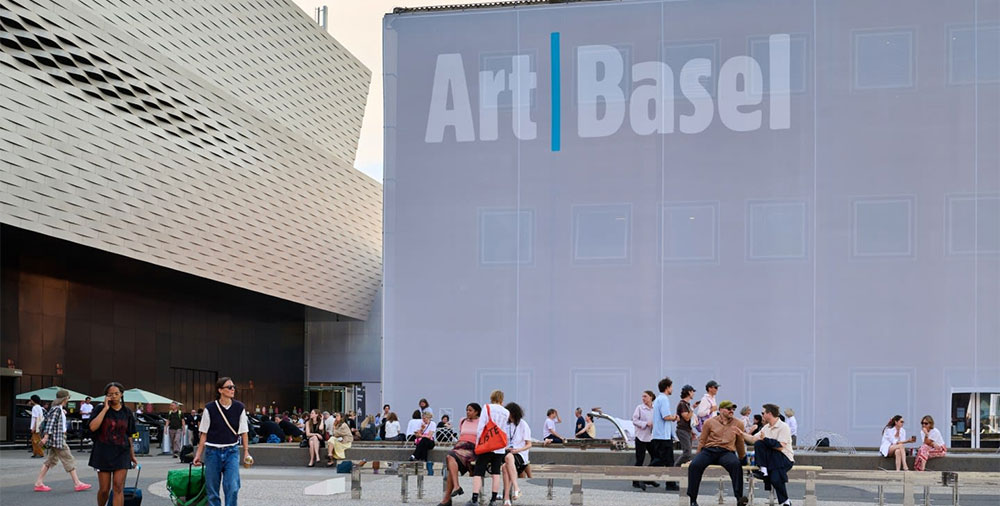
Art Basel's flagship Swiss edition ran from June 18 to 21, 2026, with preview days on June 16 and 17, bringing 290 galleries from 43 countries and territories into Messe Basel for the year's most closely watched gathering of the international art trade. This edition offered several useful signals: a market that opened with confidence across price tiers, a curatorial program under new leadership at Unlimited, an expanded Premiere sector, and a set of public commissions that extended the fair's footprint into the city itself.
The numbers behind the show
This year's edition welcomed 21 newcomers across its sectors, with new or returning gallery representation from Ivory Coast, Lebanon, Saudi Arabia, and Turkey. The main Galleries sector held at 232 international exhibitors, with 14 of those graduating up from Feature, Statements, or Premiere, including Jessica Silverman, Silverlens, LC Queisser, and Pippy Houldsworth. Four galleries entered directly into the main sector for the first time: Berry Campbell, Tim Van Laere Gallery, Phillida Reid, and Ortuzar.
Premiere, now in its second year, expanded from 10 to 17 presentations, a sign that Art Basel intends to keep building out the sector as a dedicated home for museum-scale and recently produced work rather than treating it as a one-off experiment. Feature held at 16 positions surveying twentieth-century art, with five galleries joining that sector for the first time, among them Galerie Cécile Fakhoury and Tokyo's Kotaro Nukaga. Statements offered 18 solo presentations by emerging artists, with nine new participating galleries, and Edition brought seven specialists in prints and editioned work into Hall 2, including Gemini G.E.L. returning after a hiatus.
Curatorial change at Unlimited
Unlimited, the platform for work that exceeds the conventional booth format, was organized this year for the first time by Ruba Katrib, Chief Curator and Director of Curatorial Affairs at MoMA PS1. Visiting curators and institutional leaders who previewed the sector described a program that reads as grounded rather than thematically didactic, with works spanning nearly a century placed in dialogue with one another. Walker Art Center director Mary Ceruti, sharing her own walkthrough of the sector for Art Basel, pointed to Chris Burden's 1993 installation of oversized police uniforms, made in response to the 1992 Los Angeles riots, alongside Oskar Schlemmer's 1930s wall sculpture Homo, Composition in Metal and Alfredo Jaar's 1984 projection piece The Power of Words. She also highlighted Torkwase Dyson's architecturally scaled sculpture, originally commissioned for the Baltimore Museum of Art and Mississippi Museum of Art's touring exhibition on the Great Migration, and Goshka Macuga's new tapestry-and-soft-sculpture installation staging an imagined dialogue between the artist, André Malraux, and Alfred Barr on the future of museums.
Institutional acquisition activity in Unlimited was notable in its own right. Hauser & Wirth, Galerie Buchholz, and David Zwirner jointly placed Isa Genzken's 2018 installation of repurposed airplane parts with a European museum for EUR 1.2 million, while Galerie Georges-Philippe & Nathalie Vallois sold Niki de Saint Phalle's monumental Blue Obelisk with Flowers (1992) to a private museum in France for in excess of EUR 1 million. Hauser & Wirth also placed Nairy Baghramian's Side Leaps_Spatial Compositions with a Swiss collection, and White Cube sold Tracey Emin's weathered beach hut installation Knowing My Enemy (2002) for GBP 1.25 million.
Public commissions beyond the halls
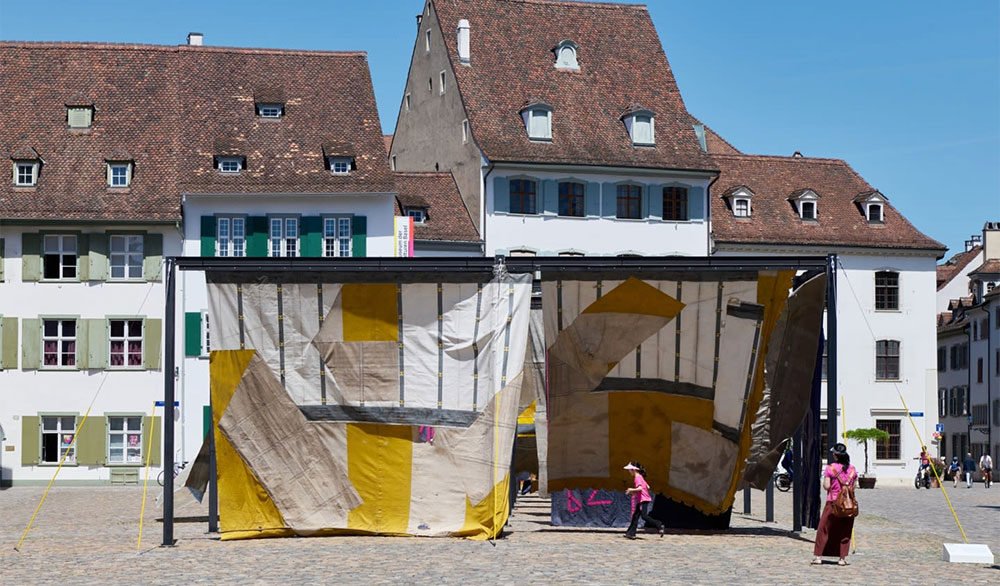
For the first time, public commissions stemming from the Art Basel Awards program premiered in the city itself. Nairy Baghramian and Ibrahim Mahama, the inaugural Gold Awardees in the Established Artist category, each unveiled a new site-responsive work: Baghramian's on the Messeplatz, directly outside the show, and Mahama's on the Münsterplatz, in the historic center of the city. The pairing extends Art Basel's commitment to placing ambitious new production in dialogue with Basel's civic spaces rather than confining it to the exhibition halls.
Parcours, the fair's sector for site-specific work staged across the city, was curated for a third consecutive year by Stefanie Hessler, Director of the Swiss Institute in New York. This year's edition, organized around the idea of conviviality, comprised 21 projects sited along Clarastrasse and in nearby locations including Kirche St. Clara, where Pélagie Gbaguidi's Fragmentation was jointly presented by Fortes D'Aloia & Gabriel, Goodman Gallery, and Tim van Laere. Parcours remains free and open to the public through the close of the show.
Opening sales across price points
Tuesday's preview produced sales activity that gallery professionals will recognize as a useful temperature check for the year. Hauser & Wirth reported 35 works sold by 4pm on the first day, led by Picasso's 1963 painting Le peintre et son modèle dans un paysage, offered at USD 35 million and sold within the opening hours. The gallery also placed two Cy Twombly works on paper and a Louise Bourgeois sculpture, and gallery president Iwan Wirth described it as among the strongest opening days the house has had at the fair.
Other major historical placements included a 1984 Willem de Kooning oil, sold by Gagosian to an Asian private collection within the first hour, and two David Hockney works sold by Gray, including the 2014 painting Studio Interior #2 for USD 8.5 million. Thaddaeus Ropac reported sales of major works by Pierre Soulages and Helen Frankenthaler, the latter coinciding with a retrospective of the artist currently on view at Kunstmuseum Basel.
The fair also debuted Basel Exclusive, a new initiative for unveiling previously undisclosed works during the VIP opening. Early placements under this banner included an Almine Rech sale of a Picasso painting in the USD 6 to 6.5 million range and a Sprüth Magers placement of a John Baldessari work from the 'Emoji' series. Casey Kaplan reported a sold-out presentation by Patricia Fernández Carcedo that included a Basel Exclusive work.
Activity extended well beyond the upper tier. Fortes D'Aloia & Gabriel reported several sales of work by Brazilian artists in the tens of thousands of dollars. In Statements, Gypsum Gallery sold nine works by Egyptian artist Hana El-Sagini priced between EUR 3,000 and 10,000, with the gallery describing the response as the kind that tends to mark a turning point in an artist's trajectory. New York gallery Berry Campbell, making its Basel debut, sold paintings by Mary Abbott, Judith Godwin, and Pat Passlof, with cofounder Christine Berry noting that the concurrent Frankenthaler exhibition at Kunstmuseum Basel had helped focus attention on twentieth-century women artists undergoing critical reassessment. In Zero 10, the fair's sector for art of the digital era, Fellowship sold John Gerrard's real-time simulation work STANDARD (2023) for USD 500,000, and Bitforms and Max Estrella jointly placed a Rafael Lozano-Hemmer work for USD 180,000.
A new recognition for gallerists
Art Basel inaugurated its Gallery Legacy Award this year, an honor intended to recognize a gallerist whose career has shaped artists' practices, collectors' habits, and the wider field. The first recipient is Paula Cooper, who opened her eponymous New York gallery in SoHo in 1968 and helped establish the neighborhood as an art district years before it became one. Cooper has long maintained an artist-favorable revenue split of 60/40 rather than the standard 50/50, and her program has repeatedly intersected with social and political moments, from a 1968 benefit exhibition against the Vietnam War to a 2024 show built around the American flag ahead of the US election. As part of the award, Cooper has directed support to a younger gallery of her choosing: New York's Chapter NY, founded by Nicole Russo, will receive up to USD 50,000 at next year's edition.
What it signals for the year ahead
Taken together, the early sales data and the curatorial choices at this year's show point to a market that remains discriminating but far from cautious, with demand visible at both the historical top end and in younger, lower-priced programs. The expansion of Premiere and the steady churn of galleries graduating from Statements and Feature into the main sector suggest Art Basel is continuing to formalize pathways for galleries to grow within the fair's own structure. For institutions, the most consequential moves of the week may prove to be the museum and foundation acquisitions out of Unlimited, alongside a public commissions program that is now reaching beyond the exhibition halls and into the fabric of the city itself.
Art Basel's next flagship editions follow later in the year in Paris, at the Grand Palais from October 23 to 25, and the fair's calendar continues with its Hong Kong edition, which this year introduced a new Echoes sector dedicated to recent work by emerging artists.